Want to practice this with a native Korean teacher?
100-min free trial — no card required.
Ready to learn Korean but feeling a bit overwhelmed by all the new characters? What if I told you that you could learn the entire Korean alphabet, Hangul (한글), in just a single afternoon? This isn't an exaggeration—it's what makes Hangul one of the most brilliant writing systems in the world. Learning it is the very first step to unlocking K-dramas without subtitles, singing along to K-pop, and connecting with Korean culture on a deeper level. To make it easy for you, we’ve created the ultimate Hangul alphabet chart and guide.
Think of this as your friendly roadmap. We'll break down every consonant and vowel into simple, easy-to-digest parts. By the end of this guide, you'll not only recognize the letters but also understand the genius behind them. So, grab a cup of tea, get comfortable, and let’s start this exciting journey together!
Your Go-To Hangul Quick Reference
Welcome to the heart of your Korean learning journey! The first step to reading and writing Korean is getting to grips with its incredibly logical alphabet. Forget trying to memorize thousands of complex characters; Hangul was scientifically designed to be learned in a day. It's not just a list of random shapes, but a brilliantly organized system just waiting to click.
To make that "click" happen for you, we’ve put together a comprehensive Hangul alphabet chart. This guide is meant to be your quick reference, whether you're seeing these characters for the first time or just need a quick refresher. The whole point is to give you a clear, organized overview that makes the alphabet feel a lot less intimidating.
Let's start with a look at the three core components you'll find in the Hangul script.
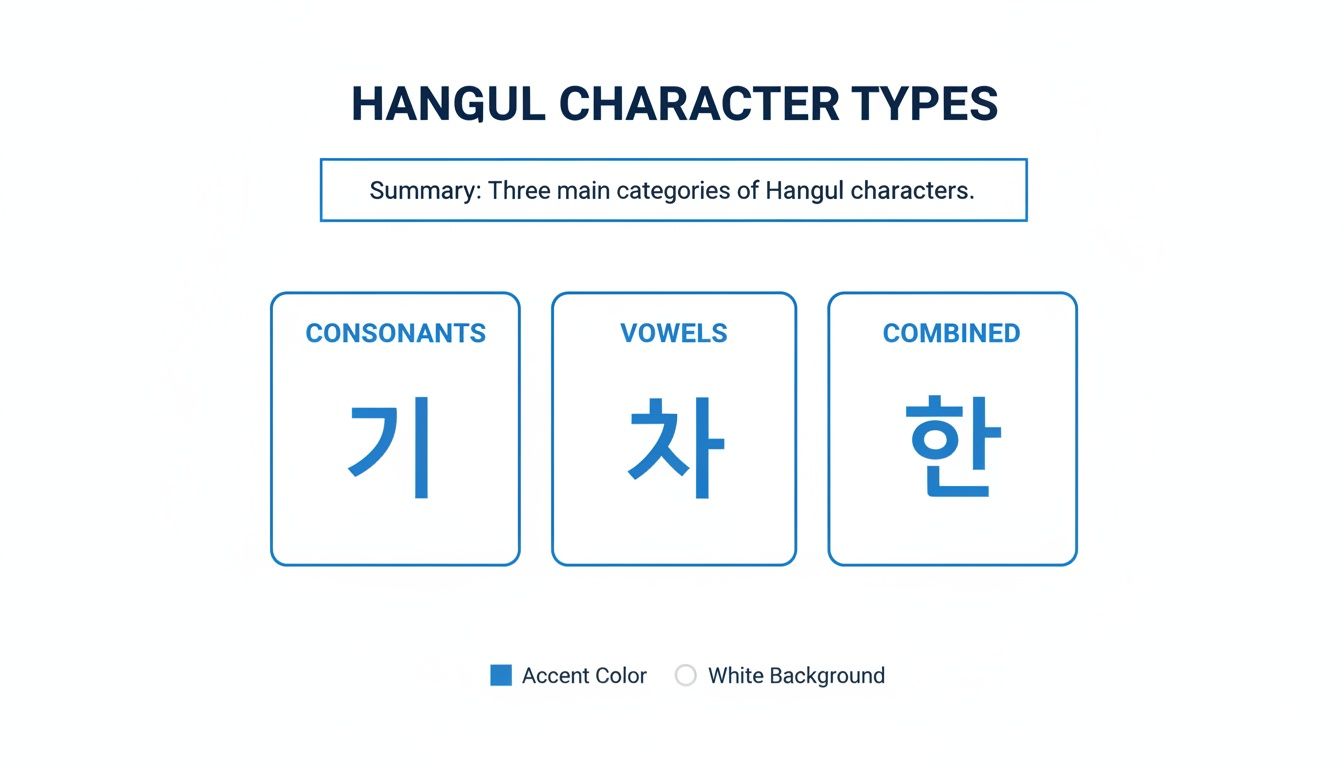
As you can see, individual consonants and vowels don't stand alone. They combine to form complete syllable blocks, which are the fundamental building blocks of written Korean.
To help you get a clear picture of how Hangul is structured, here’s a quick breakdown of its character categories.
Hangul Character Categories At a Glance
This table summarizes the different types of characters in the Korean alphabet to help you understand the structure.
| Category | Number of Letters | Description |
|---|---|---|
| Basic Consonants | 14 | These are the foundational consonant sounds. Many were designed to mimic the shape of the mouth when making the sound. |
| Double Consonants | 5 | These are tensed versions of five basic consonants, producing a stronger, more forceful sound. |
| Basic Vowels | 10 | The core vowel sounds, built from just three simple strokes: a horizontal line (earth), a vertical line (human), and a dot (heaven). |
| Diphthongs | 11 | Also known as complex vowels, these are created by combining two basic vowel sounds to form a new, gliding sound. |
Understanding these distinct groups is the first step to mastering the alphabet efficiently.
Our chart is meticulously organized so you can instantly tell the difference between these character types. You'll see everything sorted into these four clear groups:
- Basic Consonants: The foundational sounds of the language.
- Double Consonants: Tensed sounds that add a bit of punch.
- Basic Vowels: Simple vowel sounds that form the core of every syllable.
- Diphthongs (Complex Vowels): Vowels made by combining two basic vowel sounds.
This structured approach is designed to prevent that feeling of being overwhelmed. It lets you build your knowledge one step at a time. Feel free to download and print the chart to keep on your desk for constant reference. Having this tool handy will genuinely speed up how quickly you recognize and remember Hangul characters as you progress with your lessons on Ktalk.live.
The Genius Behind The Korean Alphabet
To really get the most out of a Hangul alphabet chart, it's worth taking a moment to appreciate its incredible origin story. Unlike most writing systems that evolved organically over hundreds of years, Hangul (한글) was a planned, scientific invention. It was created out of a king's desire to empower his people.
Before the 15th century, Koreans relied on complex Chinese characters, which they called Hanja. Mastering Hanja took years of dedicated study, making literacy a luxury only the wealthy elite could afford. This left the vast majority of the population completely unable to read or write.
A Vision for Universal Literacy
King Sejong the Great, the fourth king of the Joseon Dynasty, saw this as a massive obstacle to his nation's progress. He dreamed of a writing system so straightforward that anyone could learn it in a matter of days, regardless of their social standing or background. His aim was to make knowledge accessible to all and build a more unified, literate society.
"A wise man can acquaint himself with them before the morning is over; a stupid man can learn them in the space of ten days." - A popular saying about Hangul's simplicity.
This vision sparked one of history's most impressive linguistic projects. In 1443-1444, King Sejong and a team of scholars deliberately designed Hangul from the ground up. This was the first time a government had ever created an entirely new script for official use, a project that led to its formal adoption by 1895. You can find more details on this historic achievement at Manoa Hawaii.
The Hunminjeongeum
The new alphabet was officially unveiled in 1446 in a document called the Hunminjeongeum, which means "The Proper Sounds for the Instruction of the People." This text laid out the philosophical and scientific principles behind the letters, showcasing the king's deep commitment to making it easy to learn. For example, the consonant shapes were designed to mimic the shape your mouth makes when you produce their sounds, while the vowels were based on core philosophical ideas.
This incredible creation is celebrated every year in South Korea on October 9th, known as Hangul Day. It’s a national holiday that honors a writing system born not from conquest or chance, but from a profound vision for empowering everyone through education.
Getting to Grips with the 14 Basic Consonants
Alright, now that you’ve got a feel for the story behind Hangul, let's jump into the characters themselves. This section is your bread and butter for the 14 basic consonants—the building blocks of pretty much every Korean word. Think of this as the detailed playbook that complements your main Hangul alphabet chart.
We’ll break down each consonant, one at a time. Don't worry if you make mistakes—even Koreans do sometimes! What matters most is progress. The most important thing to grasp is how a consonant’s sound can shift slightly depending on where it lands in a syllable. It might sound complicated, but I promise it’s much more intuitive once you see it in action.
ㄱ (Giyeok) and ㄴ (Nieun)
Let's kick things off with the very first consonant, ㄱ (Giyeok).
- Pronunciation: When it starts a word or syllable, it has a soft 'g' sound, like in 'go'. But stick it at the end of a syllable, and it hardens into a 'k' sound, like in 'book'.
- Example Words:
- 가구 (gagu) - furniture
- 한국 (hanguk) - Korea
Next up is ㄴ (Nieun), which is refreshingly consistent.
- Pronunciation: This one is always an 'n' sound, like in 'nose'. It doesn't matter where you find it in a syllable; it’s one of the most dependable sounds in the entire alphabet.
- Example Words:
- 나라 (nara) - country
- 언니 (eonni) - older sister (for a female)
ㄷ (Digeut) and ㄹ (Rieul)
The consonant ㄷ (Digeut) behaves a lot like ㄱ, changing its tune based on its position.
- Pronunciation: At the beginning, it's a soft 'd' sound, like in 'dog'. Move it to the end of a syllable, and it crisps up into a 't' sound, like in 'cat'.
- Example Words:
- 다리 (dari) - leg
- 믿다 (mitda) - to believe
Now we get to ㄹ (Rieul), which is famously tricky for English speakers because it pulls double duty as both an 'r' and an 'l'.
- Pronunciation: When it’s sandwiched between two vowels, it becomes a soft, almost-flapped 'r'. At the end of a syllable or before a consonant, it turns into a clear 'l' sound.
- Example Words:
- 라디오 (radio) - radio
- 서울 (seoul) - Seoul
Quick Tip: Seriously, don't sweat the ㄹ sound at first. It’s one of the biggest hurdles for learners. Getting it perfect comes from listening and mimicking, not just reading rules. With practice on platforms like K-talk Live, your ear will naturally start to pick it up.
ㅁ (Mieum) and ㅂ (Bieup)
Just like its cousin ㄴ, the consonant ㅁ (Mieum) is wonderfully straightforward.
- Pronunciation: It’s always an 'm' sound. No exceptions. Think 'mom'.
- Example Words:
- 마음 (maeum) - heart, mind
- 엄마 (eomma) - mom
And then we have ㅂ (Bieup), which follows that same sound-changing rule as ㄱ and ㄷ.
- Pronunciation: It starts life as a 'b' sound, like in 'boy'. But at the end of a syllable, it sharpens into a 'p' sound, like in 'stop'.
- Example Words:
- 바보 (babo) - fool
- 밥 (bap) - rice
ㅅ (Siot) and ㅇ (Ieung)
The sound of ㅅ (Siot) is a little more nuanced.
- Pronunciation: Most of the time, it's a soft 's' sound. The exception? When it comes before certain vowels like ㅣ (i), it morphs into a 'sh' sound. At the end of a syllable, it's pronounced as a 't'.
- Example Words:
- 사람 (saram) - person
- 시간 (sigan) - time ('shi-gan')
- 옷 (ot) - clothes
The consonant ㅇ (Ieung) is truly unique; it's a part-time sound.
- Pronunciation: When you see it at the beginning of a syllable block, it’s completely silent. It's just a placeholder. But when it’s the final consonant, it comes to life with the 'ng' sound from 'sing'.
- Example Words:
- 아이 (ai) - child (The ㅇ is silent)
- 사랑 (sarang) - love (The final ㅇ sounds like 'ng')
The Rest of the Basic Crew
Here are the last few basic consonants to round out your foundation.
- ㅈ (Jieut): Starts as a 'j' sound (like jam). When it’s the final consonant, it becomes a 't' sound.
- 자주 (jaju) - often
- 낮 (nat) - daytime
- ㅊ (Chieut): An aspirated 'ch'—think of the puff of air in church. At the end of a syllable, it also becomes a 't' sound.
- 차 (cha) - tea, car
- 꽃 (kkot) - flower
- ㅋ (Kieuk): An aspirated 'k' sound, like the 'k' in kite. It stays a 'k' sound even at the end.
- 커피 (keopi) - coffee
- 부엌 (bueok) - kitchen
- ㅌ (Tieut): An aspirated 't' sound, with a puff of air like in talk. It remains a 't' sound at the end.
- 토마토 (tomato) - tomato
- 끝 (kkeut) - end
- ㅍ (Pieup): An aspirated 'p' sound, like in pie. It keeps its 'p' sound when it's the final consonant.
- 포도 (podo) - grape
- 앞 (ap) - front
- ㅎ (Hieut): A soft, breathy 'h' sound, like in hat. At the end of a syllable, it changes to a 't' sound.
- 하나 (hana) - one
- 좋다 (jota) - to be good
Understanding The 10 Basic Vowels
Now that you've got a handle on the consonants, it's time to meet their partners: the 10 basic vowels. Just like the consonants, each vowel has a distinct sound and a wonderfully simple design. Getting these down is the key to building syllable blocks, and you'll probably find them more consistent than the consonants in your Hangul alphabet chart.
The great thing about vowels is that they're refreshingly straightforward. Unlike some consonants that can shift their sound depending on where they are in a syllable, a vowel’s sound is consistent. What you see is what you hear. This consistency makes them much easier to memorize.
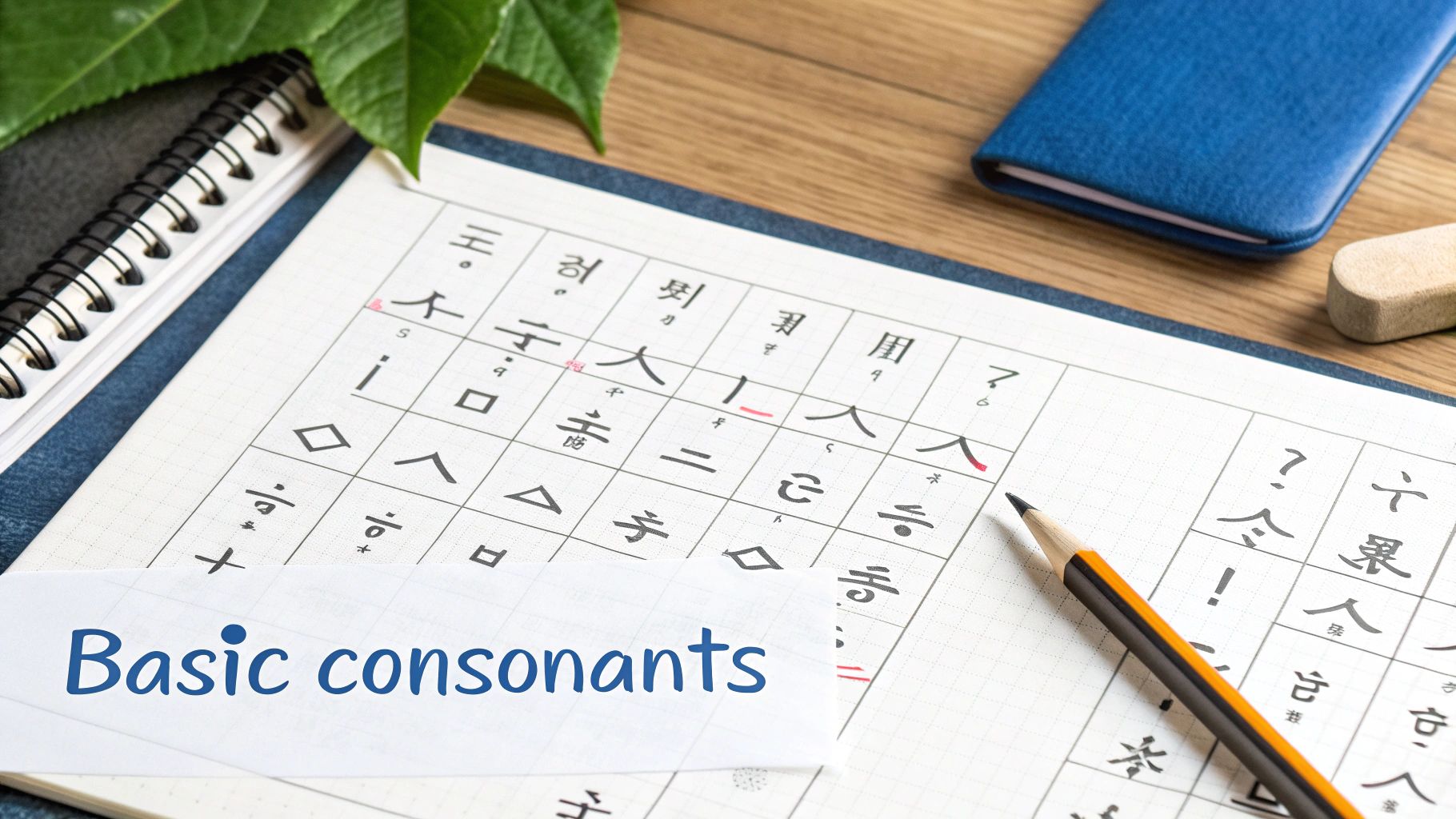
To let you hear their pure sounds, we'll pair each vowel with the silent placeholder consonant ㅇ (Ieung). Remember, this is how you always write a syllable that starts with a vowel sound in Korean.
The Vertical Vowels
These first few vowels are all built around a central vertical line. The key is to notice the small horizontal tick and which way it points.
- ㅏ (a): Makes an 'ah' sound, like the 'a' in "father". Example: 아 (a)
- ㅓ (eo): Think of the 'uh' sound in "uh-oh" or the 'o' in "son". Example: 어 (eo)
- ㅣ (i): A clear 'ee' sound, like the 'ee' in "see". Example: 이 (i)
- ㅑ (ya): Adding a second little tick to ㅏ sticks a 'y' sound on the front. Sounds like "ya" in "ya-hoo". Example: 야 (ya)
- ㅕ (yeo): Adding a second tick to ㅓ creates the 'yeo' sound. Similar to the 'yu' in "yummy". Example: 여 (yeo)
The Horizontal Vowels
These next vowels are based on a main horizontal line. This time, notice whether the small vertical tick points up or down.
- ㅗ (o): A crisp 'oh' sound, the same as the 'o' in "go" or "boat". Example: 오 (o)
- ㅜ (u): Makes a clear 'oo' sound, like the 'oo' in "moon". Example: 우 (u)
- ㅡ (eu): To make this sound, keep your teeth roughly together and pull your lips back as if saying "cheese," but make an 'uh' sound. It's close to the 'u' in "push". Example: 으 (eu)
- ㅛ (yo): Adding a second tick to ㅗ gives you the 'yo' sound, as in "yo-yo". Example: 요 (yo)
- ㅠ (yu): Adding a second tick to ㅜ creates the 'yu' sound, exactly like the word "you". Example: 유 (yu)
Pro Tip: In Korean, vowels are often classified as 'bright' (ㅏ, ㅗ) or 'dark' (ㅓ, ㅜ). This concept becomes important later in grammar, especially when you start conjugating verbs. Getting familiar with these pairs now will give you a real head start!
This simple, organized system is what makes Hangul so brilliant. With just these ten vowels, you have the building blocks for every sound you'll need to make. For live, expert feedback on your pronunciation, joining a small group class on K-talk Live can be a massive help.
Diving Deeper: Double Consonants and Diphthongs
So, you’ve got a handle on the basic consonants and vowels from your Hangul alphabet chart. Fantastic. Now it’s time to tackle the sounds that really separate the beginners from the confident readers: the tense double consonants and the combined vowels, also known as diphthongs.
Don't be intimidated by how they look. Double consonants are just stronger, tighter versions of their single counterparts, and diphthongs are simply two vowels squished together to create a new, gliding sound. Getting these down is what will make your Korean sound much more natural.
The Five Double Consonants
In Hangul, we have five double consonants, and you'll often hear them called “tense” sounds. This is the key. You pronounce them by creating more tension in your throat, producing a sharp, hard sound without a puff of air.
A good way to think about it is to compare the sounds in English. Imagine the soft 'g' in 'go' (like ㄱ), the airy 'k' in 'kite' (like ㅋ), and then the hard, sharp 'k' in 'sky'. That last one is exactly the kind of tense sound you're aiming for with ㄲ.
- ㄲ (ssang-giyeok): A tensed 'k' sound. Example: 꽃 (kkot) - flower.
- ㄸ (ssang-digeut): A tensed 't' sound. Example: 딸기 (ttalgi) - strawberry.
- ㅃ (ssang-bieup): A tensed 'p' sound. Example: 빵 (ppang) - bread.
- ㅆ (ssang-siot): A tensed 's' sound. Example: 비싸다 (bissada) - to be expensive.
- ㅉ (ssang-jieut): A tensed 'j' or 'ch' sound. Example: 짜다 (jjada) - to be salty.
Pronunciation Tip: To really feel the difference, try saying the three related sounds in order: ㄱ (g), ㅋ (k), and ㄲ (kk). Doing this little drill helps your mouth muscles learn the subtle shifts.
The Eleven Diphthongs
Next up are the diphthongs, or complex vowels. These are just combinations of the basic vowels you’ve already memorized. Instead of trying to learn eleven new shapes from scratch, just see them for what they are: two vowels blended together.
- ㅐ (ae): ㅏ (a) + ㅣ (i) = Sounds like the 'a' in "cat". Example: 개 (gae) - dog.
- ㅔ (e): ㅓ (eo) + ㅣ (i) = Sounds like the 'e' in "bed". Example: 네 (ne) - yes.
- ㅘ (wa): ㅗ (o) + ㅏ (a) = Sounds like "wa" in "water". Example: 사과 (sagwa) - apple.
- ㅝ (wo): ㅜ (u) + ㅓ (eo) = Sounds like "wo" in "won". Example: 뭐 (mwo) - what.
- ㅢ (ui): ㅡ (eu) + ㅣ (i) = A smooth glide from the 'eu' sound into the 'i' sound. Example: 의사 (uisa) - doctor.
Getting comfortable with these double consonants and diphthongs is a major milestone. They add so much depth to the language. Be patient, practise them out loud, and keep that Hangul alphabet chart nearby. If you want some live feedback from a native speaker, joining a K-talk Live trial class can really help you nail these tricky sounds.
How to Combine Hangul into Syllable Blocks
Alright, so you've met all the individual letters from the Hangul alphabet chart. Now for the fun part: seeing how they snap together. Unlike English, where we just write letters in a long line, Hangul groups its letters into tidy, square syllable blocks.
Here’s the golden rule: every single Korean syllable block must have at least one consonant and one vowel. Think of it like building with LEGOs—the pieces only fit together in specific ways to create a solid block.
The Basic Syllable Structures
There are a few core patterns for combining Hangul letters. The two most common structures you'll see depend on whether the syllable ends with a vowel or a consonant sound.
Consonant + Vowel: This is the go-to structure for any syllable that ends in a vowel sound.
- For Vertical Vowels (like ㅏ, ㅣ, ㅓ): The consonant always takes the spot to the left of the vowel. For instance, combining ㄱ (g) and ㅏ (a) gives you 가 (ga).
- For Horizontal Vowels (like ㅗ, ㅜ, ㅡ): The consonant sits right on top of the vowel. Take ㄴ (n) and ㅗ (o), and you get 노 (no).
Consonant + Vowel + Consonant: This structure is for syllables that end with a consonant sound. That final consonant, called a batchim (받침), always tucks in at the very bottom of the block.
- For example, look at the word 한 (han) from 'Hangul'. It’s built from ㅎ (h), ㅏ (a), and then the final ㄴ (n) at the bottom.
- The same goes for 글 (geul), which is made of ㄱ (g), ㅡ (eu), and a final ㄹ (l).
The Special Role of the Placeholder ㅇ
One of the trickiest—but most important—things for beginners to grasp is the consonant ㅇ (Ieung).
At the Beginning of a Syllable: When a syllable needs to start with a vowel sound, you must use ㅇ as a silent placeholder in the initial consonant position. It makes no sound at all.
- For example, to write the sound 'a', you combine the silent ㅇ with the vowel ㅏ to make 아.
At the End of a Syllable (as a Batchim): When ㅇ shows up at the bottom of the block, it's no longer silent. In this final position, it makes a very clear "ng" sound, just like in the English word "sing".
- For instance, 앙 (ang) is made by taking 아 (a) and adding a final ㅇ (ng).
Getting this placeholder rule down is absolutely crucial. Without it, you simply can't write any Korean syllable that starts with a vowel sound correctly. It’s a small detail that makes a world of difference.
Understanding Batchim: The Final Consonant Rule
So, you've got the hang of building Korean syllable blocks. That's fantastic! Now you're ready for the next big step: Batchim (받침). The word itself means “support” or “prop,” and that’s a great way to think about it—it’s the final consonant that props up a syllable from the bottom.
Grasping this concept is a real game-changer for reading Korean correctly, whether you're looking at a menu or working through your Hangul alphabet chart.
Here's the core idea: while many different consonants can sit in that final batchim position, they can only be pronounced in one of seven possible ways. This is a huge relief because it simplifies pronunciation quite a bit. It doesn't matter if you see a ㅅ, ㅈ, or ㅎ at the bottom of a block; its sound gets "neutralized" into one of just seven distinct sounds: [g], [n], [d], [l], [m], [b], or [ng].
The Seven Sounds Of Batchim
Take these three words for example: '낮' (daytime), '낯' (face), and '낱' (piece). Despite the different final consonants, they are all pronounced identically as [nat]. That's because the sounds for ㅈ, ㅊ, and ㅌ all soften to a [t]/[d] sound when they're in the batchim position.
To help you keep track, I’ve put together a quick-reference table.
Batchim Pronunciation Rules
This table breaks down which final consonants (batchim) change their pronunciation to one of the seven representative sounds.
| Pronounced Sound | Consonants in Batchim Position | Example Word (Hangul) | Pronunciation |
|---|---|---|---|
| [ㄱ] (k) | ㄱ, ㅋ, ㄲ | 부엌 (kitchen) | [bu-eok] |
| [ㄴ] (n) | ㄴ | 산 (mountain) | [san] |
| [ㄷ] (t) | ㄷ, ㅅ, ㅆ, ㅈ, ㅊ, ㅌ, ㅎ | 옷 (clothes) | [ot] |
| [ㄹ] (l) | ㄹ | 물 (water) | [mul] |
| [ㅁ] (m) | ㅁ | 밤 (night) | [bam] |
| [ㅂ] (p) | ㅂ, ㅍ | 밥 (rice) | [bap] |
| [ㅇ] (ng) | ㅇ | 강 (river) | [gang] |
This neutralization rule is absolutely fundamental to the natural flow of spoken Korean. It might feel like a lot to memorize at first, but you'll find it becomes second nature with a bit of practice.
Key Takeaway: Resist the urge to pronounce the original sound of a consonant when it's at the bottom of a syllable block. Just remember the seven-sound rule. This one principle will clear up so many pronunciation mysteries.
Getting comfortable with batchim is a massive leap toward sounding more authentic. If you really want to hear these rules explained and demonstrated by an expert, nothing beats live practice. Consider joining a free trial class on Ktalk.live—hearing a native speaker break it down can make all the difference.
Got Questions About Learning Hangul? We’ve Got Answers.
As you start working with the Hangul alphabet chart, you're bound to have some questions. It happens to everyone! Let’s tackle some of the most common ones to clear things up and get you started on the right foot.
How Long Does It Really Take To Learn Hangul?
Honestly, probably a lot less time than you’re imagining. Hangul was designed to be logical and easy to learn, which is why most people can get the basic characters and their sounds down in just a few hours. There’s even a classic saying in Korea: "A wise man can learn it in a morning, and a foolish man can learn it in ten days."
While memorizing the letters is quick, getting comfortable enough to read smoothly will take a little more practice. If you put in consistent effort for a week or two, you’ll find yourself starting to recognize syllables and simple words without much trouble.
What's The Best Way To Practice Writing Hangul?
The secret is all about repetition and getting the stroke order right from the beginning. Using a Hangul alphabet chart that shows you the stroke order is a great start.
- Grab some practice sheets: Start by tracing the letters on printable worksheets. This is fantastic for building the muscle memory for the correct stroke patterns (always top to bottom, left to right).
- Write out simple words: Once you have the letters down, practice writing common words you already know, like annyeong (안녕) or sarang (사랑). This helps your brain connect the abstract shapes to actual meaning.
- Go big: Try using a small whiteboard or a writing app. Sometimes, practising the movements on a larger scale can make them feel less awkward at first.
Why Do Some Hangul Letters Have Different Sounds?
This is probably one of the biggest hurdles for beginners, especially with consonants like ㄱ (which can sound like 'g' or 'k') and ㅂ (which can be 'b' or 'p'). The sound a consonant makes often changes depending on where it sits in a syllable block—specifically, whether it's at the beginning or at the end (in the final batchim position).
For instance, ㄱ has a soft 'g' sound when it starts a syllable (like in 가구, gagu), but it becomes a sharper 'k' sound when it's at the end (like in 한국, hanguk). These are consistent pronunciation rules that help the language flow better.
Can I Learn Korean Without Learning Hangul?
You could learn a handful of phrases using romanization, but I strongly advise against it if you're serious about learning Korean. Romanization is just an approximation of the real sounds, and relying on it will almost certainly lead to pronunciation mistakes that are incredibly difficult to fix later on.
Learning Hangul is the single most important first step you can take. It’s your key to reading everything, writing anything, and pronouncing Korean correctly. Think of it as the foundation that unlocks the rest of the language for you.
Your Korean Journey Starts Now
You've just seen how logical and beautifully designed Hangul is. It's not just an alphabet; it's an open invitation to start reading and writing in Korean, no matter your starting point. With the detailed charts and reference sections in this guide, you have a solid foundation and toolkit for building a real connection with the Korean language.
Believe it or not, the entire modern Korean alphabet boils down to 24 basic characters. From these simple building blocks, you can form thousands of different syllable combinations. This incredible efficiency is why Hangul's original manuscript, the Hunminjŏngŭm, was added to the UNESCO Memory of the World Register in 1997. Every word you learn brings you one step closer to confidence. Keep going—your Korean journey starts now!
🌟 Ready to turn your knowledge into conversation? Join K-talk Live—where global learners connect with expert tutors, practice speaking, and grow together in fun, small-group classes!
Ready to stop reading and start speaking?
Practice what you just learned with a native Korean teacher — free for 100 minutes. No card, no commitment.