Want to practice this with a native Korean teacher?
100-min free trial — no card required.
Ever watched a K-drama and wished you could say hello just like the characters do? Learning the most common greetings in the Korean language is your first step into having real conversations, and it's easier than you think! With the right approach, it becomes a fun and rewarding journey. This guide will help you start strong, building your confidence from the very first word.
The one phrase you absolutely must know is 안녕하세요 (Annyeonghaseyo)—it’s a polite and versatile greeting that works in almost any situation. Think of it as your key to unlocking countless friendly interactions in Korean. By mastering this and a few others, you're not just learning words; you're learning to connect with people and their culture in a meaningful way. Let’s get you started!
Your First Step Into Korean Conversations
That first greeting is your key to unlocking the Korean language. Think of it as a friendly handshake with a new culture; it’s a simple but vital connection that opens the door. Getting this right from the start sets the stage for every conversation you'll have later on.
This guide will walk you through the most essential greetings in the Korean language, starting with the absolute basics. We'll explore why understanding politeness levels is so important and give you practical tips to figure out which words to use.
Quick Guide to Korean Greetings by Formality
To get you speaking right away, here’s a handy table you can reference. It covers the most common greetings and explains when to use them. This little cheat sheet will help you feel much more confident from your very first "hello."
| Korean (Hangul) | Romanization | English Meaning | Formality Level | When to Use |
|---|---|---|---|---|
| 안녕하세요 | Annyeonghaseyo | Hello | Standard/Polite | Greeting strangers, elders, colleagues, or in most general situations. |
| 안녕 | Annyeong | Hi / Hey | Casual/Informal | With close friends, family, or people younger than you. |
| 안녕하십니까 | Annyeonghashimnikka | Hello (very formal) | Formal/Honorific | In official presentations, news broadcasts, or addressing someone of high status. |
| 여보세요 | Yeoboseyo | Hello | Polite (on phone) | Answering or making a phone call. |
| 좋은 아침 | Joheun achim | Good morning | Polite | A friendly morning greeting, often used in workplaces or with neighbours. |
This table gives you a snapshot of how much variety there is in Korean greetings. As you can see, the right phrase depends on who you're talking to. Don’t worry if it seems like a lot—we’ll break it down for you.
The beauty of learning Korean greetings is that you're not just learning words; you're learning how to show respect and build connections in a culturally meaningful way.
Decoding 안녕하세요 (Annyeonghaseyo): Your Go-To Greeting
If you only learn one Korean greeting, make it this one: 안녕하세요 (Annyeonghaseyo). This single phrase is your universal key to polite conversation in Korea. It’s the Swiss Army knife for beginners, perfect for just about any social situation.
What makes it so special is its meaning. While we translate it as ‘hello,’ it literally asks, "Are you at peace?" or "Please be well." This isn’t just a greeting; it’s a built-in expression of care for the other person's well-being. This beautiful nuance is at the very heart of how people connect in Korea.
Breaking Down The Pronunciation
Annyeonghaseyo can look like a mouthful at first, I get it. The trick is to break it down into its five syllables. Let's walk through it slowly.
- 안 (An): Think of the "ahn" sound in the name "John."
- 녕 (Nyeong): This is the trickiest part. It’s like "nyong," with the "ny" sound you find in "canyon."
- 하 (Ha): Easy one! Just like a "ha" when you laugh.
- 세 (Se): Pronounced just like the English word "say."
- 요 (Yo): Exactly like the toy, "yo-yo."
All together, it’s: An-nyeong-ha-se-yo. Try saying it slowly a few times. Don’t worry if you make mistakes—even Koreans do sometimes! What matters most is progress.
When To Use Annyeonghaseyo
The real beauty of Annyeonghaseyo is its incredible versatility. It's your default polite greeting, making it a safe and respectful choice for almost any situation.
You'll find yourself using it all the time. For instance:
- Walking into a shop or restaurant.
- Greeting a new colleague or classmate.
- Meeting someone older than you for the first time.
- Addressing a teacher or anyone in a position of authority.
By mastering this one phrase, you give yourself the power to start conversations respectfully and with confidence. It’s so much more than a word; it’s a gesture that shows you value Korean culture.
Ready to give it a try with a native speaker? You can practice it live in one of our free trial classes at Ktalk.live. Our tutors give friendly feedback to help you nail your pronunciation in a relaxed setting.
Navigating Korean Formality Levels
In English, we might switch between 'Hey,' 'Hello,' and 'Good morning' to signal politeness. Korean takes this concept to a new level, baking formality right into the grammar. Understanding these speech levels is crucial for greeting people properly.
This isn't just about being polite. It’s a fundamental way of showing respect based on age, social status, and your relationship with the person. Nailing this shows a real appreciation for the culture and helps you avoid common social missteps.
Casual Greetings for Close Friends
The most informal way to say hello is 안녕 (Annyeong). This is the one you'll hear constantly in K-Dramas between close friends, siblings, or when an adult talks to a child.
Basically, Annyeong is your 'Hey' or 'Hi.' It's warm and friendly. But here's the catch: using it with a stranger, someone older, or your boss would be rude. Keep this one for people you know well.
The Most Formal Hello
On the opposite end of the politeness scale, you have 안녕하십니까 (Annyeonghashimnikka). This is the most formal, honorific greeting, reserved for highly official situations. You’ll hear it on the news, in formal business presentations, or when addressing someone of very high rank.
For everyday chats, this greeting is almost always overkill. Still, knowing it exists helps you see the full spectrum of politeness in the Korean language. Data shows that Annyeonghaseyo is used in over 90% of public interactions, while this formal version is heard in less than 5%. You can dig into more of these patterns over on Babbel's Korean language guide.
This little decision tree can give you a simple starting point.
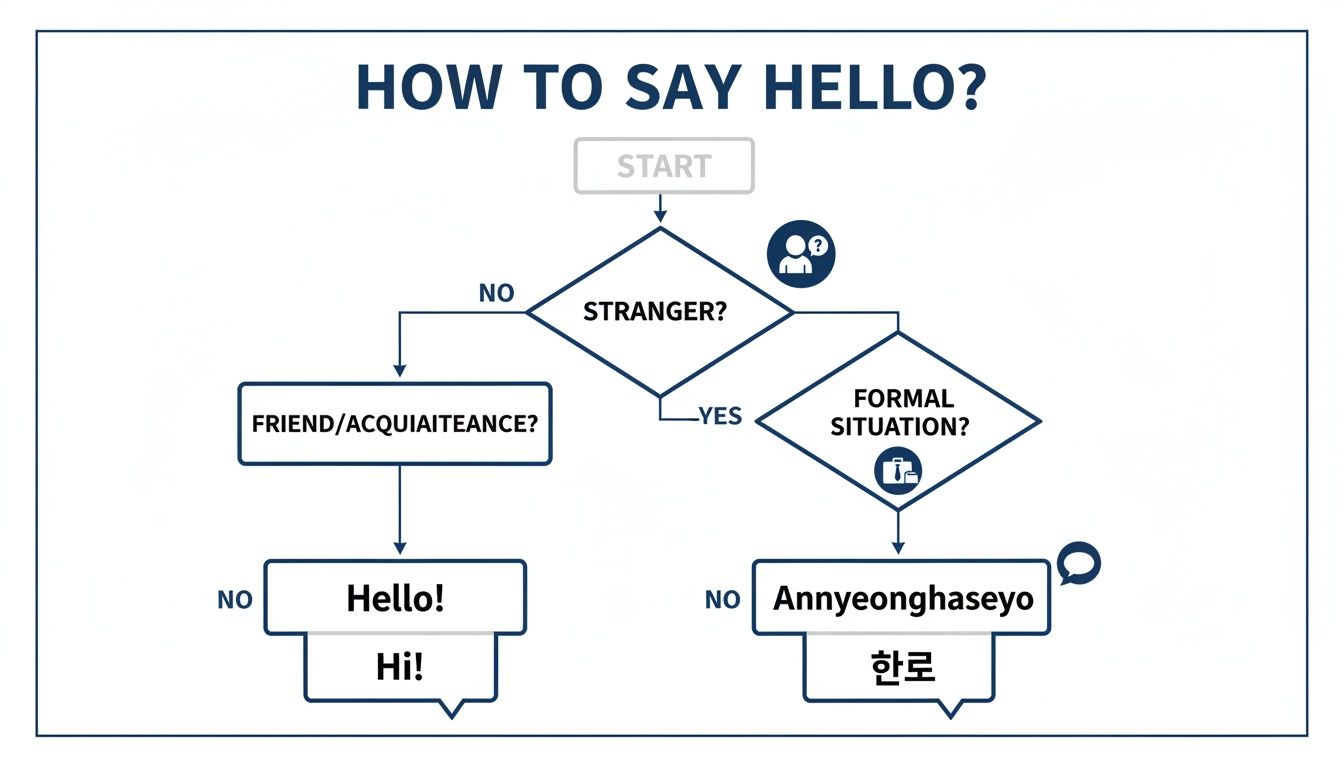
As the flowchart shows, always consider your relationship with the person to find the most appropriate choice.
Finding the Right Balance
So, how do you choose? Here’s a quick breakdown:
- Annyeong (안녕): For your inner circle—friends your age or younger.
- Annyeonghaseyo (안녕하세요): Your go-to, all-purpose greeting. When in doubt, always use this one.
- Annyeonghashimnikka (안녕하십니까): For very formal occasions like a speech or addressing a CEO.
The key takeaway is this: pay attention to how others interact and, when unsure, default to Annyeonghaseyo. It’s always better to be a little too polite than not polite enough.
Getting these levels right takes practice. A great way to get comfortable is to try them out with a native tutor on Ktalk.live, where you can get instant feedback.
Taking Your Greetings to the Next Level
Alright, you've nailed "hello." Now it's time to add more flavour to your conversations. Just like in English, knowing a few extra phrases will make you sound much more natural and connected.
Moving past a simple greeting is your ticket to starting real conversations. This is how you ask someone how they're doing or tell them it's great to meet them.
Making a Great First Impression
When you're introduced to someone new, you'll want to say more than just "hello." The most common and reliable way to say "Nice to meet you" is:
- 만나서 반갑습니다 (Mannaseo bangapseumnida)
만나서 (Mannaseo) means "because we met," and 반갑습니다 (bangapseumnida) means "I'm glad." This is the standard polite form, perfect for meeting new colleagues, your friend's parents, or anyone in a formal setting.
Pro Tip: When you say Mannaseo bangapseumnida, pair it with a slight bow. It's a simple gesture that instantly communicates respect and will always be appreciated.
Checking In: "How Are You?"
After "hello," the next logical step is to ask how the other person is doing. The standard polite way to ask "How are you?" is:
- 잘 지내세요? (Jal jinaeseyo?)
The literal translation is something like, "Are you living well?" It's a friendly follow-up to 안녕하세요 (Annyeonghaseyo).
Here’s a quick exchange:
Person A: 안녕하세요. (Annyeonghaseyo.) - Hello.
Person B: 네, 안녕하세요. 잘 지내세요? (Ne, annyeonghaseyo. Jal jinaeseyo?) - Yes, hello. How are you?
Person A: 네, 잘 지내요. (Ne, jal jinaeyo.) - Yes, I'm doing well.
Greetings for Different Times of Day
Korean has specific phrases for certain times of the day. While 안녕하세요 (Annyeonghaseyo) is the universal all-rounder, using a time-specific greeting shows a higher level of fluency.
- 좋은 아침 (Joheun achim): This literally means "Good morning." It feels more casual, making it perfect for colleagues, neighbours, or friends.
- 안녕히 주무세요 (Annyeonghi jumuseyo): This is the formal way to say "Good night," meaning "Please sleep peacefully." With close friends, you'd just say 잘 자 (Jal ja), which is "Sleep well."
Getting these situational phrases down is a fantastic way to build confidence. You can practice them with a native speaker in a K-talk Live trial class.
Understanding The Culture Of Bowing
In Korea, how you greet someone goes far beyond words. Actions speak volumes, and bowing is the cornerstone of showing respect. It’s a silent language that conveys everything from casual acknowledgment to deep reverence.
Getting a feel for this custom isn't just about following rules. It’s about genuinely connecting with the culture. When you master the bow, you’re showing that you've invested time in understanding what really matters in Korean society.

Decoding Different Types Of Bows
Think of bowing like a volume dial for respect—not all bows are the same. The angle and depth of your bow send a specific message.
- The Casual Nod (about 15°): A slight tilt of the head. It’s your go-to for friends and people you know well. Pair it with 안녕 (Annyeong).
- The Standard Polite Bow (30°–45°): The everyday, all-purpose bow. Use this when greeting elders, your boss, or someone new. It’s the perfect partner to 안녕하세요 (Annyeonghaseyo).
- The Deep Formal Bow (90°): Reserved for moments of profound respect, deep apology, or sincere gratitude.
Combining Bows And Handshakes
In business settings, you'll often see a mix of Korean and Western traditions. It’s common to bow and shake hands at the same time. Typically, the more senior person will offer their hand first. As you shake, perform a slight bow.
Here's a key detail: the two-handed handshake. As you shake with your right hand, gently place your left hand under your right forearm. This small gesture is a powerful signal of humility and respect.
This blend of gestures is a perfect example of how traditions evolve. Knowing how to navigate this mix will help you handle any professional introduction with confidence. You can learn more about how Korean etiquette blends tradition with modern practices to really get a feel for it.
Your Korean Greeting Journey Starts Now
We've covered the essentials of saying hello in Korean, from formality levels to bowing etiquette. Remember, language learning is a marathon, not a sprint. It’s all about taking small, consistent steps. Don't worry about getting it perfect right away; every time you try, you're building confidence.
Each greeting is a new opportunity to connect and a small bridge built between cultures. What matters most is that you start. The next step is simple: start using 안녕하세요 (Annyeonghaseyo). The more you use it, the more natural it will become. Every word you learn brings you one step closer to confidence. Keep going—your Korean journey starts now!
🌟 Ready to start your Korean journey? Join Ktalk.live — where global learners connect, speak, and grow together!
Your Top Questions About Korean Greetings, Answered
Once you start trying out Korean greetings, a few common questions will pop up. Nailing these little details will boost your confidence and make your conversations feel much more natural. Let's walk through some of the most frequent sticking points for learners.
What's the Biggest Mistake Learners Make?
By far, the most common slip-up is getting the formality level wrong. A classic example is using the casual 안녕 (Annyeong) with an older person, which can come across as rude. Learners often pick it up from K-dramas where friends use it constantly.
Here's a golden rule: when in doubt, just use the polite form, 안녕하세요 (Annyeonghaseyo). It's always better to be a little too formal than not formal enough.
Another thing people forget is the physical gesture. Forgetting to bow or nod when greeting someone older is a big one. The words and the gesture go hand-in-hand to show respect.
How Do You Say Goodbye in Korean?
Saying goodbye in Korean isn't one-size-fits-all. The phrase changes depending on whether you're leaving or staying.
Here’s how it works:
- If you are leaving, you say 안녕히 계세요 (Annyeonghi gyeseyo) to the person who is staying. It literally means, "Stay in peace."
- If you are staying and the other person is leaving, you say 안녕히 가세요 (Annyeonghi gaseyo). This one means, "Go in peace."
Of course, with close friends, a simple 안녕 (Annyeong) works for both hello and goodbye. Another casual option is 잘 가 (Jal ga), which just means "Go well."
Is It Okay to Wave Instead of Bowing?
Waving is completely fine in casual settings with friends or people your age or younger.
However, it's not a replacement for bowing when in a formal situation or greeting an elder. When you say 안녕하세요 (Annyeonghaseyo) to someone you need to show respect to, the bow or nod should always be your first move. You might add a little wave after that initial greeting, but that sign of respect always comes first.
🌟 Ready to start your Korean journey? Join K-talk Live — where global learners connect, speak, and grow together! You can book your first class for free at https://ktalk.live.
Ready to stop reading and start speaking?
Practice what you just learned with a native Korean teacher — free for 100 minutes. No card, no commitment.