Want to practice this with a native Korean teacher?
100-min free trial — no card required.
Learning Korean might seem challenging at first, but with the right approach, it becomes a fun and rewarding journey! If you're just starting, there's one phrase you absolutely need to know: 안녕하세요 (Annyeonghaseyo). This is your all-purpose, go-to greeting, and it will serve you well in almost any situation you can think of. Think of it as your friendly, respectful key to unlocking conversations all across Korea and the first, most important step in mastering a proper greeting in Korean.
Your First and Most Important Korean Greeting

Every language learning journey starts with a single step. For anyone learning Korean, that first, crucial step is getting comfortable with 안녕하세요 (Annyeonghaseyo). It’s more than just a word; it’s a gesture of respect and your official entry pass into Korean culture.
You'll use it everywhere—when meeting a new coworker, ordering coffee, or greeting someone older than you. It strikes the perfect balance between politeness and warmth, which is why it works so well for strangers, acquaintances, and pretty much everyone in between.
Interestingly, the phrase literally translates to something like, "Are you at peace?" or "Are you well?" It's a beautiful sentiment that shows you genuinely care about the other person's state of being.
Breaking Down 안녕하세요 (Annyeonghaseyo)
Let's nail the pronunciation so you can say it confidently. Don’t worry if you make mistakes—even Koreans do sometimes! What matters most is progress.
- 안 (an): Sounds like the "ahn" in "John."
- 녕 (nyeong): Rhymes with "young," but with a slight 'n' sound at the start.
- 하 (ha): Just like a little laugh, "ha."
- 세 (se): Sounds like the word "say."
- 요 (yo): Exactly like you'd say "yo."
String it all together: Ahn-nyeong-ha-say-yo. Say it out loud a few times. You'll find it rolls off the tongue more easily with a little practice. Mastering this one phrase opens up a world of interactions and immediately shows that you're making an effort to connect with Korean social customs.
Quick Guide to Korean Greetings by Formality
This table breaks down the three most common ways to say "hello," showing you which one to use and when.
| Korean (Hangul) | Romanization | Formality Level | When to Use It |
|---|---|---|---|
| 안녕하십니까 | annyeonghasimnikka | Formal | Business meetings, public announcements, speaking to superiors. |
| 안녕하세요 | annyeonghaseyo | Polite/Standard | Daily situations, strangers, colleagues, shopkeepers. (Your safest bet!) |
| 안녕 | annyeong | Casual/Informal | Close friends, younger people, family members. |
As you can see, 안녕하세요 (Annyeonghaseyo) sits comfortably in the middle, making it the most versatile greeting in your toolkit.
Understanding Formality: The Heart of Korean Conversation
Ever noticed how Koreans seem to have a dozen ways to say a simple 'hello'? It’s not just for kicks; it's all about formality, a social code that's woven right into the fabric of the language. It’s a lot like how you wouldn't greet your best friend, your boss, and your grandma in the exact same way in English. Korean just makes this distinction an explicit part of its grammar.
Don't let that scare you, though. This system isn't designed to trip you up. Think of it as a beautiful, built-in way to show respect and instantly define your relationship with someone. Every time you pick a greeting, you're sending a subtle social cue.
The Three Core Levels of Speech
At its core, Korean politeness boils down to three main speech levels. Getting a feel for these is your first big step toward sounding natural and making a great first impression.
- Casual (반말 - banmal): This is the language of close friends, siblings, and anyone younger than you. It's the linguistic equivalent of a warm, comfortable hug – totally informal and relaxed.
- Polite (존댓말 - jondaetmal): This is your trusty default. It’s the standard polite speech you’ll use in most day-to-day situations, like with coworkers, shopkeepers, or new acquaintances. Our main greeting, 안녕하세요 (annyeonghaseyo), fits perfectly right here.
- Formal (격식체 - gyeoksikche): This is the highest level of respect. You'll hear it on the news, in military settings, during formal business presentations, or when addressing someone of very high standing.
Imagine you have a "respect dial." With every conversation, you're adjusting that dial up or down based on who you're talking to. That’s pretty much how these speech levels work.
How to Know Which Level to Use
So, the big question is: how do you know which dial setting to use? It almost always comes down to two things: age and social rank. In Korean culture, these are fundamental elements that shape how people interact.
Here’s the golden rule for any learner: when in doubt, always go with polite language (존댓말). It is always, always better to come across as a little too polite than accidentally being too casual. Being overly informal can be seen as rude, especially when speaking to an elder or someone in a senior position.
For example, you'd use 존댓말 with a university professor, someone you've just met at a party, or your friend's parents. Over time, as a friendship deepens, the older person might give you the green light to switch to 반말. Getting this dynamic right shows you understand and respect the culture, which is key to building real connections.
Building Your Korean Greeting Vocabulary
Okay, now that you’ve got a handle on the whole formality thing, let's start building out your conversational toolkit. Getting past a basic "hello" is how you really start to connect with people. Let's dive into some of the most common and useful phrases you'll need for different situations.
Think of it this way: each new phrase is another tool for your belt. Picking the right greeting at the right moment makes your interactions feel smooth, natural, and respectful.
This little diagram breaks down the hierarchy perfectly, showing you how to move from super formal situations to just chilling with friends.
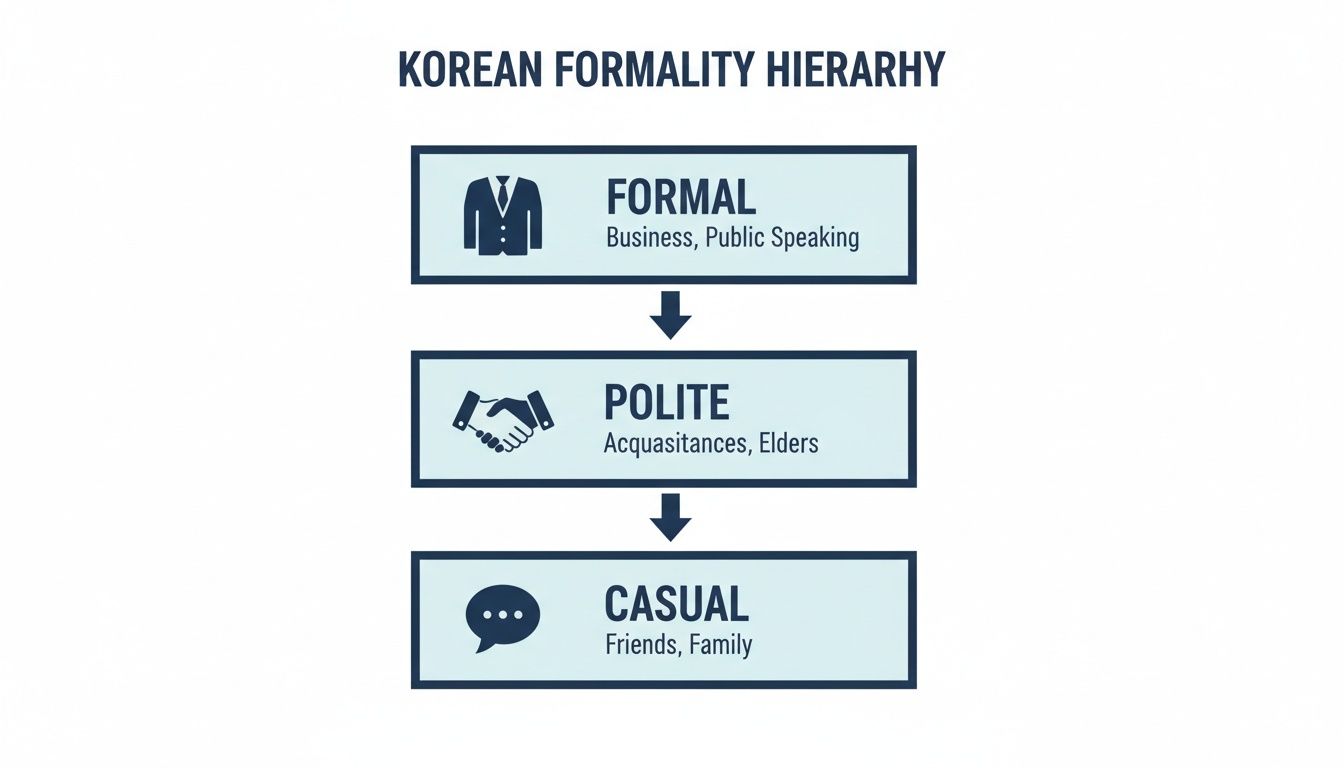
As you can see, choosing your words is all about setting the right tone of respect—from the most formal and elevated language right down to relaxed, casual speech.
To make things even clearer, here's a quick-reference table. It covers the essential greetings you'll need for just about any encounter.
Essential Korean Greetings for Every Situation
| Situation | Korean Phrase (Hangul) | Romanization | Formality | Meaning and Notes |
|---|---|---|---|---|
| Everyday Hello | 안녕하세요 | Annyeonghaseyo | Polite | Your go-to greeting for almost everyone. Perfect for daily interactions. |
| Casual Hello (Friends) | 안녕 | Annyeong | Casual | Used with close friends, younger people, or family. Very informal. |
| Very Formal Hello | 안녕하십니까 | Annyeonghasimnikka | Formal | For official settings, news broadcasts, or showing deep respect. |
| Good Morning | 좋은 아침입니다 | Joheun achimimnida | Polite | Literally "Good morning." Often used in the workplace. |
| How Have You Been? | 잘 지냈어요? | Jal jinaesseoyo? | Polite | A common and friendly follow-up to Annyeonghaseyo. |
| Nice to Meet You | 반갑습니다 | Bangapseumnida | Polite | The standard, polite way to respond when meeting someone new. |
| Goodbye (You are leaving) | 안녕히 계세요 | Annyeonghi gyeseyo | Polite | "Stay well." You say this as you are the one walking away. |
| Goodbye (They are leaving) | 안녕히 가세요 | Annyeonghi gaseyo | Polite | "Go well." You say this to the person who is leaving. |
| Good Night | 안녕히 주무세요 | Annyeonghi jumuseyo | Polite | Said to someone who is going to bed. A respectful way to say good night. |
This table should give you a solid foundation for handling most common situations you'll encounter.
A Closer Look at 안녕하세요 vs. 안녕하십니까
So, you've seen both 안녕하세요 (Annyeonghaseyo) and 안녕하십니까 (Annyeonghasimnikka). What's the real difference?
Think of 안녕하세요 (Annyeonghaseyo) as your all-purpose, friendly handshake. It’s polite, warm, and fits just about any situation you’ll find yourself in. It strikes the perfect balance.
안녕하십니까 (Annyeonghasimnikka), on the other hand, is more like a formal, crisp military salute. It carries a heavy dose of formality and is reserved for very specific contexts—addressing a large audience, hearing it on a news broadcast, or showing immense respect to a very high-ranking person.
As a learner, you'll rarely need to use Annyeonghasimnikka. For your day-to-day conversations, sticking with 안녕하세요 (Annyeonghaseyo) is your best bet.
Putting Your Greetings into Practice with Real Dialogues

Alright, knowing the phrases is one thing, but actually using them in a conversation? That's where the magic happens. Let's look at a few real-world dialogues to see how a greeting in Korean actually kicks things off. Reading through these helps you get a feel for the natural back-and-forth.
Scenario 1: Greeting a Colleague on Monday Morning
This is a classic workplace chat you'll have over and over. A simple, polite exchange makes morning interactions smooth and friendly.
Dialogue:
- Sumin (수민): 김 대리님, 안녕하세요. 주말 잘 보내셨어요?
- (Kim daerim-nim, annyeonghaseyo. Jumal jal bonaesyeosseoyo?)
- Assistant Manager Kim, hello. Did you have a good weekend?
- Minjun (민준): 네, 수민 씨. 잘 보냈어요. 수민 씨도요?
- (Ne, Sumin-ssi. Jal bonaesseoyo. Sumin-ssi-doyo?)
- Yes, Sumin. I had a good weekend. You too?
- Sumin (수민): 네, 저도요. 감사합니다.
- (Ne, jeo-doyo. Gamsahamnida.)
- Yes, me too. Thank you.
Key Takeaway: See what happened there? The conversation started with the standard polite greeting but immediately moved to a friendly follow-up. Asking about the weekend is a warm, common way to connect with colleagues.
Scenario 2: Meeting a Friend’s Older Brother
Meeting a friend’s family, especially someone older, calls for a step up in politeness. You want to show respect right from the first "hello."
Dialogue:
- Friend (친구): 오빠, 이쪽은 내 친구, 제인이야.
- (Oppa, ijjogeun nae chingu, Jein-iya.)
- Older brother, this is my friend, Jane.
- You (제인): 안녕하세요! 처음 뵙겠습니다. 제인입니다.
- (Annyeonghaseyo! Cheoeum boepgesseumnida. Jein-imnida.)
- Hello! It’s the first time we’re meeting. I am Jane.
- Brother (오빠): 아, 네. 안녕하세요. 반갑습니다.
- (A, ne. Annyeonghaseyo. Bangapseumnida.)
- Ah, yes. Hello. It’s nice to meet you.
Expert Tip: Using 처음 뵙겠습니다 (Cheoeum boepgesseumnida) is a game-changer. It's a highly polite and respectful phrase for a first introduction with someone older or of higher status. It instantly makes a great first impression.
Scenario 3: Interacting with a Shopkeeper
Simple courtesy goes a long way. When you walk into a shop or cafe in Korea, a quick greeting is pretty much expected.
Dialogue:
- You: 안녕하세요.
- (Annyeonghaseyo.)
- Hello.
- Shopkeeper (주인): 네, 안녕하세요. 어서 오세요.
- (Ne, annyeonghaseyo. Eoseo oseyo.)
- Yes, hello. Welcome.
That small exchange makes a huge difference. It shows you respect the local customs and helps create a much friendlier atmosphere for everyone.
More Than Words: The Art of Bowing in Korean Culture
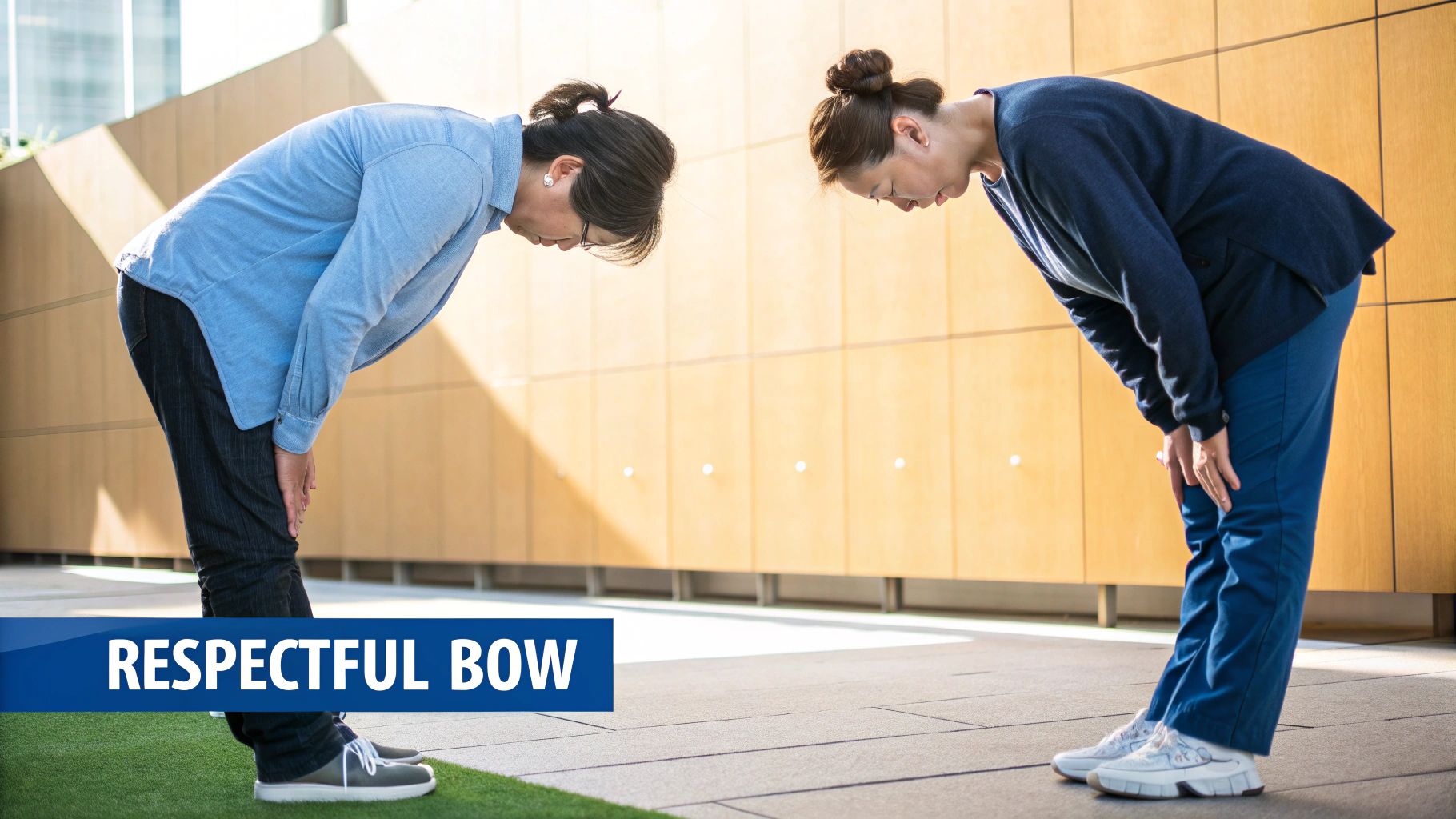
In Korea, a greeting goes way beyond just the words you choose. The simple act of bowing is a huge part of the culture, turning a "hello" into a powerful gesture of respect.
This isn’t some old-fashioned custom; bowing is a living part of daily life in modern Korea. Think of it as the non-verbal version of choosing the right formality in your speech. Nailing this art is crucial for a complete greeting in Korean.
The Different Degrees of Bowing
Not all bows are the same. The angle of your bow signals a lot about your relationship with the person you’re greeting.
The Casual Nod (목례 - mongnye): This is just a slight, quick dip of the head, about 15 degrees. It’s perfect for friends, people your age, or when you pass a coworker. It’s the physical equivalent of saying a casual 안녕 (Annyeong).
The Standard Bow (보통례 - botongnye): This is a more formal, deeper bow from the waist at roughly 30 to 45 degrees. This is your go-to for showing respect to elders, bosses, or anyone you're meeting for the first time. It pairs perfectly with 안녕하세요 (Annyeonghaseyo).
The Deep Bow (큰절 - keunjeol): Reserved for moments of profound respect, this is the most formal bow, bent at a full 90 degrees. You’ll see this during special ceremonies like Seollal (Lunar New Year) or when offering a very sincere apology.
When Handshakes and Bows Meet
So, what about handshakes? They've become more common, especially in business, but they don't replace the bow. More often than not, they happen at the same time.
The modern Korean handshake is a beautiful blend of traditions. Typically, a person will offer a slight bow while shaking hands. For added respect, the left hand is often placed lightly under the right forearm. This two-handed gesture is a sign of politeness and humility, and as many guides on Korean etiquette and customs will tell you, it's a key part of professional interactions.
Showing Respect to Elders and Superiors
If you take away just one thing about Korean greetings, let it be this: understanding hierarchy is everything. The idea of seniority is woven into social interactions, from casual gatherings to business meetings. It's a way of showing genuine respect for someone's life experience and position.
The golden rule is beautifully simple: always greet elders and superiors first. This small gesture speaks volumes. Walking into a room, your first move should be to find the oldest person, make eye contact, and greet them. This is a cornerstone of Korean etiquette.
Key Rules for Showing Respect
Navigating these social cues might seem daunting, but it really boils down to a few key habits. Once you get the hang of them, your interactions will feel much more natural.
Use Formal Language: When in doubt, always go formal. Use the polite speech style, 존댓말 (jondaetmal), when you're talking to someone older, a boss, or even a stranger.
Perform a Deeper Bow: Remember how the angle of your bow sends a message? For elders and superiors, a deeper bow of about 30 to 45 degrees is the standard. It clearly communicates a higher level of respect.
Use Two Hands: This is a big one. Whenever you give or receive something—whether it's a business card, a gift, or a glass of water—always use two hands. The proper way is to hold the object with your right hand while your left hand gently supports your right wrist.
You'll find that any briefing on cultural customs in South Korea will stress these points. Mastering this isn’t just about avoiding a faux pas; it’s about actively showing you value the person in front of you.
Your Korean Greeting Journey Starts Now
You've now learned the most important greetings, understood the crucial concept of formality, and even explored the art of bowing. From the all-purpose 안녕하세요 (Annyeonghaseyo) to knowing when a simple nod will do, you have the tools to make a wonderful first impression. Don't worry about being perfect right away. The most important thing is to be respectful and willing to learn. Every word you learn brings you one step closer to confidence. Keep going—your Korean journey starts now!
🌟 Ready to start your Korean journey? Join Ktalk.live — where global learners connect, speak, and grow together! https://ktalk.live
Ready to stop reading and start speaking?
Practice what you just learned with a native Korean teacher — free for 100 minutes. No card, no commitment.