
Want to practice this with a native Korean teacher?
100-min free trial — no card required.
Are you ready to dive into the amazing world of Korean language and culture? That's fantastic! The first step in any new language is learning how to say "hello," and when it comes to a proper greeting in Korea, it's more than just a word—it’s an art. Getting this right opens the door to respectful and meaningful connections.
Learning how to greet someone properly might seem a little intimidating at first, but don't worry. This guide will walk you through everything from the essential phrases to the subtle body language that will help you make a great first impression. Let's start with the one phrase that will be your key to unlocking Korean conversations: Annyeonghaseyo (안녕하세요).
Your First Korean Greeting: Annyeonghaseyo and Beyond
You’ve probably heard Annyeonghaseyo in K-dramas or songs. It's the classic Korean "hello," but its meaning runs deep. A proper greeting in Korea is a beautiful mix of the right words, respectful body language, and an understanding of the culture. Get this right, and you're on your way to sounding like a natural!
Let’s break down this famous greeting. The root of the word is annyeong (안녕), which means "peace" or "well-being." So when you say Annyeonghaseyo, you’re not just saying "hi." You're kindly asking, "Are you at peace?" or wishing them well. It’s a wonderful sentiment packed into an everyday phrase.
Ready to say it out loud? It’s easier than you think! Let's go syllable by syllable:
- An (안): Sounds like "ahn."
- Nyeong (녕): Like "nyawng."
- Ha (하): A simple "hah."
- Se (세): Like "seh."
- Yo (요): Finishes with a crisp "yoh."
Put it all together, and you get: Ahn-nyawng-hah-seh-yoh.
💡 Here's a key tip: That little "-yo" (요) at the end is your politeness marker. It instantly makes the phrase respectful and safe to use in almost any situation, from greeting a barista to meeting a new classmate.
Mastering this one phrase is your foundation. Once you're comfortable with it, you'll be ready to explore the other levels of formality we’ll cover next.
Understanding Formality in Korean Greetings
Think about how you speak to your boss versus your best friend. You naturally change your tone and words, right? That same social awareness is essential when learning how to greet people in Korea. The language itself has different levels of politeness built in to reflect social hierarchy.
Nailing the right level of formality isn't just about grammar; it’s about showing you understand and respect the culture. Getting this right is a huge step toward feeling confident in any social situation.
The Three Levels of Speech
Think of Korean speech levels as different outfits. You choose the right one for the right occasion. For greetings, you'll mainly encounter three styles.
- Formal (합쇼체 - hap-shyo-che): This is your most respectful, top-tier speech. It’s like wearing a tuxedo or formal gown. You’ll hear it on the news, in business presentations, or when addressing someone of very high status.
- Standard Polite (해요체 - hae-yo-che): This is your versatile, everyday polite language. It’s the perfect blend of respectful and friendly, making it your safest bet for most daily interactions. This is the level where Annyeonghaseyo lives.
- Informal (해체 - hae-che): This is the casual, relaxed speech you save for close friends and people younger than you. Think of it as your "sweatpants and t-shirt" language—comfortable and easygoing.
To see how this works, check out this chart. It shows how the core idea of respect is the foundation for everything in a Korean greeting, from your body language down to the words you choose.
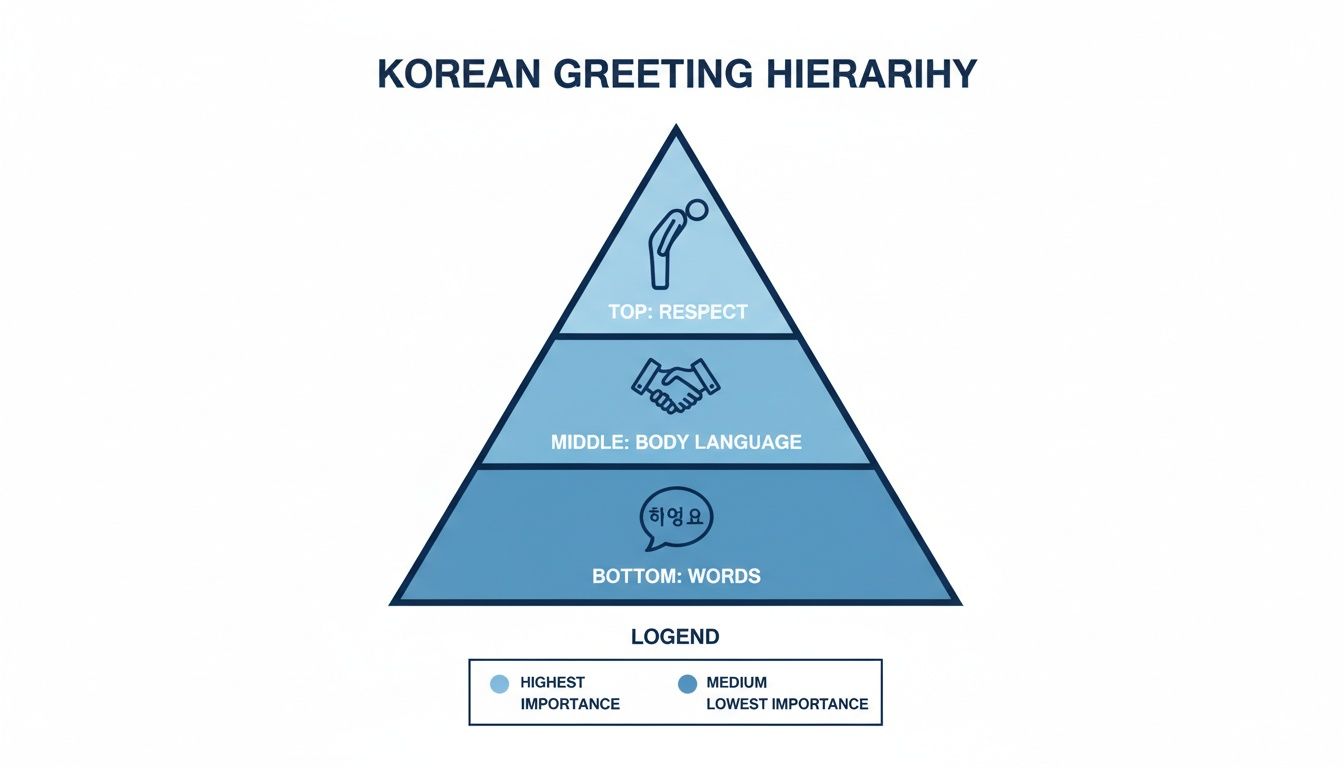
As the pyramid shows, it's not just what you say, but how you show respect with your entire presence.
Seeing Formality in Action
So, how does a simple "hello" actually change across these levels? It's amazing how a single greeting in Korea can hold so much social nuance.
The most formal version is Annyeonghashimnikka (안녕하십니까). This has a real air of official respect, perfect for a job interview or meeting a highly respected elder. Pronounced "ahn-nyawng-ha-shim-nee-kkah," that formal ending, -mnikka (ㅁ니까), signals the highest politeness level.
Next is the one you already know: Annyeonghaseyo (안녕하세요). As we've mentioned, this is your go-to polite greeting. The -yo (요) at the end strikes that perfect balance between respectful and approachable.
Finally, with close friends, you can drop the formal endings and just say Annyeong (안녕). Pronounced "ahn-nyawng," this is your quick, casual "Hey" or "Hi." Just be careful—using this with a stranger or an elder could come across as rude.
Here’s a quick-reference table to help you see these side-by-side.
Korean Greetings at Different Formality Levels
This table breaks down how common greetings shift depending on the social context.
| English Meaning | Formal (합쇼체) | Standard Polite (해요체) | Informal (해체) |
|---|---|---|---|
| Hello | 안녕하십니까 (Annyeonghashimnikka) | 안녕하세요 (Annyeonghaseyo) | 안녕 (Annyeong) |
| Good morning | 좋은 아침입니다 (Joh-eun achim-imnida) | 좋은 아침이에요 (Joh-eun achim-ieyo) | 좋은 아침 (Joh-eun achim) |
| Goodbye (you are leaving) | 안녕히 계십시오 (Annyeonghi gyeshipshio) | 안녕히 계세요 (Annyeonghi gyeseyo) | 잘 있어 (Jal isseo) |
| Goodbye (they are leaving) | 안녕히 가십시오 (Annyeonghi gasipshio) | 안녕히 가세요 (Annyeonghi gaseyo) | 잘 가 (Jal ga) |
💡 The golden rule? If you’re ever in doubt, just stick with the standard polite form (-yo). It’s always better to be a little too polite than not polite enough. It shows you’re making an effort to be culturally aware, and Koreans will always appreciate that.
The Art of Bowing and Body Language
In Korea, how you say hello is only half the story. Your actions, especially the bow, are just as important as your words. Think of it as the physical heartbeat of a greeting—a silent, powerful way to show respect that’s woven deep into daily life.
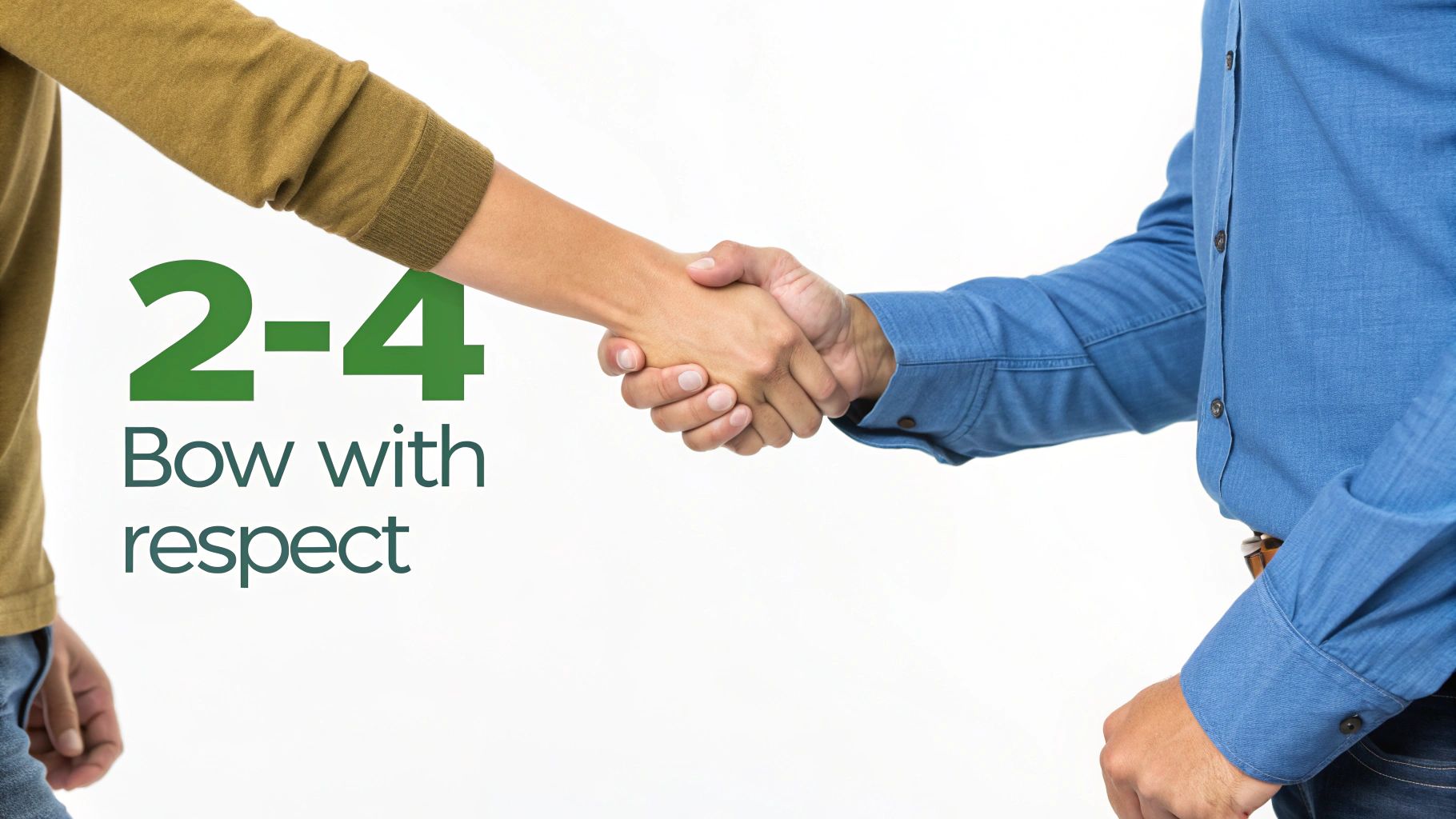
The bow has deep roots stretching back centuries to the Joseon Dynasty, when Confucian ideals about social order became paramount. Even today, it's a living tradition. A 2023 survey by the Korean Culture and Information Service revealed that 78% of South Koreans still bow when first meeting someone professionally. You can learn more about Korean etiquette on Wikipedia.
Understanding the Different Types of Bows
Not all bows are the same. The angle sends a clear message about your relationship with the person and the level of respect you're showing.
Here’s a quick guide to the main types:
- The Casual Nod: A slight dip of the head. This is for close friends, classmates, or colleagues your age. It's the physical version of an informal Annyeong (안녕).
- The Standard Bow (30-45 Degrees): Your everyday, respectful bow. Use this when meeting someone for the first time, greeting your boss, or saying hello to an elder. Bend from the waist to about a 30 or 45-degree angle. This bow perfectly accompanies Annyeonghaseyo (안녕하세요).
- The Deep Bow (90 Degrees): This is the keunjeol (큰절), a gesture of profound respect or a heartfelt apology. It’s reserved for very formal occasions, like bowing to elders on New Year's Day (Seollal).
💡 A quick cultural tip: When performing a formal bow, avoid eye contact and lower your gaze toward the floor. It’s a small detail, but it’s a powerful sign of humility and deference that Koreans will definitely notice and appreciate.
The Modern Handshake
While bowing is traditional, handshakes are now common, especially in business. But the Korean handshake has its own style. It’s often a hybrid gesture, combined with a slight bow or nod. When shaking hands with someone older or more senior, always use two hands—either by gently cupping their hand with both of yours or by supporting your right forearm with your left hand to signal extra respect.
Greetings for Every Situation and Time of Day
Alright, you've got the basic "hello" down. Now, let's learn the phrases that will make you sound more like a local. A greeting in Korea is about choosing the right words for the right moment to make your interactions feel genuine.

Think of this as your playbook for everyday Korean life.
Starting Your Day Right
While Annyeonghaseyo works anytime, using a specific morning greeting adds extra warmth.
- Phrase: 좋은 아침 (Joh-eun achim)
- Pronunciation: joh-eun ah-cheem
- Meaning: Good morning
To be polite with colleagues or strangers, add the polite ending: 좋은 아침이에요 (Joh-eun achim-ieyo). With close friends, the simple 좋은 아침 (Joh-eun achim) is perfect.
Making a Great First Impression
When you meet someone for the first time, you want to show you're happy to meet them. After the initial Annyeonghaseyo, this is the phrase to use.
- Phrase: 만나서 반갑습니다 (Mannaseo bangapseumnida)
- Pronunciation: man-na-seo ban-gap-seum-ni-da
- Meaning: Nice to meet you
This is the standard, formal way to say you're pleased to make their acquaintance. If the situation feels less formal, you can soften it to 만나서 반가워요 (Mannaseo bangawoyo).
Essential Greetings for Daily Life
Life in Korea has a rhythm, and part of that includes specific greetings for particular situations.
- Answering the Phone: Always answer with 여보세요? (Yeoboseyo?). Pronounced "yuh-bo-seh-yo," it's strictly for phone calls. You'll never hear someone say this face-to-face.
- Before a Meal: It's customary to say 잘 먹겠습니다 (Jal meokgesseumnida). It literally means "I will eat well," and shows gratitude to whoever prepared or paid for the meal.
- Checking In: Instead of asking "How are you?", Koreans often ask 밥 먹었어요? (Bap meogeosseoyo?), which means "Have you eaten?". This isn't just about food; it's a cultural way of showing you care about someone's well-being.
Korean greetings have evolved, mixing old traditions with new influences. Bowing was once the standard, but globalization brought the handshake into the picture, which is now used in about 65% of business greetings between men. Still, the core of communication remains distinct, with caring questions like "Have you eaten?" used in an estimated 70% of daily exchanges. You can find more insights into these Korean cultural shifts on factsanddetails.com.
Navigating Social Hierarchies in Greetings
In Korea, every greeting in Korea is tied to social hierarchy, where age and status are the foundation of showing respect. Once you get the hang of these unwritten rules, you’ll connect with real cultural fluency.
The most important rule is simple: always greet the most senior or eldest person first. Whether in a business meeting or with friends, your first bow and formal greeting should be aimed at the person with the highest rank. This small gesture speaks volumes about your respect.
The Importance of Titles
Using titles instead of names is another huge part of the culture. You’d never call your boss by their first name. Instead, you’d use their title, like Kim bujang-nim (김 부장님), which means "Director Kim." The suffix -nim (님) is an honorific that instantly adds respect.
Calling someone by their first name is only for close friends of the same age or someone much younger. If you call a new acquaintance by their first name, it can be seen as a major sign of disrespect. This is a core part of Korea's communication style. In fact, a 2024 survey showed that 85% of professionals greet the most senior person first to keep workplace interactions smooth. You can discover insights on Korean professional etiquette on iorworld.com.
Key Rules for Showing Respect
Here’s a quick guide to making sure your greetings always land well.
- Elders First: Always address the oldest person in the room first with a polite bow.
- Use Titles: Stick to professional or social titles. Save first names for close friends.
- Bow Deeper for Seniors: The depth of your bow should match their status.
- Receive with Two Hands: When an elder or senior gives you something, always accept it with two hands.
Common Mistakes to Avoid When Greeting in Korea
Confidence comes from knowing what not to do just as much as what you should. Every mistake is a chance to learn, but knowing these common pitfalls will help you feel more prepared for any greeting in Korea.
Using Casual Language Too Soon
This is the number one mistake learners make. It's tempting to use the casual Annyeong (안녕), but using it with someone you just met or who is older can come across as disrespectful. It's like calling your new CEO by a nickname—too familiar, too fast.
What to do instead: Always start with the polite form, Annyeonghaseyo (안녕하세요). It’s your safest and most versatile option. It’s better to be a little too formal than not formal enough. Let the other person give you the green light to switch to more casual language.
Getting the Bow Wrong
Another common mistake is the bow—either forgetting it or getting the execution wrong. For instance, offering a handshake without a nod can feel cold. On the flip side, holding direct eye contact during a deep bow can be misinterpreted as confrontational.
What to do instead:
- Always pair your greeting with a nod or a bow. A quick dip of the head or a simple 30-degree bow is perfect for most situations.
- Lower your gaze during a formal bow. When showing deep respect, look down toward the floor as you bow. This is a powerful sign of humility.
- Use two hands for handshakes with elders. If a handshake is offered by someone senior, support your right forearm with your left hand to show extra deference.
You're Ready to Greet the World!
We’ve covered a lot, from the levels of formality in Korean greetings to the subtle art of the bow. You now know that saying hello in Korea is about showing respect and understanding the situation you're in. The most important thing is to be observant and not be afraid to make mistakes—even Koreans do sometimes! Every time you try, you’re building confidence.
Every word you learn brings you one step closer to fluency. You've already taken the biggest step by deciding to learn. Now you have the foundation. The next part is the most fun—getting out there and actually using it. Keep going—your Korean journey starts now!
🌟 Ready to start your Korean journey? Join Ktalk.live — where global learners connect, speak, and grow together! Book your free trial class today and turn your knowledge into conversation.
Ready to stop reading and start speaking?
Practice what you just learned with a native Korean teacher — free for 100 minutes. No card, no commitment.