Want to practice this with a native Korean teacher?
100-min free trial — no card required.
Ever had that moment of hesitation, that split-second of panic, right before hitting 'send' on an important email in Korean? You’re not alone. In a world dominated by instant messaging, it's easy to think a formal email is old-fashioned. But for anything professional or academic in Korea, it’s an absolute game-changer. Learning to write a proper email in Korean shows not just language skill, but cultural respect.
This guide will walk you through everything, step-by-step, to make sure your messages are always clear, respectful, and get the job done. Don’t worry if it seems challenging at first — with the right approach, it becomes a fun and rewarding journey! Let's get you ready to write with confidence.
Why Bother With Korean Emails?
You might be thinking, "Isn't everyone just on KakaoTalk?" And for casual chats, you'd be right. But when it comes to the things that really matter—job applications, university business, or any kind of official inquiry—email is still the gold standard in Korea.
Getting this right is a powerful signal of cultural respect. When you use the correct honorifics, strike the right tone, and follow the expected structure, you're showing you understand and value Korean etiquette. A polished email can open doors for you, while a sloppy one can shut them before you even get a foot in.
Ultimately, learning to write a proper email in Korean gives you the confidence to handle some of life's most important moments. Think about it. You'll need this skill when you're:
- Applying for that dream job at a Korean company.
- Reaching out to a university professor about their course.
- Making a formal request to a business.
- Building solid professional relationships with your colleagues.
Navigating Korean Email Formality Levels
Picking the right level of politeness is the single most important decision you'll make when writing a Korean email. It’s not just about being polite; it’s about showing you understand and respect Korean social dynamics. Getting this wrong can make you seem rude, while getting it right sets the perfect tone from the very first word.
But first, are you sure email is the right tool for the job? This quick flowchart can help you decide.
As you can see, for anything professional or academic, email is almost always the way to go. To help you choose the right style, here's a quick rundown of the three main levels.
| Formality Level (Speech Style) | Who It's For | Real-World Scenarios |
|---|---|---|
| Hapsyo-che (하십시오체) (Formal) | Superiors, clients, professors you don't know, government officials, or anyone you're contacting for the first time. | Job applications, formal business proposals, inquiries to a company's customer service, contacting a CEO. |
| Haeyo-che (해요체) (Polite Informal) | Colleagues, classmates, professors you have a relationship with, acquaintances, or in follow-up emails after a formal introduction. | Everyday office communication with team members, emailing a professor about an assignment, a friendly follow-up with a business contact. |
| Hasoseo-che (하소서체) (Archaic Formal) | Historical figures, royalty, deities. (Almost never used in modern communication). | You might see it in historical dramas, religious texts, or official royal proclamations from the Joseon Dynasty. |
Essentially, you'll be living in the Hapsyo-che and Haeyo-che worlds.
Key Korean Honorifics and Speech Styles
1. Hapsyo-che (하십시오체) – The Formal Standard
This is your go-to for almost all professional emails. It’s the highest level of politeness used in modern business and is the safest, most respectful choice when you’re unsure.
- When to use it: Reaching out to a company for the first time, applying for a job, emailing a senior executive, or sending a formal inquiry.
- Key verb endings: Statements end in -ㅂ/습니다 (-b/seumnida) and questions end in -ㅂ/습니까? (-b/seumnikka?).
- Example: 감사합니다 (gamsahamnida) - Thank you.
2. Haeyo-che (해요체) – The Polite, Yet Friendly Style
This is the standard polite style you hear everywhere in Korea. It’s less stiff than Hapsyo-che, striking a great balance between respect and warmth.
- When to use it: Emailing a colleague you work with often, writing to a professor who knows you well, or in less formal business follow-ups.
- Key verb endings: Sentences end in -아요/어요 (-ayo/eoyo).
- Example: 감사해요 (gamsahaeyo) - Thank you.
3. Using Honorifics: -님 (nim) and Special Vocabulary
True fluency in Korean email etiquette goes beyond just verb endings. You also need to use special nouns and particles—honorifics—to show respect.
The suffix -님 (nim) is your all-purpose respect marker, attached to names and job titles.
- With a name: 김민준님 (Kim Minjun-nim)
- With a title: 선생님 (seonsaengnim - Teacher), 교수님 (gyosunim - Professor)
Forgetting to add -님 is a major faux pas. You can also use special honorific vocabulary:
- To give: Instead of 주다 (juda), use 드리다 (deurida).
- Name: Instead of 이름 (ireum), use 성함 (seongham).
These details might seem small, but they make a massive difference. Don’t worry if you make mistakes—even Koreans do sometimes! What matters most is progress.
How to Structure a Korean Email
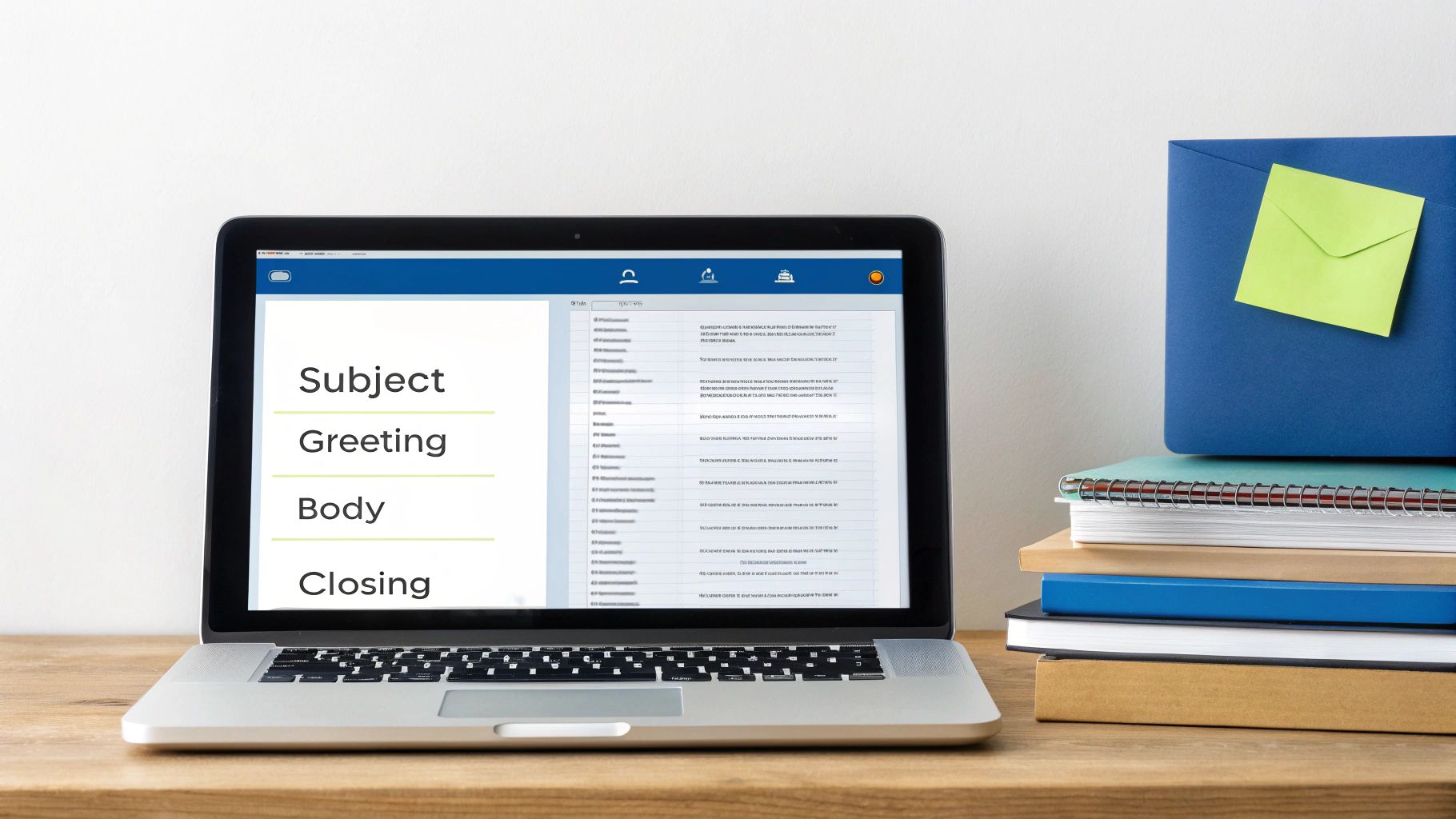
Alright, you've got the basics of formality down. Now, let's build a Korean email. Think of it like a simple recipe with four main ingredients: the subject line, the greeting, the main message, and the closing. Get these four parts right, and you'll come across as clear and professional.
1. Nail the Subject Line (제목)
Your subject line, or 제목 (jemok), is the first thing anyone sees. In the Korean business world, a vague subject line is a fast track to the trash folder. Your goal is simple: state your purpose and who you are, concisely. A great format is: [Purpose of Email] Your Name - Regarding [Topic]
- Business Example:
[문의] Ktalk Live 김민준 - 파트너십 제안 관련- ([Inquiry] Kim Minjun from Ktalk Live - Regarding Partnership Proposal)
- Academic Example:
[한국어학개론] 박서연 - 과제 질문입니다.- ([Intro to Korean Linguistics] Park Seoyeon - Question about the assignment.)
The square brackets [ ] are standard practice and help the recipient categorize your message instantly.
2. Choose the Perfect Salutation (인사말)
The greeting, or 인사말 (insanmal), sets the entire tone. The safest way to start a formal email is with the person’s full name and their title, followed by -님께 (-nim-kke).
- To a specific person:
김민준 부장님께(Gim Minjun bujangnim-kke - To Manager Kim Minjun) - If you don't know their name:
담당자님께(Damdangjanim-kke - To the person in charge)
After that, add a polite opening line like 안녕하세요. (Annyeonghaseyo. - "Hello.") or 처음 인사드립니다. (Cheoeum insadeurimnida. - "I am greeting you for the first time.")
3. Write a Clear Main Body (본문)
This is the core of your email, the 본문 (bonmun). If this is your first time contacting the person, start with a brief self-introduction. Then, get to your point clearly and respectfully.
- To state your purpose:
...에 대해 문의드리고자 이메일을 드립니다.(...e daehae mun-uideurigija imeil-eul deurimnida.) - "I am emailing you to inquire about..." - To attach a file:
관련 자료를 첨부하였으니 확인 부탁드립니다.(Gwallyeon jaryoreul cheombuhayeosseuni hwagin butakdeurimnida.) - "I have attached the relevant documents; please check them."
Stick with the formal Hapsyo-che (하십시오체) verb endings like -습니다/ㅂ니다 for any initial business or academic email.
4. End with a Professional Closing (맺음말)
Finally, the closing, or 맺음말 (majeunmal), is how you wrap things up politely. This usually involves a final concluding phrase followed by your sign-off.
- If you're expecting a reply:
답변 기다리겠습니다.(Dapbyeon gidarigesseumnida.) - "I will await your reply." - A simple, polite closing:
감사합니다.(Gamsahamnida.) - "Thank you."
After the phrase, sign off with your name followed by 드림 (deurim) or 올림 (ollim), which both mean "sincerely."
Example Sign-Off:
김민준 드림
마케팅 매니저
Ktalk Live
010-1234-5678
Real-World Korean Email Templates You Can Adapt
Theory is one thing, but seeing how all the pieces fit together is where it all starts to click. Here are three complete email templates for situations you’ll almost certainly run into. Think of these as your starting blueprints you can adapt with your own details.
1. Formal Business Inquiry to a Potential Partner
You’re reaching out to a company to propose a partnership. Your first impression has to be flawless—professional, respectful, and perfectly clear. For this, we’ll use the highest level of formality, Hapsyo-che (하십시오체).
Subject: [Ktalk Live] 파트너십 제안 관련 문의드립니다.
(From Ktalk Live - Inquiry Regarding Partnership Proposal)
Body:
김민준 부장님께,
안녕하세요. 처음 인사드립니다. 저는 온라인 한국어 교육 플랫폼 Ktalk Live의 마케팅 담당자 박서연입니다.
귀사의 혁신적인 마케팅 전략에 깊은 인상을 받아 연락드렸습니다. 저희 Ktalk Live는 전 세계 학습자들에게 고품질의 한국어 교육을 제공하고 있으며, 귀사와의 파트너십을 통해 함께 성장할 기회를 만들고 싶습니다.
저희 서비스에 대한 소개 자료를 첨부하였으니 검토 후 회신 부탁드립니다.
귀한 시간을 내어주셔서 감사합니다. 긍정적인 답변 기다리겠습니다.
박서연 드림 마케팅 매니저 Ktalk Live
2. Academic Email to a Professor
You have a question for your professor about a final paper. The tone is still very respectful but can be slightly less stiff than a corporate inquiry. This example uses the polite Haeyo-che (해요체), which strikes a great balance.
Subject: [한국문화의 이해] 1234567 김유진 - 기말 과제 관련 질문입니다.
([Understanding Korean Culture] Student ID 1234567 Kim Yujin - Question Regarding Final Assignment)
Body:
박은영 교수님께,
안녕하세요, 교수님. 한국문화의 이해 수업을 듣고 있는 김유진입니다.
다름이 아니라, 기말 과제 주제에 대해 질문이 있어 이메일 드려요. 공지된 주제 목록 외에, 제가 개인적으로 관심 있는 '현대 한국 사회의 웹툰 문화'에 대해 보고서를 작성해도 괜찮을까요?
바쁘시겠지만, 시간 괜찮으실 때 짧게라도 답변해 주시면 정말 감사하겠습니다.
늘 좋은 강의 감사해요.
김유진 올림
3. Casual Email to a Korean Friend
Finally, an email to a friend. All those strict formality rules go out the window. The tone here is warm and relaxed, using the informal Hae-che (해체), also known as Banmal (반말). You might think email is old-fashioned for friends when apps like KakaoTalk exist, but it's great for longer messages.
Subject: 주말에 뭐해?
(What are you doing this weekend?)
Body:
민준아,
잘 지내? 나는 요즘 새 프로젝트 때문에 좀 바빴어.
이번 주 토요일에 시간 어때? 홍대에 새로 생긴 맛집 있는데, 같이 가서 저녁 먹자.
너만 괜찮으면 7시쯤 만나는 거 어때? 시간 되면 알려줘!
답장 기다릴게!
유진이가
Your Korean Email Questions Answered
Even with the rules down, a few tricky situations always seem to crop up. Let's tackle some of the most common questions that stump Korean learners.
What If I Don’t Know the Recipient’s Title?
This happens all the time. Don't worry, there's a standard, professional way to handle it. Simply use this phrase:
- 담당자님께 (Damdangjanim-kke) - "To the person in charge"
This is your go-to, respectful solution. It signals politeness and ensures your email gets routed correctly.
Are Emojis Okay in Korean Emails?
For any formal business or academic email, the answer is a hard no. Emojis or text emoticons (like ^^) can seem unprofessional and undermine the serious tone you're trying to set. However, in a casual email to a colleague you know well, a simple, positive emoji is usually fine.
My rule of thumb: If you're writing in formal Hapsyo-che, skip the emojis. If you're using polite Haeyo-che with someone you know, a simple one might be okay. When in doubt, leave it out.
What's the Biggest Mistake Foreigners Make?
The most frequent mistake is getting the politeness level wrong. This happens when people directly translate phrases from English, which can sound abrupt in Korean, or when they mix different speech levels (e.g., a formal greeting with a casual sign-off).
Another common error is being too direct with requests. Korean communication often relies on softening language. Adding "cushion words" like 바쁘시겠지만... (Bappeusigetjiman... - "I know you're busy, but...") before making a request makes a world of difference.
Your Journey to Confident Korean Emails Starts Now
You've made it through the guide, and now you have the building blocks for writing a solid email in Korean. Remember, getting this right isn't just about language; it’s about showing respect and making a great first impression. The only way to get truly comfortable is to jump in and start writing.
Draft a quick email to an imaginary professor or a business contact. Every time you do this, you’re turning theory into an active skill. Every word you learn brings you one step closer to confidence. Keep going—your Korean journey starts now!
🌟 Ready to start your Korean journey? Join Ktalk.live — where global learners connect, speak, and grow together! Practice with our experienced tutors in a live, supportive setting and get a free trial class.
Ready to stop reading and start speaking?
Practice what you just learned with a native Korean teacher — free for 100 minutes. No card, no commitment.