
Want to practice this with a native Korean teacher?
100-min free trial — no card required.
Ever wondered how to talk about man's best friend in Korean? Learning a new language is a journey, and picking up practical words you'll actually use makes it so much more fun and rewarding. If you want to say dog in Korean, you'll quickly find two very common words: 개 (gae) and 강아지 (gangaji). But which one should you use?
This guide is here to help you navigate that choice with confidence. We'll break down the difference between the general term for "dog" and the more affectionate word for "puppy." Understanding this small distinction won't just improve your vocabulary; it will help you sound more natural and connect better with native speakers. Ready to start your Korean journey? Let's dive in!
Your Guide to Korean Dog Vocabulary
Learning how to say dog in Korean is a fantastic starting point for any beginner. You'll hear these words everywhere, from K-dramas to casual chats with friends about their pets.
The real key is figuring out which word to use in the right situation. Choosing between 개 (gae) and 강아지 (gangaji) isn't just about a direct translation; it’s about conveying the right feeling and context.
It’s similar to English. You might see a large German Shepherd and say, "That's a big dog." But if you see a tiny, fluffy Pomeranian, you're more likely to exclaim, "What a cute little puppy!" Korean captures that same emotional difference directly in its vocabulary.
To make it super simple, here's a little flowchart to help you decide which word to use in a snap.
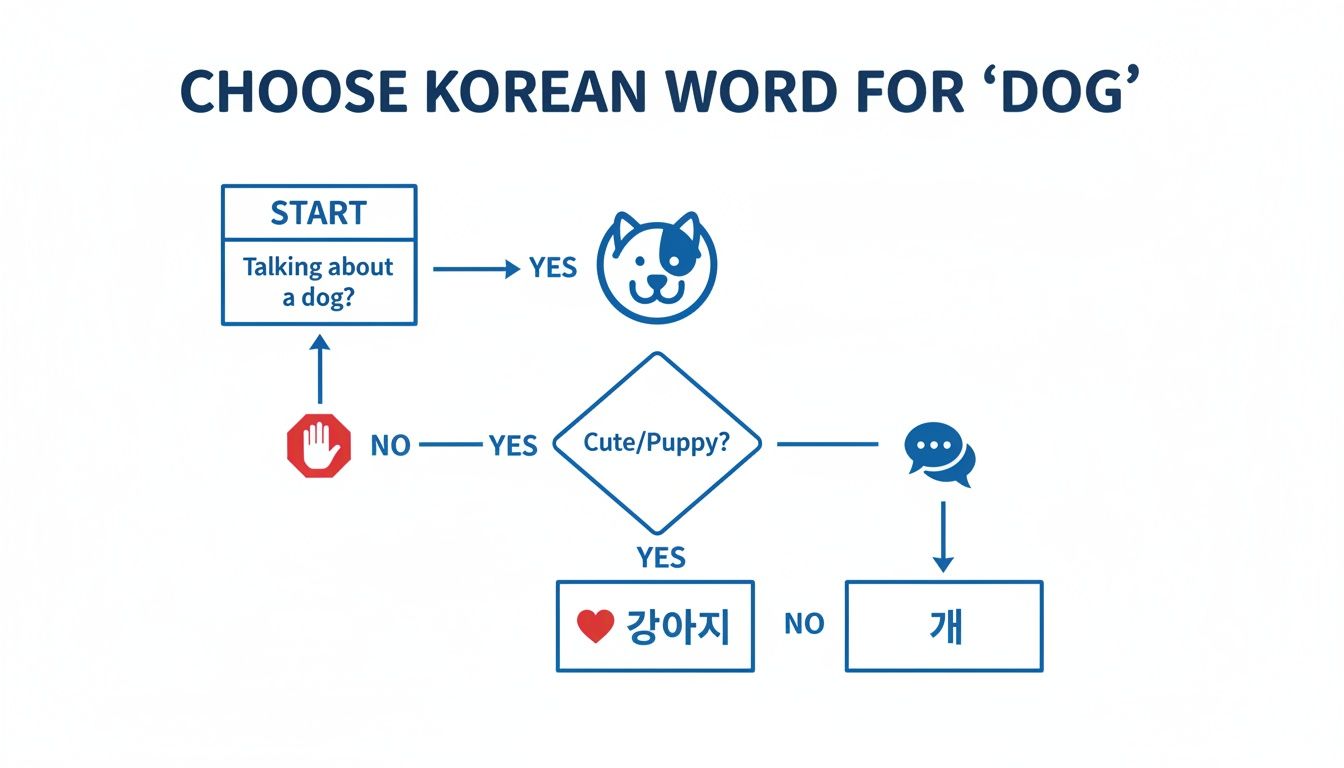
As you can see, it often comes down to emotion. If you're talking about a small dog or want to show affection, 강아지 (gangaji) is your best friend. For general statements or neutral descriptions, 개 (gae) is the perfect fit.
Korean Words for Dog: A Quick Comparison
Let's break these two core words down side-by-side. Getting the hang of this nuance is one of those small details that will make your Korean sound much more natural.
| Korean Word | Romanisation | Pronunciation Tip | When to Use It |
|---|---|---|---|
| 개 | gae | Sounds a bit like the 'ca' in 'cab' | The standard, neutral term for any dog. |
| 강아지 | gang-a-ji | gang-ah-jee | For puppies, or any dog you're being affectionate towards. |
Now that you've got the basics down, you're ready to see how these words actually work in real conversations. Next up, we'll dive into some example sentences to see how native speakers use them every day. This is where your Korean skills really start to come to life.
Understanding 개 (Gae): Your Go-To Word for 'Dog'
When you want to talk about dogs in Korean, your starting point and most common word is 개 (gae). Think of it as the standard, all-purpose term for 'dog'—it's the direct equivalent of what we use in English.
It doesn't matter if you're talking about a tiny chihuahua, a massive great dane, or just dogs in general. 개 (gae) is your word. It's what you'll find in the dictionary and hear people use in everyday conversations.
For example, if someone asks if you like dogs, this is the word you'll use to answer. It's simple, direct, and universally understood. Don't worry about getting it wrong—this is the safest bet for any situation.
Putting 개 (Gae) into Action
Using 개 (gae) is pretty straightforward because it fits into sentences just like 'dog' does in English. Let's look at a few practical examples to see how it works.
Here are some phrases you can use right away:
- 저는 개를 좋아해요. (Jeoneun gaereul joahaeyo.)
- This is how you say, "I like dogs." A perfect, simple sentence to express your affection for our four-legged friends.
- 저 개는 정말 커요. (Jeo gaeneun jeongmal keoyo.)
- Use this to say, "That dog is really big." It's great for when you're pointing out a specific dog you see.
- 개가 짖고 있어요. (Gaega jitgo isseoyo.)
- This one means, "The dog is barking." A simple, observational phrase you might use while out for a walk.
As you can tell, 개 (gae) is perfect for general statements and facts. It doesn't carry any special emotional flavor—it just gets the job done and clearly identifies the animal.
Building on 개 (Gae) to Sound More Advanced
Once you've mastered 개 (gae), you've unlocked the door to a bunch of other related words. Many Korean terms for dog-related things use 개 as a base, which makes expanding your vocabulary much easier.
A fantastic example is 반려견 (banryeogyeon), which means "companion dog."
You'll hear the word 반려견 (banryeogyeon) more and more in South Korea these days. It points to a really interesting cultural shift where dogs are increasingly seen as true members of the family, not just pets. Dropping this term into a conversation shows you have your finger on the pulse of modern Korean culture.
This word is formed by combining 반려 (banryeo), meaning 'companion', with 견 (gyeon), the formal Sino-Korean character for 'dog'. While 개 (gae) is your everyday workhorse, knowing words like 반려견 (banryeogyeon) helps you sound more nuanced and culturally aware.
Using 강아지 (Gangaji) for Puppies and Beloved Pets
Now, let's talk about the other essential word for dog in Korean: 강아지 (gangaji). This is where the language gets warmer and more affectionate. While the dictionary translates 강아지 (gangaji) as ‘puppy’, its real-world usage is so much richer.

Koreans use 강아지 (gangaji) for almost any dog they find cute or endearing, regardless of its age. Think of it this way: saying 개 (gae) is like a neutral observation, "There is a dog." But using 강아지 (gangaji) is like exclaiming with a smile, "Oh, look at that adorable little doggy!"
By choosing this word, you instantly signal fondness and soften the entire feel of the conversation. It shows you're seeing more than just an animal—you're seeing a sweet creature, a beloved pet.
When Affection Is Key
So, when should you reach for 강아지 (gangaji)? It’s your go-to word whenever you want to express adoration. It’s perfect for talking about your own pet, complimenting a friend's furry companion, or pointing out a particularly charming dog at the park.
Here are a few classic scenarios where 강아지 (gangaji) is the most natural choice:
- Describing your own dog: If you have a pet dog, you'll almost always call them your 강아지 (gangaji).
- Complimenting someone else's pet: Saying their 강아지 (gangaji) is cute is the standard, friendly way to do it.
- Seeing a small or fluffy dog: The cuter and more 'aww'-inducing the dog, the more fitting 강아지 (gangaji) feels.
Basically, if the sight of the dog makes your heart melt even a little bit, 강아지 (gangaji) is the word you're looking for.
Cultural Insight: The affection baked into 강아지 (gangaji) is so powerful that it's often used as a term of endearment for people, too! In K-dramas, you’ll frequently hear a character call their child or romantic partner "우리 강아지" (uri gangaji), which means "my puppy." It's a clear signal of deep, sweet affection.
Real-Life Examples with 강아지 (Gangaji)
Let's see how this plays out in a few sentences. You'll immediately notice how much warmer and more personal these feel compared to the examples with 개 (gae).
우리 강아지 너무 귀여워요. (Uri gangaji neomu gwiyeowoyo.)
"Our dog is so cute." This is exactly what a proud pet owner in Korea would say. It's brimming with love.강아지 산책 시킬 시간이야. (Gangaji sanchaek sikil siganiya.)
"It's time to walk the dog." Using 강아지 (gangaji) here paints a picture of a cherished daily routine with a beloved family member, not just a chore.이 강아지 이름이 뭐예요? (I gangaji ireumi mwoyeyo?)
"What is this dog's name?" Asking this way is much friendlier and more polite. It shows you see the dog as a cute little individual worth getting to know.
Opting for 강아지 (gangaji) is a simple but effective way to add a layer of kindness to your Korean. It shows you’re not just translating words from a dictionary; you're connecting with the culture and its affectionate view of our furry friends.
How to Pronounce 'Dog' in Korean Naturally
Nailing the pronunciation is your ticket to sounding natural when you speak Korean. It’s what separates a learner from someone who really speaks the language. Let's tackle the two main words for dog: 개 (gae) and 강아지 (gangaji).
Don't worry if you make mistakes—even Koreans do sometimes! Our goal here is clear communication and confidence, not flawless pronunciation from day one.
Mastering the Sound of 개 (Gae)
For most English speakers, the trickiest part of 개 (gae) is the vowel sound '애' (ae). It’s a bright, open sound that doesn't have a perfect one-to-one match in English.
A Quick Pronunciation Tip: Think about the 'a' sound in words like "apple" or "cat." Now, open your mouth a little wider, as if you're about to say "ah" (like in "spa"). Combine those two ideas – it’s that bright "a" sound from "cat," but with a more open jaw. Gae.
A common mistake is dragging it out or pronouncing it like the English word "gay," which has a two-part vowel sound (ay). Korean vowels are usually quick and clean. It’s a single, crisp sound. Try saying "cat," "cab," "can," and then carry that exact vowel over to make "gae."
Breaking Down 강아지 (Gangaji)
This longer word might look a bit daunting, but it's a breeze when you take it one syllable at a time.
- 강 (gang): This first part rhymes perfectly with the English word "gong." The 'a' sound is the open "ah" you hear in "father."
- 아 (a): This is that same exact "ah" sound from the first syllable. Easy!
- 지 (ji): This sounds just like the name "Gee" or how you'd say the letter "G" in English.
Now, string them together slowly: Gang-a-ji. The rhythm is pretty even, without a heavy stress on any one part. Once you get the feel for it, you can pick up the pace until it flows naturally. A little bit of practice, and 강아지 (gangaji) will roll right off your tongue.
Why Dogs Are More Than Just Pets in Korean Culture
To truly master a language, you have to look beyond the words and into the culture that gives them meaning. This couldn't be more true when learning how to say dog in Korean. Over the last few decades, the role of dogs in South Korea has changed dramatically, evolving from working animals to beloved members of the family.

You can see this cultural shift reflected in the language. While 개 (gae) is the standard word for 'dog', the growing use of 반려견 (banryeogyeon), 'companion dog', points to a deeper, emotional connection. This term shows that dogs are now seen as life partners who share our homes, our lives, and our hearts.
The Rise of the "Companion Dog"
Walk around any city in modern Korea, and you'll see that dogs are a massive part of daily life. This isn’t just a feeling; it’s a major social trend. According to one report, about one in four Korean homes now lives with a dog. This is why you'll hear words for dog in Korean—like 개 (gae) and 강아지 (gangaji)—popping up constantly. You can dig into more details about this trend over on koreatimes.co.kr.
This massive shift has influenced everything from local businesses to what people watch on TV. For example, you’ll find:
- Pet-friendly cafés: It’s now normal to find spots where you can grab a coffee with your four-legged friend.
- "Pet-cams": Many households have cameras set up to check in on their furry buddies while they're at work.
- TV Shows: Countless Korean variety shows feature celebrities doting on their adorable companion dogs.
This evolution in how society sees dogs makes picking the right vocabulary even more crucial. When you use a term like 반려견 (banryeogyeon), it shows you’re not just reciting words from a list—you’re in tune with the modern culture and values that surround them.
Why This Cultural Context Matters for You
Understanding this background does more than just add words to your vocabulary; it gives you real insight. The next time you hear someone lovingly refer to their pet as 우리 강아지 (uri gangaji), "our puppy," you'll catch the deep, familial bond they're expressing.
By appreciating this cultural movement, your language learning becomes richer. You’re no longer just memorizing translations; you're connecting with the feelings and social changes that shape how Koreans talk about their four-legged family members every day.
Common Questions About Saying Dog in Korean
Even after learning the basics, a few tricky questions often pop up for Korean learners. Let's clear those up so you can speak with confidence.
Can I call a small, cute dog 'gae'?
You definitely can. Technically, 개 (gae) works for any dog, no matter the size. It's never grammatically wrong.
However, to sound more natural and affectionate, 강아지 (gangaji) is the better choice for a smaller or cuter dog. Think of it like calling a cute little dog a 'puppy' in English, even if it's fully grown. It just fits the vibe better and adds a touch of warmth.
How do you say 'woof woof' in Korean?
In Korean, the sound a dog makes isn't 'woof woof'—it's 멍멍 (meong-meong).
You'll hear this onomatopoeia all the time, especially in kids' shows or when people are talking about their pets. For instance, you might say '개가 멍멍 짖어요' (Gaega meong-meong jijeoyo), which means 'The dog is barking.'
Does 'gae' have any negative meanings?
This is a great question, and the answer is yes, but it's all about context. In modern slang, 개 (gae) can be used as a prefix to intensify other words, a bit like using 'freaking' or 'super' in English.
Don't let that scare you, though. When you're clearly talking about an animal, everyone will understand you mean 'dog'. The context makes your meaning perfectly clear, so there’s no risk of accidentally offending someone.
You're Ready to Talk About Dogs in Korean!
Congratulations! You now know the key differences between 개 (gae) and 강아지 (gangaji). You've learned not just the words for dog in Korean, but also the cultural context and emotion behind them. This is a huge step toward speaking Korean more naturally and confidently. Remember, it's these little nuances that bring the language to life.
Every word you learn brings you one step closer to fluency. Don't be afraid to practice these words with friends, language partners, or even your own furry companion. Keep going—your Korean journey starts now!
🌟 Ready to start your Korean journey? Join Ktalk.live — where global learners connect, speak, and grow together
Ready to stop reading and start speaking?
Practice what you just learned with a native Korean teacher — free for 100 minutes. No card, no commitment.