Want to practice this with a native Korean teacher?
100-min free trial — no card required.
Ever been deep into a K-drama or watching your favourite K-pop group and thought, "Wow, they're so cute!"? Learning how to say cute in Korean is one of the most fun and rewarding first steps for any learner. It’s not just a word; it’s a key that unlocks a huge part of everyday conversation and pop culture in Korea.
But where do you start? The first word you absolutely need is 귀여워요 (gwiyeowoyo). It’s your friendly, all-purpose way to compliment everything from an adorable puppy to a friend's new style. This guide will walk you through the essential words, the cultural context behind them, and how to use them naturally. Think of it as your first confident step into a much larger world of Korean expressions!
Your Quick Guide to Saying Cute in Korean
Before we dive deep, let's get you speaking right away. In Korean, "cute" isn't just a simple adjective—it’s a massive part of social interaction. The word you'll hear everywhere is 귀여워요 (gwiyeowoyo), and it's central to how people talk about everything from appearances to the design of a new phone case.
This ties into a much bigger cultural concept called aegyo (애교). Aegyo is a sort of charming, performed cuteness that people use to show affection, often with a slightly higher-pitched voice or playful gestures. Its popularity really took off in the late 1990s with first-generation K-pop girl groups, and you can learn more about the cultural impact of aegyo and its history.
Quick Tip: Always think about who you're talking to. Korean has different politeness levels, so choosing the right ending for your compliment is just as important as the word itself.
Essential Korean Words for 'Cute'
Here's a quick reference table to help you master the most common ways to express "cuteness" in Korean. Think of this as your cheat sheet for everyday compliments.
| Korean Expression | Romanization | English Meaning | When to Use |
|---|---|---|---|
| 귀엽다 | gwiyeopda | to be cute (dictionary form) | The base verb, not used in conversation. |
| 귀여워요 | gwiyeowoyo | It's cute / You're cute | The standard polite form. Safe for most situations. |
| 귀여워 | gwiyeowo | It's cute / You're cute | The casual form. Use with close friends or someone younger. |
| 귀요미 | gwiyomi | cutie / a cute person | A popular slang noun for a cute person or thing. |
This table covers the essentials you'll need for about 90% of situations. Memorizing these will give you a solid base for giving compliments naturally and accurately.
Mastering the Different Forms of Gwiyeopda
So, you want to call something cute in Korean? The first word you absolutely need to know is 귀엽다 (gwiyeopda). But here’s the thing: you’ll almost never use it in that exact form. Think of it as the raw ingredient; you have to cook it a little differently depending on who you're talking to.
In Korean, how you end your sentences is a huge deal. It shows respect and signals your relationship with the other person. Nailing this is one of the fastest ways to sound more natural. Using the wrong form can make you sound a bit stiff or, on the flip side, way too familiar.
Politeness Levels Explained
When it comes to 귀엽다 (gwiyeopda), there are three main flavours you'll use all the time. Getting these right is a game-changer.
Formal: 귀엽습니다 (gwiyeopseumnida) – This is the most formal, "black-tie" version. You'd pull this one out for a business presentation or when addressing a respected elder for the first time. It's polite, professional, and shows a high degree of respect.
Standard Polite: 귀여워요 (gwiyeowoyo) – This is your everyday go-to. It's the perfect balance of polite and friendly. Use it with store clerks, new acquaintances, or pretty much anyone you're not super close with. It's always a safe and friendly bet.
Casual/Informal: 귀여워 (gwiyeowo) – This is the warm, casual form you save for your inner circle—close friends, siblings, and people younger than you. It feels intimate and relaxed but could come off as rude if you use it with a stranger.
Learning to dance between these forms is what separates beginners from more seasoned speakers. It shows you don't just know the words; you understand the culture behind them.
The flowchart below helps visualize how these spoken compliments connect to the wider cultural concept of aegyo, or acting cute.

As you can see, the act of aegyo (애교) often gets a response like 귀여워요 (gwiyeowoyo), and a person who is naturally cute might be called a 귀요미 (gwiyomi).
Conjugating Gwiyeopda for Different Situations
Let's put this into practice. Seeing how these forms change inside a real sentence makes it all click. This table breaks down the conjugations with some easy-to-understand examples.
| Politeness Level | Korean Conjugation | Romanization | Example Sentence (Korean & English) |
|---|---|---|---|
| Formal | 귀엽습니다 | gwiyeopseumnida | 그 강아지는 정말 귀엽습니다. (That puppy is very cute.) |
| Standard Polite | 귀여워요 | gwiyeowoyo | 이 모자 너무 귀여워요! (This hat is so cute!) |
| Informal | 귀여워 | gwiyeowo | 와, 너 정말 귀여워. (Wow, you're really cute.) |
See how the core feeling of "cute" is the same, but the ending completely changes the tone? That's the magic of Korean politeness levels.
Key Takeaway: If you're ever unsure which form to use, stick with 귀여워요 (gwiyeowoyo). It’s respectful, friendly, and works in almost every situation. Ready to get some real-world practice? You can join a free trial class at Ktalk.live and test your skills with a native speaker.
Going Beyond the Basic “Cute” in Korean
So, you’ve mastered 귀여워요 (gwiyeowoyo). That's fantastic! It's your go-to word for anything cute in Korean. But if you really want to sound natural, it's time to add a few more colors to your palette.
Think about English. We have "cute," but we also have "adorable," "charming," and "lovely." Each one paints a slightly different picture. Korean is no different. Digging into these nuances is what separates a beginner from someone who truly feels the language.
Kkamjjikhada: For a Playful, Spunky Cuteness
Ever see something that’s not just cute, but also tiny, clever, and just bursting with personality? That's the perfect time to pull out 깜찍하다 (kkamjjikhada). It’s a word for a kind of spunky, witty charm.
A baby is gwiyeowo, but a tiny kitten that pounces on a toy with surprising ferocity? That’s kkamjjikhada. It’s the cuteness that makes you chuckle.
- Polite Form: 깜찍해요 (kkamjjikhaeyo)
- Casual Form: 깜찍해 (kkamjjikhae)
Example:
"이 캐릭터 스티커 정말 깜찍해요!" (I kaerikteo seutikeo jeongmal kkamjjikhaeyo!)
"This character sticker is so charmingly cute!"
Sarangseureopda: For Heart-Melting, Lovable Cuteness
Now, let's shift gears. When you see something so precious it genuinely warms your heart and fills you with affection, you're feeling 사랑스럽다 (sarangseureopda). The root of this word is 사랑 (sarang), which means "love."
This isn't about playful charm; it's about an endearing, deeply lovable quality. You’d use this to describe a child's innocent smile. It’s a cuteness that feels profound and beautiful.
- Polite Form: 사랑스러워요 (sarangseureowoyo)
- Casual Form: 사랑스러워 (sarangseureowo)
Example:
"그녀가 웃는 모습이 너무 사랑스러워요." (Geunyeoga unneun moseubi neomu sarangseureowoyo.)
"The way she smiles is just so lovely."
Gwiyomi: The Go-To Noun for a "Cutie"
Sometimes you don't want an adjective; you need a noun. You don't want to say someone is cute, you want to call them a "cutie." For that, the perfect slang word is 귀요미 (gwiyomi).
This term blew up thanks to K-pop and variety shows. It’s a fun, playful way to point to a person or animal and simply label them a "cutie." It's definitely casual and used between friends.
Example:
"우리 강아지는 진짜 귀요미야." (Uri gangajineun jinjja gwiyomiya.)
"My puppy is such a cutie."
Understanding Aegyo: The Culture of Cuteness
To really get what "cute" means in Korean, you have to understand a massive cultural concept: 애교 (aegyo). This isn't just about being cute; it's about acting cute. Think of it as a charming performance meant to show affection or soften a request.
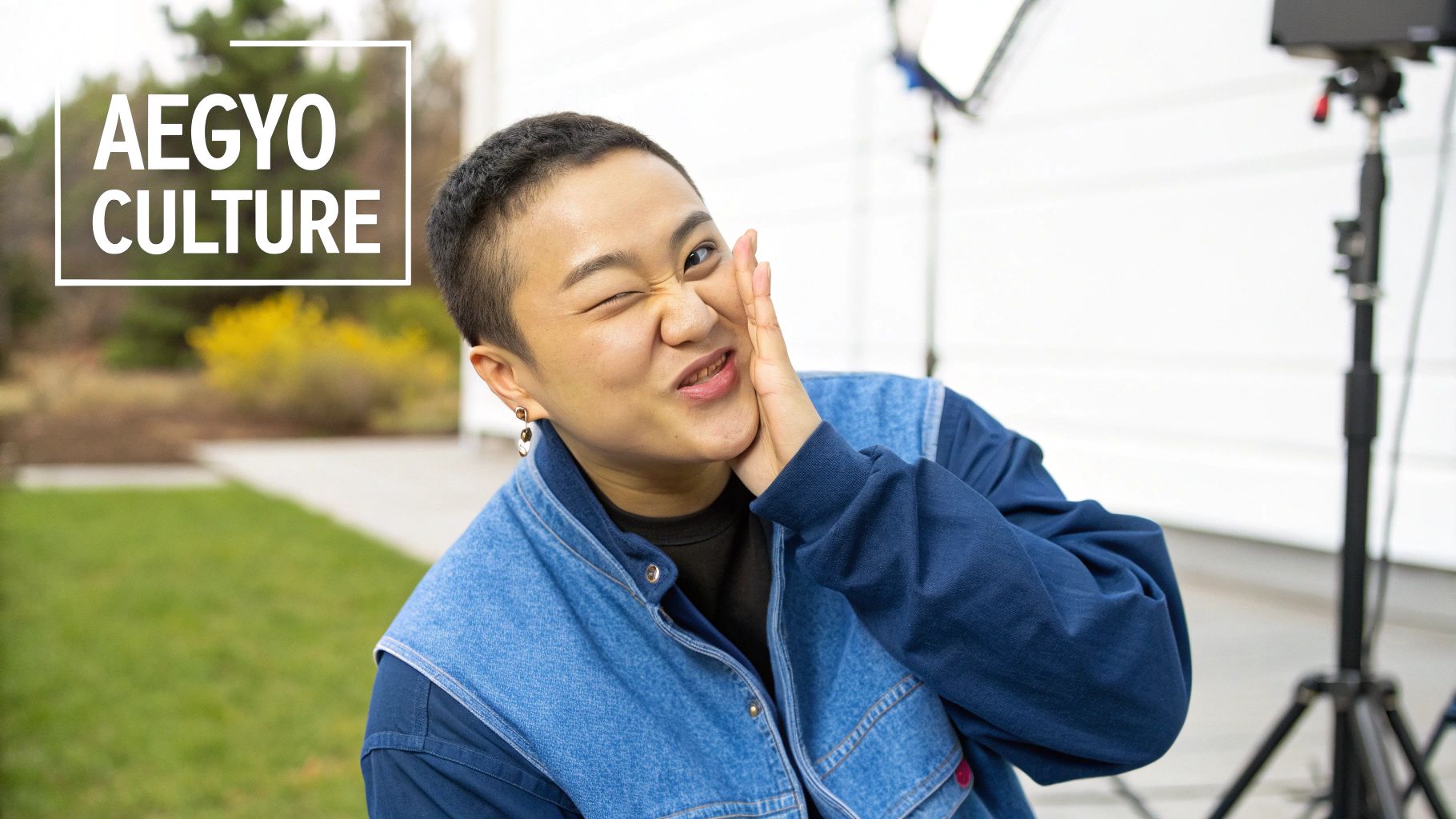
Aegyo is more than a simple smile. It's a whole package: a sweet, higher-pitched voice, playful pouts, and signature hand gestures. If you’ve ever watched a K-drama where a character tries to get a friend to buy them dinner with a sugary "pleeease?" you've seen textbook aegyo.
Aegyo in Daily Life and Pop Culture
You’ll spot aegyo all over the place in Korea. It's a common way for friends to joke around or for couples to flirt. But where it really takes center stage is in K-pop and K-dramas, where it’s a core part of an idol’s skillset and a huge driver of fan culture.
In K-pop, this unique style of cuteness shapes everything from choreography to musical concepts. This emphasis on cuteness is surprisingly powerful. In fact, a study of 782 university students found that K-culture's charm was a major factor in boosting their motivation to learn Korean. You can read more about how cuteness culture influences language learning.
The Key Elements of Aegyo
So, what does aegyo actually involve? A few classic moves and sounds are instantly recognizable.
- Vocal Tone: The voice usually goes up a notch, becoming softer and more sing-song.
- Hand Gestures: Think of the classic "V" sign by the cheek, finger hearts, or a gentle tap on someone's arm.
- Facial Expressions: Pouting lips, puffed-out cheeks, and wide, innocent eyes are all standard tools.
- Special Phrases: A common trick is adding a "~ㅇ" (-ng) sound to the end of words. For example, "오빠" (oppa) might become "오빵" (oppang).
Important Context: Aegyo is all about reading the room. It’s a huge part of entertainment but would be a major misstep in a formal business meeting. Understanding the right time and place is everything.
Why Cuteness Is a Big Deal in Korean Society
You’ve probably noticed how often the idea of "cute" comes up in Korean media. It’s not just a casual compliment—it’s a massive part of the cultural fabric. To get the hang of Korean words for 'cute', you need to understand why it’s such a big deal.
In Korea, "cute" is a genuine compliment and a desirable quality for adults. A cute look or playful manner is often seen as friendly and easy to get along with, creating a social pull towards a more youthful, endearing vibe.
Appearance as a Social Indicator
This focus on cuteness ties into the broader cultural emphasis on appearance. In modern Korea, how you present yourself is often seen as a reflection of your character. A 2015 Gallup Korea report found that an incredible 86% of people surveyed believe looks are an important part of life.
There’s a strong connection between being seen as attractive and being perceived as capable. Interviews with young Korean adults have revealed that attractiveness is often linked with positive traits like being skilled and sociable. For a deeper dive, you can check out the full research about how appearance is valued in Korea.
Cuteness as a Communication Tool
But it’s not all about looks. Acting "cute" is also a powerful way to communicate and smooth over social interactions. It can make a request sound less demanding and lighten the mood. This is where you see concepts like aegyo (애교) come into play—acting in a cute way to appear more charming.
Key Insight: When someone says "귀여워요" (gwiyeowoyo), they're often complimenting more than just your face. They could be talking about your charming personality, a sweet gesture, or your endearing way of speaking. It’s an incredibly versatile way to build a connection.
How to Give Cute Compliments Naturally
Okay, you've learned the words and the culture. Now for the fun part: putting it all into practice. Knowing how to say cute in Korean is one thing, but delivering a compliment that feels natural is the real goal.

The trick is to speak from a place of genuine appreciation. Don't just drop a word like "cute" and leave it hanging. Add a little something extra to show why you think so. A warm, excited tone makes your compliment feel so much more sincere.
Real-Life Compliment Scenarios
Let's break down how these phrases actually play out in everyday conversations.
When a friend shows up with a new haircut:
- What to say: "와, 머리 잘랐네! 너무 귀여워!" (Wa, meori jallanne! Neomu gwiyeowo!)
- Translation: "Wow, you cut your hair! It's so cute!"
- Why it works: You're being specific. You showed that you noticed the change, which makes it feel much more personal.
Reacting to a funny pet video online:
- What to say: "어떡해, 이 강아지 진짜 귀요미다!" (Eotteokhae, i gangaji jinjja gwiyomida!)
- Translation: "Oh my gosh, this puppy is such a cutie!"
- Why it works: Kicking it off with "어떡해" (eotteokhae) adds that dramatic, 'I-can't-handle-the-cuteness' feeling.
Spotting a charming item in a shop:
- What to say: "이 컵 디자인이 정말 깜찍해요." (I keop dijaini jeongmal kkamjjikhaeyo.)
- Translation: "The design of this cup is really charmingly cute."
- Why it works: Using "깜찍해요" (kkamjjikhaeyo) elevates the compliment. You're pointing out its clever, delightful charm.
How to Receive a Compliment
So, what do you do when someone calls you cute? The best response is a simple, gracious "thank you."
Polite Response: "감사합니다." (Gamsahamnida.) - "Thank you."
Casual Response: "고마워." (Gomawo.) - "Thanks."
Resist the instinct to deny the compliment. In Korea, simply accepting it with a smile is the most natural and polite way to respond. Want some real-time feedback? Consider joining a Ktalk.live class to practice with native speakers.
Common Questions About Saying Cute in Korean
As you start using these new words, a few questions are bound to pop up. Let's walk through some common sticking points so you can feel totally confident.
Can I Call a Man “Gwiyeowo” in Korean?
Yes, absolutely! While calling a grown man "cute" might be uncommon in some cultures, it's a completely normal and positive compliment in Korea. It’s often used to point out a charming personality or a sweet gesture, not just physical appearance. You’ll hear K-pop fans constantly call their favorite male idols 귀여워 (gwiyeowo).
What’s the Difference Between Gwiyeowo and Yeppeo?
This is a great question. The two words point to different kinds of beauty.
- 귀여워 (gwiyeowo) is your go-to for "cute" or "adorable." It's incredibly versatile and works for people, animals, and quirky objects.
- 예뻐 (yeppeo) translates to "pretty." This one is typically reserved for more classic, conventional beauty—think stunning actresses or beautiful flowers.
Quick Tip: If something makes you smile because it’s charming and sweet, gwiyeowo is almost always the right word. If it’s just straight-up beautiful, go with yeppeo.
Do I Have to Use Aegyo to Speak Korean?
Definitely not. It's important to see aegyo (애교) for what it is: a specific style of behavior, not a requirement of the Korean language. It's a cultural phenomenon you should be aware of, but it’s not a grammar rule you need to master. No one expects you to start acting out aegyo. Your main goal should always be clear, polite communication.
Now that you're armed with the words and cultural insights for "cute in Korean," you're ready to start connecting on a deeper level. Every word you learn brings you one step closer to confidence. Keep going—your Korean journey starts now!
🌟 Ready to start your Korean journey? Join Ktalk.live — where global learners connect, speak, and grow together! https://ktalk.live
Ready to stop reading and start speaking?
Practice what you just learned with a native Korean teacher — free for 100 minutes. No card, no commitment.