
Want to practice this with a native Korean teacher?
100-min free trial — no card required.
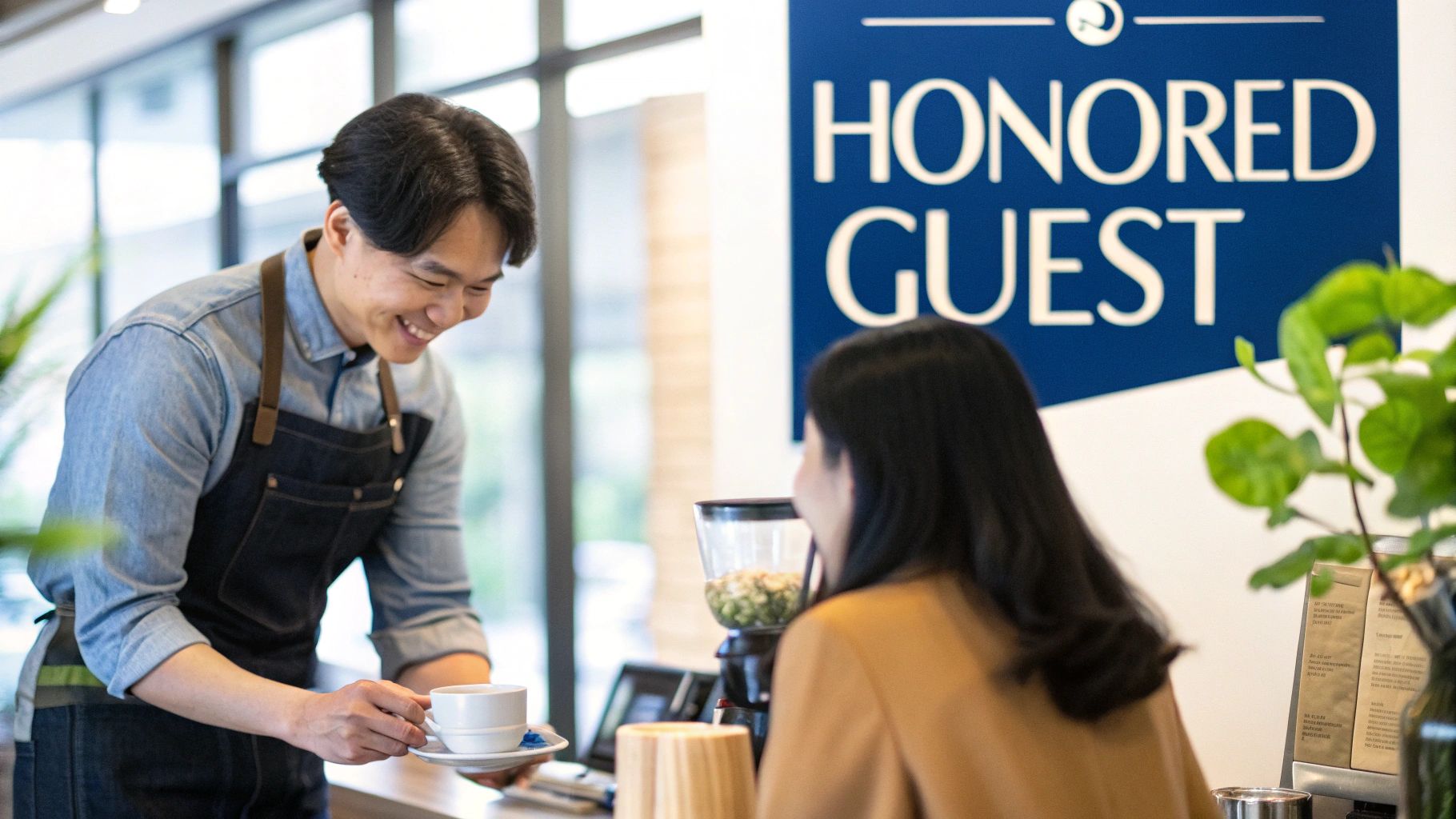
Have you ever wondered what makes customer service in Korean so unique? It's all built on a single, powerful idea: the customer is an honored guest. This principle, captured in the word Son-nim (손님), means politeness and respect aren't just extras—they're the foundation of every interaction. Understanding this cultural mindset is your first step toward communicating with confidence. Learning these key phrases and cultural norms will not only help you in stores and restaurants but also deepen your appreciation for Korean culture. Ready to dive in? Let's get started on this rewarding journey!
The Art of Service in Korean Culture
Picture walking into a busy café in Seoul. The greeting you receive isn't just a simple welcome; it's a small ceremony steeped in respect. This is the essence of Korean customer service. Every part of the experience is thoughtfully designed to make you, the customer, feel genuinely valued and at ease. This philosophy dictates everything, from the specific words chosen to the subtle gestures exchanged, creating a seamless and respectful environment.
Why Politeness Is Non-Negotiable
In Korea, your level of politeness is seen as a direct measure of your professionalism and respect. It's a bit different from some Western cultures where a casual, friendly tone is the goal. Here, formality is often the clearest signal of good service. That means using the right honorifics and polite speech levels isn't just a good idea—it's absolutely essential. Don't worry if this sounds complex; even small efforts are greatly appreciated!
This is about more than just memorizing phrases. It's about reading social cues and showing you genuinely care. This expectation is so deeply embedded that it even shapes major business decisions. For example, South Korea's Customer Relationship Management (CRM) software market is on track to hit US$1.46 billion by 2025 as companies invest heavily in respectful, personalized service. You can dig into more insights on Korea's data-driven service culture on Statista.
First Steps to Great Interactions
If you want to handle customer service in Korean well, start by focusing on these core elements:
- Shift your mindset: Think of an interaction as a chance to show respect, not just a task.
- Observe and learn: Watch how people interact in shops or restaurants. Notice the subtle bows, the use of two hands, and the consistently polite language.
- Start with the basics: Learning a few key polite phrases goes a long way. It immediately shows you respect the culture.
By truly embracing this guest-first approach, you're not just learning a language. You're starting to build real, meaningful connections.
Building Your Politeness Vocabulary
Getting the hang of customer service in Korean really comes down to knowing the right words. Think of it as building a toolkit—the more polite phrases you have, the better equipped you are for any situation. It’s all about showing respect and ensuring you’re understood. Let’s walk through the must-know greetings, requests, and expressions that form the foundation of any polite conversation in Korea.

Essential Greetings And Farewells
First impressions matter, a lot. How you greet someone can set the entire mood for your interaction.
- 안녕하세요 (Annyeonghaseyo) - This is your go-to, all-purpose Hello. It's polite and works everywhere.
- 어서 오세요 (Eoseo oseyo) - Meaning Welcome, this is what you'll almost always hear from staff the moment you step inside.
- 안녕히 가세요 (Annyeonghi gaseyo) - This means Goodbye and is what you say to someone who is leaving.
- 안녕히 계세요 (Annyeonghi gyeseyo) - This also means Goodbye, but it's for the person who is staying put. The shopkeeper will say this to you as you leave.
Nailing these simple phrases is a small gesture that shows effort and goes a long way.
Asking For Help And Making Requests
So, you need something. How do you ask without sounding demanding? Your most useful tool here is the phrase 주세요 (juseyo), which means "please give me." It’s incredibly versatile.
For example:
- 물 좀 주세요 (Mul jom juseyo) - Please give me some water.
- 메뉴판 좀 주세요 (Menyupan jom juseyo) - Please give me the menu.
When you need to get someone's attention—like a server in a busy restaurant—the perfect phrase is 저기요 (Jeogiyo). It’s the Korean equivalent of a polite "Excuse me."
Expressing Gratitude And Apologizing
A simple "thank you" can completely change the dynamic of an interaction.
감사합니다 (Gamsahamnida) is the more formal "thank you" and is your safest bet in any customer service scenario. It’s the standard for thanking staff. 고맙습니다 (Gomapseumnida) is also polite but has a slightly warmer, less formal feel.
When you're not sure, stick with 감사합니다 (Gamsahamnida).
And what if you make a small mistake? A quick, polite apology works wonders.
- 죄송합니다 (Joesonghamnida) - This is a formal I am sorry. Use this if you’ve genuinely caused an inconvenience.
- 잠시만요 (Jamsimanyo) - This literally means Just a moment, but it's often used as a soft apology when you need to squeeze past someone.
Once you have these core phrases down, you’ve built a solid foundation for handling most encounters with confidence.
Essential Customer Service Phrases at a Glance
| Hangul (Korean) | Romanization | English Meaning | When to Use It |
|---|---|---|---|
| 안녕하세요 | Annyeonghaseyo | Hello | A universal polite greeting for any situation. |
| 어서 오세요 | Eoseo oseyo | Welcome | Said by staff when you enter a business. |
| 안녕히 가세요 | Annyeonghi gaseyo | Goodbye (to someone leaving) | What you say when you are leaving a place. |
| 저기요 | Jeogiyo | Excuse me | To get the attention of a server or staff member. |
| ...주세요 | ...juseyo | Please give me... | When requesting an item, like food or a menu. |
| 감사합니다 | Gamsahamnida | Thank you | The standard, formal way to express thanks. |
| 죄송합니다 | Joesonghamnida | I am sorry | A formal apology for causing an inconvenience. |
Getting to Grips with Korean Honorifics and Speech Levels
If you want to master customer service in Korean, getting a handle on honorifics is a game-changer. Think of it like a dress code for your words. You wouldn't show up to a fancy dinner in pajamas, right? In the same way, you can’t just use casual language with a store clerk. This system is built on showing respect based on age, social standing, and your relationship with the person.
It might sound intimidating, but here’s the good news: for most customer service situations, you only really need to know two main styles. Learning to spot them and use them correctly will make every interaction go more smoothly.
The Two Speech Levels You’ll Hear Most
In Korean, the ending of a verb or adjective signals the level of politeness. For customer service, you're almost always going to hear and use the formal and the standard polite styles.
Formal Style (하십시오체 - hasipsioche): This is the top tier of politeness, heard in luxury hotels or on public announcements. You can spot it by the -ㅂ니다 (-mnida) or -습니다 (-seumnida) endings on verbs.
Polite Style (해요체 - haeyoche): This is your go-to for pretty much every other daily interaction, from buying coffee to asking for directions. It’s the perfect blend of friendly and respectful. This style uses the familiar -요 (-yo) ending.
As someone learning Korean, sticking to the polite 해요체 (haeyoche) style is your safest bet.
Key Takeaway: When in doubt, just use the -요 (-yo) ending. It’s the most common and flexible polite form and will serve you well in almost any customer service scenario.
The Magic of the Honorific Marker '-시-'
Beyond the sentence ending, Korean has another clever tool for showing respect: the honorific marker -시- (-si-). This little bit of grammar gets inserted into verbs and adjectives to show deference to the person you're speaking to. It essentially "levels up" the word itself.
For instance, the basic verb for "to go" is 가다 (gada). But when a staff member asks a customer where they are going, they’ll add -시- (-si-) to be respectful, turning it into 가시다 (gasida).
That one small change makes a huge difference. It’s like the gap between saying "What do you want?" and "What can I get for you?" in English. Getting comfortable with -시- (-si-) is a massive step towards sounding more natural and culturally fluent.
Let's see how this works with some real examples.
Side-by-Side Examples
Seeing the difference in action is the best way for it to click. Here’s how a simple sentence gets transformed into a polite one.
Example 1: "To read" (읽다 - ikda)
- Plain: 친구가 책을 읽어. (Chinguga chaeg-eul ilg-eo.) - My friend reads a book. (Informal, for a close friend)
- Honorific: 선생님께서 책을 읽으세요. (Seonsaengnimkkeseo chaeg-eul ilg-euseyo.) - The teacher reads a book. (Polite and respectful)
Did you catch that? The subject particle also changes, from -가 (-ga) to the more respectful -께서 (-kkeseo).
Example 2: "Are you okay?"
- Plain: 괜찮아? (Gwaenchanh-a?) - Are you okay? (Casual, to a buddy)
- Honorific: 괜찮으세요? (Gwaenchanh-euseyo?) - Are you alright? (Polite, to a customer or elder)
You'd likely hear this from a concerned staff member. That -으세- (-euse-) completely changes the tone from a casual check-in to a polite expression of professional concern. Nailing these nuances is exactly what our tutors at Ktalk.live focus on, helping you build real confidence for real-world chats.
How to Handle Common Service Scenarios
Alright, you've got the cultural background and key phrases down. Now, let's put it all together. The best way to get comfortable is to see how these ideas play out in the real world.
We're going to walk through a few everyday situations you’ll absolutely run into in Korea. Think of this as building muscle memory for customer service in Korean.
First, remember that different contexts require different levels of politeness. This quick diagram shows the main Korean speech levels at a glance.
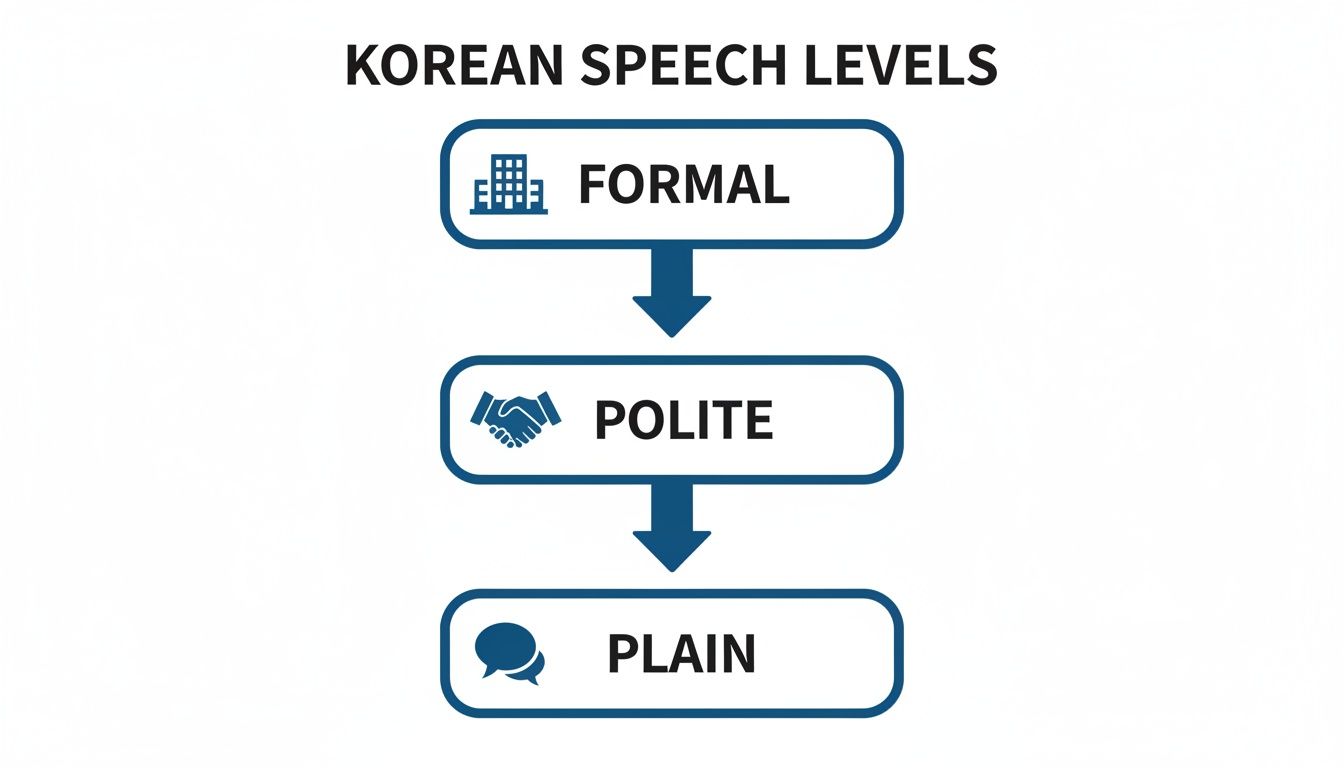
As you can see, the polite style is your best friend for most day-to-day service interactions.
Dialogue 1: Ordering at a Cafe
Picture this: you're in a busy, modern coffee shop in Seoul. Here's how a typical exchange might go.
Customer (You):
- 안녕하세요. 아이스 아메리카노 한 잔 주세요.
- (Annyeonghaseyo. Aiseu Amerikano han jan juseyo.)
- Hello. One iced Americano, please.
Barista:
- 네, 알겠습니다. 4,500원입니다.
- (Ne, algesseumnida. Sachon-obaek-won-imnida.)
- Yes, understood. That’ll be 4,500 won.
Customer (You):
- 카드로 계산할게요.
- (Kadeuro gyesanhalgeyo.)
- I’ll pay by card.
Barista:
- 감사합니다. 진동벨 받으세요.
- (Gamsahamnida. Jindongbel badeuseyo.)
- Thank you. Please take this pager.
Cultural Insight: In most Korean cafes, you order and pay at the counter right away. They'll hand you a pager (a buzzing disc) which will vibrate when your order is ready for pickup.
Dialogue 2: Shopping for Clothes
Next scenario: you're in a clothing boutique and spot something you like.
Customer (You):
- 저기요, 이거 입어봐도 될까요?
- (Jeogiyo, igeo ibeobwado doelkkayo?)
- Excuse me, may I try this on?
Staff:
- 네, 그럼요. 피팅룸은 저쪽입니다.
- (Ne, geureomyo. Pitingrumeun jeojjogimnida.)
- Yes, of course. The fitting room is over there.
Customer (You):
- (After trying it on) 이걸로 할게요.
- (Igeollo halgeyo.)
- I’ll take this one.
Staff:
- 포장해 드릴까요?
- (Pojanghae deurilkkayo?)
- Shall I wrap it up for you?
Cultural Insight: Use two hands when handing over your card or cash, and when receiving your purchase. It’s a simple, deeply ingrained sign of respect in Korean culture.
It’s also worth noting that Korea’s service scene is incredibly tech-forward. The country's Smart Customer Service System market is projected for major growth between 2025 and 2031. Korea processed a staggering 9.1 billion real-time payment transactions in 2023 alone, showing how its infrastructure is built for speed and efficiency. You can read more about South Korea's innovative customer service market on 6wresearch.com.
Practising these dialogues isn't just about memorizing lines. It's about getting used to the rhythm of real interactions.
Taking Your Skills Online: Korean Digital Etiquette
Great customer service in Korean isn’t just for face-to-face moments. It’s just as crucial in every email and chat message you type. As more interactions move online, mastering digital etiquette is key to making a fantastic impression. The core principles of respect and formality don't disappear just because you're behind a screen. Knowing how to write a polite message shows respect for the other person's time and role.
How to Write a Professional Korean Email
A standard professional email in Korea has a clean, respectful structure.
Here’s a simple framework you can use:
- A Respectful Opening: Always start by addressing the recipient formally.
- 담당자님께 (Damdangjanim-kke): To the person in charge. (A safe bet when you don't know someone's name).
- A Clear Subject Line: Keep it short and to the point.
- 주문 확인 문의 (Jumun hwagin munui): Inquiry about order confirmation.
- Introduce Yourself: Quickly say who you are.
- 안녕하세요, [Your Name]입니다. (Annyeonghaseyo, [Your Name]-imnida.): Hello, this is [Your Name].
- The Main Point: Get to your reason for writing, using clear and polite language.
- A Polite Closing: Finish with a standard closing.
- 감사합니다. (Gamsahamnida.): Thank you.
- [Your Name] 드림 (Deurim) / 올림 (Ollim): Sincerely, [Your Name].
Quick and Polite Chat Messages
Live chat is much faster, but that doesn't mean politeness goes out the window. The goal is to be clear and respectful without writing an essay.
In customer service chats, clarity and politeness are your best friends. Start with a simple greeting, state your issue, and always end with a thank you.
For instance, if you wanted to ask about a product:
- 안녕하세요. 이 제품에 대해 문의하고 싶습니다. (Annyeonghaseyo. I jepum-e daehae munuihago sipseumnida.) – Hello. I'd like to ask about this product.
- (After getting help) 네, 감사합니다! (Ne, gamsahamnida!) – Okay, thank you!
This shift to digital communication is a huge trend. Korea's Contact Center as a Service (CCaaS) market was valued at USD 145.2 million in 2024 and is projected to skyrocket to USD 492.5 million by 2030. You can dig deeper into South Korea's digital customer service growth on Grand View Research. Honing these digital communication skills on platforms like Ktalk.live is a smart way to stay ahead.
Your Path to Confident Communication
We’ve covered a lot, from the cultural view of customers as honored guests to the specific phrases you can use today. Putting it all together is your next step toward feeling truly confident and making genuine connections in Korean. Remember, the goal isn't perfection—it's progress. Don't be afraid to make mistakes; every word you learn is a victory that brings you closer to fluency. By understanding the nuances of customer service in Korean, you're not just learning a language, you're building a bridge to a deeper appreciation of the culture. Keep practicing, and you've got this!
Frequently Asked Questions
Diving into Korean customer service can feel like learning a new dance. Don't worry, we've got you covered. Here are answers to some of the most common questions to help you navigate real-life situations with grace.
What’s the Biggest Mistake Foreigners Make?
By far, the most common slip-up is accidentally using informal language, or 반말 (banmal), with staff. Even if you mean well, it can come across as disrespectful. Your safest bet is to always stick with the polite -요 (-yo) or formal -니다 (-nida) sentence endings. It’s always better to be too polite than unintentionally rude.
Another thing to watch for is non-verbal communication:
- Always use two hands when giving or receiving money, a credit card, or your shopping bag.
- A slight bow when saying thank you or sorry goes a long way.
These small actions are a huge sign of cultural respect.
Is It Okay to Bargain for Prices in South Korea?
This really depends on where you're shopping. In a department store, supermarket, or chain store, the price is fixed. Haggling just isn't done in these places.
However, if you're in a traditional market like Namdaemun in Seoul or browsing street vendors, friendly negotiation is often part of the fun. You can politely ask, "조금만 깎아주세요 (Jogeumman kkakkajuseyo)," which means "Please give me a small discount." Just remember to do it with a smile!
How Do I Get a Staff Member's Attention?
Trying to flag down a server in a busy restaurant can be a challenge. In Korea, the magic word is "저기요 (Jeogiyo)." It works just like "excuse me." Many restaurants also have a call button on the table to make things easier.
In a shop, making eye contact with a staff member and giving a small nod is often enough to signal you need help. Whatever you do, avoid big waves or snapping your fingers—these are considered quite rude. A calm and respectful approach is always the best way to go.
🌟 Ready to start your Korean journey? Join Ktalk.live — where global learners connect, speak, and grow together! You can learn more and book a free trial class at https://ktalk.live.
Ready to stop reading and start speaking?
Practice what you just learned with a native Korean teacher — free for 100 minutes. No card, no commitment.