Want to practice this with a native Korean teacher?
100-min free trial — no card required.
Starting a conversation in Korean is about more than just knowing the right words; it's about understanding the culture of respect that’s built right into the grammar. The language uses three main politeness levels—formal, standard, and informal—which change how you end your sentences based on who you're talking to. Getting a handle on this is your first real step toward sounding natural and being respectful.
Setting the Stage for Korean Conversation
Before you jump into memorising phrases, you need to get a feel for how to speak. A good conversation in Korean depends heavily on social context, much more so than in English. It's not just about what you say, but who you're saying it to.
Think of it as learning the cultural rhythm of the language. Understanding the basics of respect and sentence structure will make your first interactions much smoother and more genuine.
Understanding Korean Politeness Levels
The Korean language is built on a system of honorifics and speech levels that signal the relationship between speakers. Picking the right one is crucial for making a good impression.
- Formal (하십시오체 - hashimnikka-che): This is the most formal level you'll hear. It's reserved for things like public announcements, news broadcasts, formal business presentations, or when addressing someone of a very high social rank.
- Standard Polite (해요체 - haeyo-che): This will be your everyday go-to. It’s the safest and most versatile form, perfect for speaking with strangers, colleagues, shopkeepers, or anyone older than you. It strikes the perfect balance of respectful and friendly.
- Informal (해체 - hae-che): This casual style is only for close friends, family, and people younger than you. Be careful with this one—using it too soon can come across as rude. It's best to wait for the other person to suggest speaking more casually.
To make things a little clearer, here’s a quick reference table to help you keep these levels straight.
Essential Korean Politeness Levels at a Glance
| Speech Level | Korean Name (Romanized) | When to Use | Example Ending |
|---|---|---|---|
| Formal | 하십시오체 (hashimnikka-che) | News, military, formal presentations, public speeches | -ㅂ/습니다 (-b/seumnida) |
| Standard Polite | 해요체 (haeyo-che) | Strangers, colleagues, elders, most daily situations | -아요/어요 (-ayo/eoyo) |
| Informal | 해체 (hae-che) | Close friends, family, people younger than you | -아/어 (-a/eo) |
This table should give you a solid foundation for choosing the right tone in almost any situation you'll encounter as a learner.
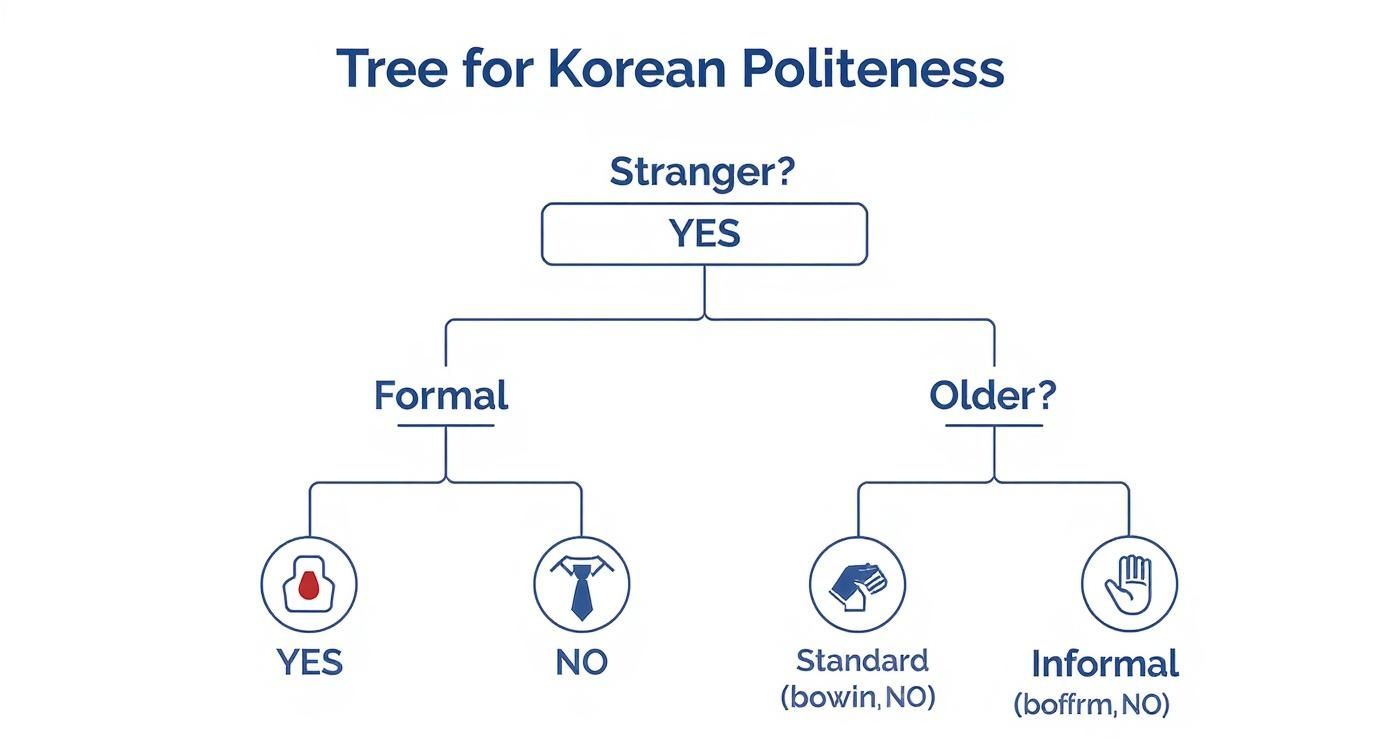
As this guide shows, it really boils down to the other person’s age and your relationship with them. When in doubt, always start polite.
The Foundation of Korean Sentences
Another big shift for English speakers is the sentence structure, which is Subject-Object-Verb (SOV). It's a fundamental difference. Instead of saying "I eat kimchi," in Korean, the structure is "I kimchi eat" (저는 김치를 먹어요 - jeoneun kimchireul meogeoyo). It takes some getting used to, but it will click with practice.
This all fits into a language with a fascinating history. Modern Korean is built on Hangul, one of the most logical writing systems ever created, and a vocabulary where about 35% of words are native Korean, 60% come from Chinese (Sino-Korean), and 5% are loanwords, mostly from English. This unique mix makes for a rich and expressive language. If you're curious, you can read more about the unique makeup of the Korean language and its heritage.
Key Takeaway: When you’re unsure which politeness level to use, just stick with the standard polite ‘-yo’ (요) ending. It’s your safety net—respectful, versatile, and perfect for almost any situation a learner will face. You can never go wrong by being too polite.
Mastering Your First Five Minutes
Those first few moments of any conversation really set the stage for everything that follows. A confident start can turn what might be a fumbling, awkward encounter into a genuinely successful conversation in Korean. The real goal here isn't just to get past "hello," but to establish a comfortable flow right from the first sentence.

Think of your opening lines as your toolkit for building instant rapport. Yes, 안녕하세요 (annyeonghaseyo) is the standard, all-purpose greeting you'll use 90% of the time. But knowing when to pull out a more formal option shows a deeper respect that Koreans truly appreciate.
For example, walking into a business meeting or addressing a respected elder, using 안녕하십니까 (annyeonghasimnikka) immediately signals a high level of politeness and cultural sensitivity. It's a small change that makes a big difference.
Making Your Introduction
Okay, you've said hello. What's next? Introducing yourself, of course. The most straightforward and effective way to do this is by stating your name and adding 입니다 (imnida), which is the formal way of saying "am/is/are."
It looks like this: 저는 [Your Name]입니다 (Jeoneun [Your Name]-imnida). Literally, "I am [Your Name]." It’s clean, polite, and there's no way it can be misunderstood.
After you've shared your name, it's only natural to ask for theirs. You have a couple of great options here:
- 성함이 어떻게 되세요? (Seonghami eotteoke doeseyo?) – "What is your name?" (This is the formal, more honorific version.)
- 이름이 뭐예요? (Ireumi mwoyeyo?) – "What's your name?" (This is standard polite and works in most daily scenarios.)
The first option uses the special honorific word for name, 성함 (seongham), instead of the standard 이름 (ireum). It's a fantastic way to show extra respect, especially if you're speaking to someone older or in a professional setting. The second one is your everyday go-to.
Pro Tip: As soon as they tell you their name, have this phrase ready: 만나서 반갑습니다 (Mannaseo bangapseumnida). It means, "It's a pleasure to meet you." This is a cornerstone of polite Korean interaction and always lands well. It shows you're engaged and happy to be speaking with them.
Building Conversational Momentum
The dreaded awkward silence after introductions is real. The easiest way to sidestep it is to have a simple follow-up question locked and loaded. Asking where someone is from is a perfect, friendly transition.
The question is: 어디에서 왔어요? (Eodieseo wasseoyo?) – "Where are you from?"
To answer it yourself, you just slot your country into a similar sentence structure: 저는 [Country]-에서 왔어요 (Jeoneun [Country]-eseo wasseoyo). For instance, "저는 영국에서 왔어요" means "I am from the UK."
Having these few key phrases down gives you a reliable script for those first few minutes. It's a simple, three-part structure—greeting, introduction, and a first question—that gives you a solid foundation. Once you get this sequence down, you'll find you can start every conversation on the right foot, which makes it so much easier to keep it going.
How to Keep the Conversation Going
Getting through the first five minutes of a conversation in Korean is a fantastic milestone, but this is exactly where many learners get stuck. Once you're past the hellos and basic introductions, what's next? How do you sidestep that dreaded awkward silence? The trick is to stop being a passive responder and start being an active driver of the conversation.

Don't worry, this doesn't mean you need to bust out complex grammar. It's all about using simple, powerful reaction words and smart follow-up questions. Think of these little phrases as conversational glue; they show you're listening, engaged, and genuinely curious about what the other person is saying.
Use Engaging Reaction Words
These are your best friends in any Korean chat. They're the equivalent of saying "Oh, really?", "Gotcha," or "Wow!" in English. These words are perfect for filling those tiny gaps in the dialogue, making everything feel much more natural and interactive. Sprinkling them in is a total game-changer.
Here are a few essential reactions to get you started:
- 아, 진짜요? (A, jinjayo?) – "Oh, really?" This one is incredibly versatile. It shows surprise and genuine interest, perfect for when someone shares something you didn't expect.
- 그렇구나 (Geureokuna) – "I see" or "So that's how it is." This is a brilliant way to acknowledge what someone's told you. It signals that you're processing their point and understand.
- 대박 (Daebak) – "Awesome!" or "Amazing!" While it started as slang, daebak is so common you'll hear it everywhere. It's the go-to reaction for any exciting or impressive news.
- 맞아요 (Majayo) – "That's right" or "I agree." A fantastic tool for building rapport. You're showing that you share their viewpoint or are confirming something they just said.
They're simple to memorise but make a huge difference in the conversational flow.
Ask Smart Follow-Up Questions
The absolute best way to keep a conversation rolling is to ask questions that invite the other person to share more. Don't just answer their questions and stop. Learn to return the serve with a question of your own. This shows you're not just waiting for your turn to talk—you're genuinely listening.
For example, if someone mentions they like hiking (등산 - deungsan), don't just nod and smile. Dig a little deeper with questions like:
- 주로 어디로 가세요? (Juro eodiro gaseyo?) – "Where do you usually go?"
- 언제부터 등산을 좋아했어요? (Eonjebuteo deungsaneul joahaesseoyo?) – "Since when have you liked hiking?"
These open-ended questions can't be answered with a simple "yes" or "no," encouraging the other person to elaborate and potentially taking the conversation in a whole new direction. They're vital for anyone wanting to sustain a meaningful conversation in Korean.
Because Korean is the sole official language for over 51 million people in South Korea, these conversational strategies work everywhere. This high level of linguistic unity means the skills you build are universally applicable across the country. You can learn more about Korean language usage and demographics on Ethnologue.com.
Key Takeaway: You're aiming for a natural back-and-forth rhythm, like a game of catch. Listen for keywords in their answers—hobbies, places, experiences—and use them as a springboard for your next question. This simple technique is what turns a stiff exchange into a real, dynamic dialogue.
Navigating Korean Cultural Cues
Holding a conversation in Korean is about more than just stringing the right words together. So much of the meaning is found in what’s not said—the body language, the unspoken rules, and the general vibe. Nailing these cultural cues is what separates a good conversation from a truly great one.
When you show you understand these social nuances, it builds instant rapport. It’s a sign of deep respect, and it helps native speakers feel much more comfortable opening up to you.
Body Language and Gestures
In Korea, how you move your body can be just as important as what you say.
The bow, for example, is a cornerstone of respect. How deep you bow says a lot. A quick nod is fine for friends, but a deeper, slower bow from the waist is what you’ll use in more formal situations or when greeting an elder.
Another huge one is using two hands. Anytime you give or receive something—a business card, a gift, even change at a store—using both hands shows politeness and sincerity. It’s a small gesture, but it communicates that you value the other person and the interaction itself.
Here’s a quick rundown of the big ones:
- Bowing: A slight head nod works for casual hellos. For anyone older or in a formal setting, you'll want to do a proper bow from the waist.
- Using Two Hands: Always, always use both hands to present or accept items. It’s a simple act of respect that goes a long way. Using one hand can come off as a bit careless or dismissive.
- Eye Contact: This can be tricky. In many Western cultures, direct eye contact shows you're engaged. In Korea, holding intense eye contact, especially with elders, can feel a little aggressive. Aim for softer, intermittent eye contact instead.
The Art of Nunchi
If there's one secret weapon for navigating Korean social life, it's nunchi (눈치). There isn't a perfect English word for it, but think of it as the subtle art of "reading the room." It's your social sixth sense—an intuitive grasp of what people are thinking and feeling so you can respond in a way that fits the situation.
Developing your nunchi means paying sharp attention to everything: body language, tone of voice, and the overall atmosphere. It's what helps you gracefully sidestep awkward moments and make your conversations feel more considerate and in sync.
Having good nunchi means you can anticipate what someone needs or avoid saying something that might make them uncomfortable. It’s a skill that Koreans really value. You’re essentially listening with your eyes just as much as your ears to get a feel for the true dynamic.
Safe and Sensitive Topics
Just like anywhere else, knowing what to talk about—and what to avoid—is key, especially when you're just getting to know someone. Your best bet is always to start with safe, positive topics to build that initial connection.
To help you get started, I've put together a quick guide on what usually works well and what you might want to steer clear of initially.
Common Conversation Topics Do's and Don'ts
| Safe Topics (Do Discuss) | Sensitive Topics (Avoid or Approach with Caution) |
|---|---|
| Food, hobbies, and travel experiences | Personal income, age (until rapport is built), and politics |
| K-pop, K-dramas, and favourite movies | Past relationships or marital status |
| Weekend plans and favourite seasons | Pointed questions about appearance or weight |
Think of this table as a helpful starting point. Of course, as you get to know someone better, some of these "sensitive" topics might become fair game. But when in doubt, stick to the safe column.
Keeping these cultural cues in your back pocket shows an awareness that goes way beyond just knowing the language. This respect for etiquette is truly the foundation of any successful conversation in Korean.
Ending the Conversation Gracefully
Just as important as a strong opening is knowing how to end a conversation smoothly. A graceful exit in Korean doesn't just show you've learned the right words; it shows you understand and respect the culture. It leaves a positive impression and keeps the door open for future chats. It's about more than just a quick annyeong; it's about picking the right phrase for the moment.

One of the first things you'll notice is that the specific farewell often depends on who is leaving and who is staying. This is a subtle but crucial distinction that immediately makes your Korean sound more natural and considerate.
Choosing the Right Farewell
So, how do you know which "goodbye" to use? Think about who is physically leaving the space. Are you walking out of a café while your friend stays, or are they the one heading out the door? Korean has a specific phrase for each situation.
- When you are leaving: The phrase you want is 안녕히 계세요 (Annyeonghi gyeseyo). It literally translates to "stay in peace." You say this to the person who is remaining behind as you depart.
- When the other person is leaving: In this case, you'll use 안녕히 가세요 (Annyeonghi gaseyo). This one means "go in peace," and you say it to the person who is on their way out.
Getting this right is one of those small details that makes a huge difference. It shows you're not just reciting from a textbook; you're actively paying attention to the social cues of the interaction.
Key Takeaway: The trick is to listen for the verb. 계세요 (gyeseyo) comes from the verb "to stay," so you say it when leaving someone who is staying. 가세요 (gaseyo) comes from "to go," so you say it to someone who is going.
Adding a Polite Closing Statement
Before you hit them with the final goodbye, it's always a nice touch to add a warm closing remark. This little addition wraps up the conversation nicely and really cements that positive impression.
A fantastic, all-purpose phrase for a new acquaintance is 만나서 반가웠습니다 (Mannaseo bangawossseumnida). It's a polite and slightly formal way of saying, "It was nice to meet you." You can't go wrong with this one.
If the vibe was a bit more casual and you genuinely enjoyed the chat, try 다음에 또 봐요 (Daeume tto bwayo). This means "See you next time" and carries a friendly, hopeful tone. It expresses a desire to meet again without being pushy, perfectly concluding a great conversation in Korean.
Common Questions About Speaking Korean
Jumping into a real Korean conversation is exciting, but it's totally normal for a few questions—and maybe some nerves—to pop up. Almost every learner hits the same roadblocks when moving from textbook knowledge to real-life chats. Let's tackle some of the most common sticking points so you can walk into your next conversation with more confidence.
Think of this as building your mental toolkit. Having these answers ready will help you handle those real-world moments with a lot more grace.
What's the Biggest Mistake Beginners Make?
Hands down, the most common slip-up is dropping into informal language, or 반말 (banmal), way too soon. In a lot of Western cultures, getting casual fast is a sign of friendship. But in Korea, if you haven't earned that right, it can come off as disrespectful. It's a big cultural tripwire.
My advice? Always, always start with the standard polite form that ends in -요 (-yo) or the more formal -ㅂ니다/습니다 (-mnida/seumnida). Keep using it until someone who's clearly your senior—in age or social standing—specifically tells you it's okay to speak more casually. It’s simply the safest and most respectful way to go.
Key Insight: Politeness is your default setting in Korean. It’s far easier to be invited to speak casually than it is to recover from the awkwardness of being too informal too early. When in doubt, just stay polite.
How Can I Practise If There Are No Native Speakers Around?
This is a massive hurdle for anyone learning outside of Korea, but thankfully, we're living in an age with incredible resources. You don't need to be in Seoul to get immersive practice.
Here are a couple of my go-to methods:
- Language Exchange Apps: I'm a big fan of platforms like HelloTalk or Tandem. They're built to connect you with native Korean speakers who are eager to learn English. You can start with texting, move on to voice notes, and even do video calls. It's a game-changer.
- Shadowing: This technique is pure gold for your pronunciation and flow. Find a short clip of a native speaker—maybe from a K-drama or a podcast—and repeat what they say, trying to match their rhythm and intonation exactly. It feels a bit silly at first, but it works wonders.
Is It Rude to Ask Someone's Age?
This is a classic cultural difference. While asking for someone's age can feel way too personal in many cultures, it's actually a very normal, and often necessary, part of getting to know someone in Korea. Why? It all comes down to figuring out which speech level and honorifics to use. It establishes the social hierarchy right away.
That said, timing is everything. It shouldn't be the very first thing you ask. Let the conversation breathe a little. Once you've exchanged names and a few pleasantries, asking 나이가 어떻게 되세요? (Naiga eotteoke doeseyo?) is completely fine and expected.
The massive global interest in Korean, fuelled by the Hallyu wave, has led to incredible support for learners. The Korean government is actively backing this trend, with around 213 King Sejong Institutes in 76 countries and a 23.6 billion won budget for instruction in over 1,800 schools worldwide. You can learn more about the global growth of the Korean language on 1stopasia.com. What this means for you is that there are more resources than ever to help you practise.
Ready to put all this knowledge into action? At K-talk Live, our live, small-group classes are designed to get you speaking from your very first day. Come see how our expert tutors can help you build the confidence for your first full conversation in Korean. Book your free 100-minute trial session at K-talk Live today!
Ready to stop reading and start speaking?
Practice what you just learned with a native Korean teacher — free for 100 minutes. No card, no commitment.