
Want to practice this with a native Korean teacher?
100-min free trial — no card required.
Ever wondered how to describe a fiery red sunset over Jeju Island or the vibrant colors of a bustling Seoul market in Korean? Learning colors in hangul is one of the most exciting first steps in your language journey. It’s like getting a new box of crayons, instantly giving you the power to paint your world with more detail and life.
Ready to add a splash of color to your Korean vocabulary? This guide will walk you through the essential Korean color words, from the basics like red and blue to their deeper cultural meanings. We'll make it simple and fun, showing you not just what the words are, but how to use them in everyday conversations. Don’t worry if it seems like a lot at first — by the end, you’ll be describing your favorite things with confidence. Every word you learn brings you one step closer to fluency!
Your Essential Korean Color Palette: The Basics
Let's start with the fundamentals. Getting a handle on the basic colors in hangul is simpler than you might think. These are the core colors you'll hear every day in conversations, see in K-dramas, and sing along to in K-pop. Mastering them builds a strong foundation for describing almost anything.
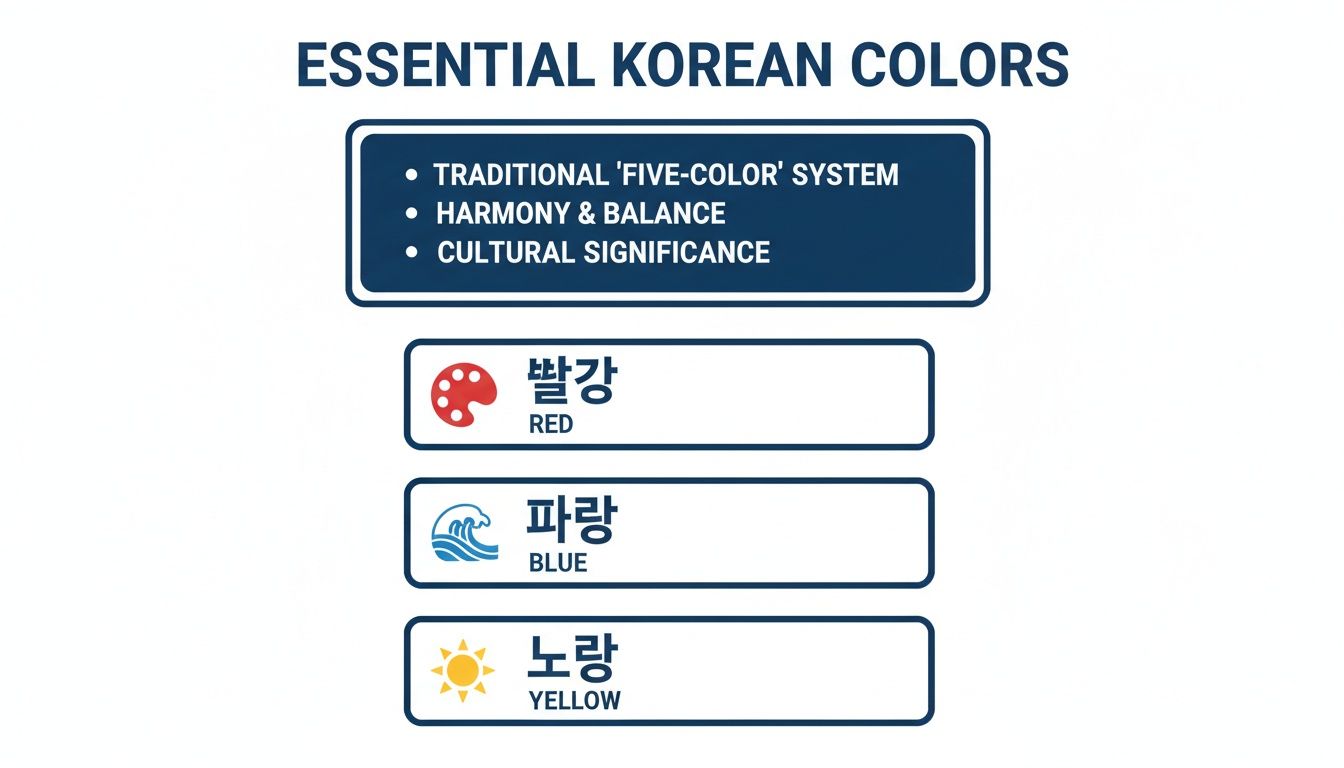
The three colors above—빨강 (red), 파랑 (blue), and 노랑 (yellow)—are absolute must-knows in the Korean language.
Core Korean Colors at a Glance
To make it easy, here’s a quick reference table with the most common colors. Focus on getting comfortable with these first, and you'll have a solid base to build on.
| English Color | Hangul (색) | Romanization | Pronunciation Tip |
|---|---|---|---|
| Red | 빨간색 | ppalgansaek | Think of a "pale gang" wearing red shirts. |
| Blue | 파란색 | paransaek | Sounds like "paran," similar to a paranormal blue ghost. |
| Yellow | 노란색 | noransaek | Imagine saying "no run" to a yellow traffic light. |
| Black | 검은색 | geomeunsaek | Sounds like "come on" into the black darkness. |
| White | 하얀색 | hayansaek | "Hayan" sounds like "high on" a white cloud. |
Once you have these five down, you're well on your way. You'll start noticing them everywhere!
Native vs. Sino-Korean: The Two Sides of Korean Colors
As you learn colors in hangul, you might notice something curious: why does a color like 'red' seem to have two different names? This isn't a mistake—it's a fascinating feature of the Korean language. Many concepts, including colors, have two sets of words: one that’s purely Korean (native) and another borrowed from Chinese characters (Sino-Korean).
Think of it like the difference between "kingly" (from Old English) and "royal" (from French) in English. They mean the same thing but are used in slightly different contexts. Native Korean words are for everyday, casual conversation.
When to Use Each Type
In your day-to-day life, you’ll almost always use native Korean color words. If you want to say "a red car," for example, you'd use the native word.
- 빨간 차 (ppalgan cha) - A red car
Sino-Korean versions pop up in more technical, academic, or artistic contexts. They have a more formal or specialized feel. For instance, 홍색 (hongsaek), the Sino-Korean word for red, is used in terms like 'infrared rays' (적외선, jeogweseon), where '적' (jeok) comes from the Sino-Korean root for red.
Key Takeaway: For everyday chats, stick with native Korean color words like 빨간색 (ppalgansaek). You’ll run into Sino-Korean words like 홍색 (hongsaek) mostly in formal settings.
A Living, Changing Palette
Like any living language, Korean is always evolving. Research shows that younger Koreans use a much wider and more specific range of color terms than older generations. They’re more likely to adopt subcategories like 'light blue' or 'yellow-green'. This shows how the Korean color palette is continually expanding, blending its deep historical roots with modern influences. You can read more about how Korean colour naming has evolved across generations.
Getting a feel for this duality is a huge step toward sounding more natural. For now, though, focus on mastering the native Korean set—it will serve you well in 99% of your daily interactions.
How to Use Colors as Adjectives in Sentences

You’ve learned the names for different colors in hangul, which is a fantastic start! Now, let's put them into action. Knowing how to say "blue" is one thing, but describing a "blue sky" is when your Korean skills really come alive.
The great news? Turning a color noun into a descriptive adjective is incredibly simple. In Korean, adjectives come before the noun they describe, just like in English, which makes the sentence structure feel familiar.
The Basic Transformation Rule
For most native Korean color words, you just add the particle -ㄴ (n) to the end of the word stem. This tiny change transforms the color into a word that can describe something else.
Here's how it works:
- Start with the color noun, like 빨강 (ppalgang), which means "red."
- Drop the final -ㅇ (ng), leaving the stem 빨가 (ppalga).
- Add the adjective particle -ㄴ (n) to that last syllable.
What you get is 빨간 (ppalgan), which means "red" as an adjective. Now you're ready to describe something!
- 빨간 + 사과 (sagwa - apple) = 빨간 사과 (a red apple)
This straightforward rule works for most basic colors and helps build confidence because it's so consistent.
Putting It All Into Practice
Once you get the hang of this rule, you can start describing countless objects around you. This is a super practical skill for everything from shopping to complimenting someone's outfit.
This table shows you how to switch a Korean color noun to its adjective form to describe everyday objects.
| Color Noun (Hangul) | Adjective Form (Hangul) | Example Sentence (Hangul and English) |
|---|---|---|
| 파랑 (parang) | 파란 (paran) | 파란 하늘을 보세요. (Paran haneureul boseyo.) - Look at the blue sky. |
| 노랑 (norang) | 노란 (noran) | 저는 노란 우산이 있어요. (Jeoneun noran usani isseoyo.) - I have a yellow umbrella. |
| 하양 (hayang) | 하얀 (hayan) | 하얀 고양이가 귀여워요. (Hayan goyangiga gwiyeowoyo.) - The white cat is cute. |
| 까망 (kkamang) | 까만 (kkaman) | 그는 까만 모자를 썼어요. (Geuneun kkaman mojareul sseosseoyo.) - He wore a black hat. |
See the pattern? It’s beautifully consistent.
Pro Tip: While this rule is perfect for native Korean colors, some colors don’t change. This is especially true for words ending in 색 (saek), like 갈색 (galsaek, brown). It stays the same: 갈색 가방 (galsaek gabang, a brown bag). You don’t need to add -ㄴ.
Mastering this simple adjective transformation is a major milestone. You're no longer just listing colors in hangul—you're using them to paint vivid pictures with your words. Try it now: describe three objects around you using this grammar!
Getting into Shades and Nuances
Once you've got the basic colors down, the real fun begins. Just like in English, Korean has a whole world of words to describe different shades and tones. Learning these is key to moving beyond sounding like a textbook and starting to sound more natural.
Was the sky just blue, or was it a pale, hazy blue? Nailing these distinctions brings your descriptions to life.
Lightening and Darkening Your Palette
Describing shades in Korean is surprisingly straightforward. You can often just add a simple prefix to a color word. The two you'll use most are *연- (yeon-)* for 'light' or 'pale' and *진- (jin-)* for 'deep' or 'dark'.
To make a color lighter, you add **연- (yeon-)**:
- 연두색 (yeondusaek) - Light green (literally "light bean color")
- 연보라색 (yeonborasaek) - Light purple, or lavender
To make a color darker or more intense, you add **진- (jin-)**:
- 진홍색 (jinhongsaek) - Deep red, or crimson
- 진녹색 (jinnoksaek) - Dark green
Another common way to say 'dark' is with the adjective 진한 (jinhan). You just place it before the full color name.
For example, a dark blue shirt would be a 진한 파란색 셔츠 (jinhan paransaek syeocheu).
The Curious Case of Blue and Green
Here's one of the most fascinating things about Korean colors: the way the language handles the blue-green spectrum. Historically, the single term 푸르다 (pureuda) could cover both blue and green.
This nuance has left its mark on the modern language. Research has shown that Korean speakers categorise the blue-green spectrum with a surprisingly large number of specific terms. Words like 하늘색 (haneulsaek, sky blue) and 연두색 (yeondusaek, light green) are treated as distinct color categories.
This little insight is more than just a vocabulary lesson—it’s a peek into how language shapes the way we see the world.
The Cultural Meaning Behind Korean Colors
Learning the colors in hangul is about more than matching words to swatches; it’s a ticket to seeing Korea through a new lens. In Korea, colors are steeped in symbolism, carrying centuries of history you’ll find in everything from clothes to food. This deep connection helps you understand the why behind what you see.
Obangsaek: The Five Cardinal Colors
At the heart of Korean color theory is 오방색 (Obangsaek), the five traditional cardinal colors. This concept is rooted in the philosophy of the five elements and directions.
- Blue (파랑, parang): East, wood, and spring. It represents new beginnings and hope.
- Red (빨강, ppalgang): South, fire, and summer. It signifies passion and good fortune.
- Yellow (노랑, norang): Center and Earth. Historically, it was a noble color reserved for royalty.
- White (하양, hayang): West, metal, and autumn. It stands for purity, truth, and is also the traditional color of mourning.
- Black (검정, geomjeong): North, water, and winter. It represents wisdom and formality.
You’ll spot these five colors everywhere, from a traditional hanbok (한복) to the arrangement of food. Together, they represent a desire for harmony with the universe.
Color Preferences and Modern Meanings
Culture doesn't stand still. While Obangsaek is influential, modern tastes have also emerged. A nationwide survey found that blue is the overwhelming favorite in Korea today. The same survey revealed that purple and brown are among the least-liked colors. If you're curious, you can dig into the Korean colour preference survey findings.
By understanding both ancient symbolism and modern preferences, you'll gain a much richer, more nuanced view of Korean culture.
Wrapping Up Your Korean Color Journey
And there you have it! You've journeyed through the vibrant spectrum of colors in Korean, from the basics to the subtle meanings woven into the culture. This is more than just memorizing words; it's about gaining new tools to describe the world and connect with Korea on a deeper level.
Every color word you’ve learned is a new shade you can use to paint a more vivid picture with your language skills. Keep your eyes open and try describing the things you see every day in Korean. Every time you point out a 빨간 사과 (a red apple), you’re taking one more step towards fluency. What matters most is progress, so keep going — your Korean journey is just getting started!
🌟 Ready to start your Korean journey? Join Ktalk.live — where global learners connect, speak, and grow together! https://ktalk.live
Ready to stop reading and start speaking?
Practice what you just learned with a native Korean teacher — free for 100 minutes. No card, no commitment.