Want to practice this with a native Korean teacher?
100-min free trial — no card required.
Ever found yourself trying to say "book" in Korean and pausing for a second? It’s a classic little trip-up for learners. If you’re talking about the kind of book you read, the word is a straightforward 책 (chaek). But if you mean you want to book a table or a ticket, you'll need a verb like 예약하다 (yeyakada). Nailing this difference is a game-changer!
Learning how to say book in Korean is like getting a key that unlocks two very different doors. One leads to the world of literature and study, letting you talk about your favourite novels. The other opens up the practical world of daily life in Korea, helping you reserve a spot at that popular restaurant in Seoul you've been dying to try.
This guide will walk you through both meanings with simple examples, pronunciation tips, and real-world dialogues. By the time you’re done, you'll know exactly which word to use when, making your Korean sound much more natural and confident. Every word you learn brings you one step closer to fluency. Let's get started!
Talking About a Book You Can Hold and Read
Let's start with the basics. When you're talking about a physical book—the kind you can flip through and put on a shelf—the Korean word you need is 책 (chaek). This is the noun for "book," and it’s one of the most fundamental words you'll learn.
Getting the pronunciation right is your first step. It's not quite like the English "check." Think of the "ch" sound in "chair," but let out a little puff of air. The vowel is like the "e" in "egg," and the final "k" sound is short and sharp. You don't release the sound with a breath; you just stop it cleanly. All together, it's a quick, crisp sound: chaek.
Putting 'Chaek' into Action
Once you've got the sound down, using 책 (chaek) in a sentence is pretty intuitive. You'll pair it with different verbs, just like you would in English, to talk about reading, buying, or enjoying a book.
Here are a few common examples you’ll hear all the time:
To read a book
- Korean: 책을 읽다 (chaek-eul ikda)
- Breakdown: Here, 책 (chaek) is the book, 을 (eul) is a particle marking it as the object of the action, and 읽다 (ikda) is the verb "to read."
To buy a book
- Korean: 책을 사다 (chaek-eul sada)
- Breakdown: Same structure, just with the verb 사다 (sada), which means "to buy."
This book is interesting
- Korean: 이 책은 재미있어요 (i chaek-eun jaemi-isseoyo)
- Breakdown: 이 (i) means "this," and 재미있어요 (jaemi-isseoyo) is the polite way to say something "is interesting."
These simple phrases are the foundation for so much more. You can use them to talk about your hobbies, what you’re studying, or simply what you did over the weekend.
A Quick Word on Particles: The little marker after 책 (chaek) is crucial. It changes depending on what the book is doing in the sentence. Use 을/를 (eul/reul) when something is being done to the book (like reading or buying it). Use 이/가 (i/ga) when the book is the one doing something (like being interesting). Nailing this difference will make your Korean sound much more natural.
From Paperbacks to Pixels: Modern Types of Books
Just like everywhere else, how people read in Korea has changed with technology. The language has kept up, and knowing these modern terms will help you sound current.
Here are a few key variations you should know:
- E-book: 전자책 (jeonja-chaek)
- This is a simple combination of 전자 (jeonja), meaning "electronic," and our word 책 (chaek). Easy!
- Audiobook: 오디오북 (odio-buk)
- This one’s even easier—it's a direct loanword from English, so it sounds almost identical.
- Comic Book: 만화책 (manhwa-chaek)
- You might already know 만화 (manhwa), the Korean word for comics (including webtoons). Just add 책 to the end to specify a physical comic book.
By getting comfortable with 책 (chaek) and its modern cousins, you're doing more than just memorising vocabulary. You're opening the door to conversations about everything from classic Korean literature to the latest hit webtoon.
Getting to Grips With Verbs for Booking and Reserving
Alright, we’ve covered the noun book in Korean, 책 (chaek). Now, let’s tackle the action of booking something, which is where things get interesting for Korean learners. Don't worry, it's not as tricky as it seems once you understand the two key verbs: 예약하다 (yeyakada) and 예매하다 (yemaehada).
Let's break it down with a simple analogy.
Think of 예약하다 (yeyakada) as "reserving" or "making a reservation." You're essentially holding a spot, a service, or a block of time. You're booking a table at a restaurant, an appointment with a doctor, or a hotel room.
On the flip side, 예매하다 (yemaehada) is all about "purchasing in advance," specifically tickets. This is for when you're buying a seat for an event or transport, like a concert, a movie, or a flight. It implies a pre-purchase for access.
This quick decision tree can help you visualise which path to take.
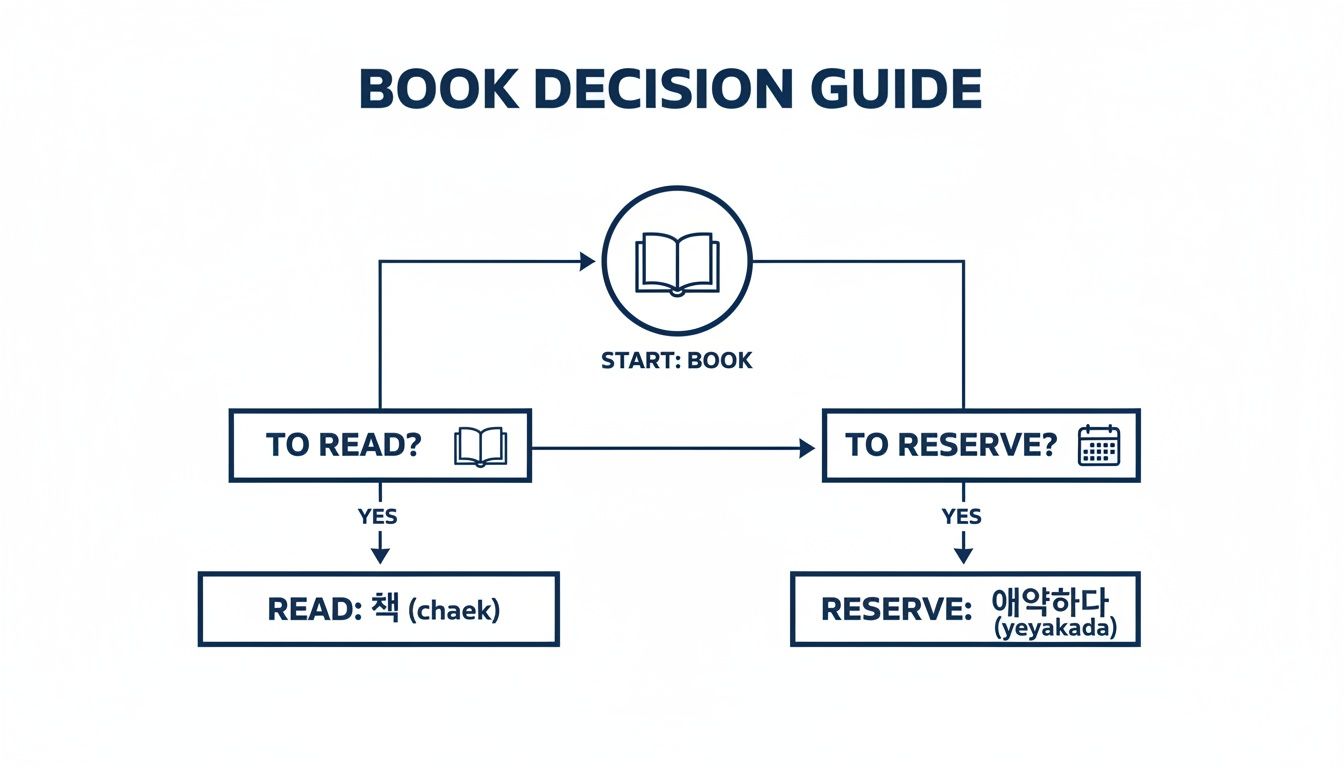
As you can see, the first question is whether you mean a physical book to read (책) or an action. If it’s an action, you then decide if it’s a general reservation (예약하다) or an advance ticket purchase (예매하다).
예약하다 vs 예매하다: When to Use Which Verb
To make it crystal clear, let's look at some common, real-world situations. This table lays out exactly when to use each verb, so you can pick the right one every time.
| Scenario | Correct Verb | Example Sentence (Korean & English) |
|---|---|---|
| Getting a table at a restaurant | 예약하다 (yeyakada) | 식당을 예약했어요. (sikdang-eul yeyak-haesseoyo.) I reserved a restaurant. |
| Buying movie tickets online | 예매하다 (yemaehada) | 영화표를 예매했어요. (yeonghwapyo-reul yemae-haesseoyo.) I bought movie tickets in advance. |
| Booking a hotel for your holiday | 예약하다 (yeyakada) | 호텔을 예약해야 해요. (hotel-eul yeyak-haeya haeyo.) I have to book a hotel. |
| Getting tickets for a K-pop concert | 예매하다 (yemaehada) | 콘서트 티켓을 예매할 거예요. (konseoteu tiket-eul yemae-hal geoyeyo.) I'm going to buy concert tickets. |
| Scheduling a doctor's appointment | 예약하다 (yeyakada) | 병원 예약했어요? (byeongwon yeyak-haesseoyo?) Did you book a doctor's appointment? |
| Purchasing your flight ticket | 예매하다 (yemaehada) | 비행기 표를 예매했어요. (bihaenggi pyo-reul yemae-haesseoyo.) I purchased a flight ticket. |
At a glance, you can see the pattern: 예약하다 is for appointments and spaces, while 예매하다 is almost always about buying a ticket (표/티켓).
A Closer Look: When to Use 예약하다 (yeyakada)
예약하다 (yeyakada) is your bread-and-butter verb for most reservations. It's incredibly versatile and is the one you’ll probably use most often in day-to-day life in Korea.
You'll reach for 예약하다 when you are:
- Reserving a restaurant table: 식당을 예약하다 (sikdang-eul yeyakada)
- Booking a hotel room: 호텔을 예약하다 (hotel-eul yeyakada)
- Scheduling a doctor's appointment: 병원을 예약하다 (byeongwon-eul yeyakada)
- Making a hair salon appointment: 미용실을 예약하다 (miyongsil-eul yeyakada)
In all these cases, you're holding your place. Even if a deposit is involved, the core action is about securing the service or time slot, not buying a physical ticket.
For instance, to book a table for two people at 7 PM, you'd say:
- Korean: 7시에 두 명 예약하고 싶어요. (ilgop-si-e du myeong yeyakago sipeoyo.)
- English: I’d like to book for two people at 7 o'clock.
A Closer Look: When to Use 예매하다 (yemaehada)
Now for 예매하다 (yemaehada). This one is more specialised. You use it when you're actually purchasing a ticket ahead of time for a specific event, performance, or journey. The act of pre-purchasing is the key.
Use 예매하다 in these scenarios:
- Buying movie tickets: 영화표를 예매하다 (yeonghwapyo-reul yemaehada)
- Purchasing concert tickets: 콘서트 티켓을 예매하다 (konseoteu tiket-eul yemaehada)
- Booking a flight ticket: 비행기표를 예매하다 (bihaenggipyo-reul yemaehada)
- Buying a train ticket: 기차표를 예매하다 (gichapyo-reul yemaehada)
Pro Tip: A fantastic little trick is to look for the word "ticket"—표 (pyo) or 티켓 (tiket). If you see one of those, you're almost certainly going to use 예매하다. It's a reliable clue that you're on the right track!
Imagine you've just snagged tickets for the hottest new movie. You'd tell your friend:
- Korean: 영화표 두 장 예매했어요. (yeonghwapyo du jang yemaehaesseoyo.)
- English: I bought two movie tickets in advance.
Getting the hang of these two verbs will make your Korean sound much more authentic and precise. With a bit of practice, knowing the right way to say book in Korean will become second nature.
And what better way to practise than in a real conversation? To build real-world confidence, try using these phrases with a native speaker by joining a free trial class at K-talk Live.
Practical Dialogues for Booking Things in Korea
Okay, you've got the theory down. You know the difference between 예약하다 (yeyakada) and 예매하다 (yemaehada), which is a huge step. But theory only gets you so far, right? Let's put this knowledge into practice so you can actually feel confident when you need to book something in Korean.
The best way to make these words stick is to see them in action. We'll walk through three super common situations you’ll definitely run into, whether you're visiting Korea or living here.
We'll cover booking a restaurant table, checking into a hotel, and buying movie tickets. As you read, pay attention to the key phrases and the natural, polite flow of the conversation.
Dialogue 1: Reserving a Restaurant Table
First up, a classic phone call to a popular restaurant. Since you're reserving a space and a service, the magic word here is 예약하다 (yeyakada).
식당 (Sikdang - Restaurant Staff): 안녕하세요, K-BBQ입니다. 무엇을 도와드릴까요?
- Annyeonghaseyo, K-BBQ-imnida. Mueoseul dowadeurilkkayo?
- Hello, this is K-BBQ. How may I help you?
손님 (Son-nim - Customer): 네, 오늘 저녁 예약하고 싶은데요.
- Ne, oneul jeonyeok yeyakago sipeundeyo.
- Yes, I'd like to make a reservation for this evening.
식당 (Sikdang): 몇 분이세요?
- Myeot bun-iseyo?
- For how many people?
손님 (Son-nim): 세 명이요.
- Se myeong-iyo.
- For three people.
식당 (Sikdang): 성함과 연락처를 알려주시겠어요?
- Seongham-gwa yeollakcheo-reul allyeojusigesseoyo?
- Could I have your name and contact number?
손님 (Son-nim): 이름은 김민준이고, 번호는 010-1234-5678입니다.
- Ireum-eun Kim Minjun-igo, beonho-neun 010-1234-5678-imnida.
- The name is Kim Minjun, and the number is 010-1234-5678.
Key Takeaway: The phrase 예약하고 싶어요 (yeyakago sipeoyo), meaning "I want to reserve," is your golden ticket. It's polite, direct, and gets straight to the point.
Dialogue 2: Checking In at a Hotel
Just like with a restaurant, securing a hotel room uses 예약하다 (yeyakada). This is a typical conversation you’d have at the front desk when you arrive to check in.
호텔 직원 (Hotel Jikwon - Hotel Staff): 안녕하세요, 체크인하시겠어요?
- Annyeonghaseyo, chekeu-in-hasigesseoyo?
- Hello, are you checking in?
투숙객 (Tusukgaek - Guest): 네, 어제 예약했어요.
- Ne, eoje yeyak-haesseoyo.
- Yes, I made a reservation yesterday.
호텔 직원 (Hotel Jikwon): 예약하신 성함이 어떻게 되세요?
- Yeyak-hasin seongham-i eotteoke doeseyo?*
- What is the name on the reservation?
투숙객 (Tusukgaek): 박서준입니다.
- Park Seojun-imnida.
- It's Park Seojun.
Dialogue 3: Buying Movie Tickets
Now for our other key verb! Since you're purchasing a ticket in advance, you’ll need 예매하다 (yemaehada). Imagine you're at the cinema box office.
직원 (Jikwon - Staff): 어서 오세요. 어떤 영화를 예매하시겠어요?
- Eoseo oseyo. Eotteon yeonghwa-reul yemae-hasigesseoyo?
- Welcome. Which movie would you like to buy tickets for?
고객 (Gogaek - Customer): '부산행' 두 장 주세요.
- ‘Busanhaeng’ du jang juseyo.
- Two tickets for 'Train to Busan,' please.
직원 (Jikwon): 네, 좌석은 어디로 하시겠어요?
- Ne, jwaseog-eun eodiro hasigesseoyo?
- Okay, where would you like to sit?
Running through these dialogues a few times will really help cement the concepts in your mind and get you ready for the real world. If you want to take it to the next level, why not try practising with a native tutor? You can join a free trial class at K-talk Live and build your speaking confidence from day one.
How Korean Books Connect You to the Culture
Learning the word for a book in Korean—책 (chaek)—is your first step. But it's so much more than a new vocabulary word. Think of it as a key that unlocks a hidden door into the very heart of Korean society. Reading stories, poems, and essays in their native language gives you a perspective that even the best translations can't quite replicate.
When you pick up a book in Korean, you're hearing the language as the author intended. You get the real rhythm, the clever wordplay, and the cultural quirks that are often lost in translation. This is where you'll find the subtle humour, sharp social critiques, and deeply felt emotions that define the Korean experience, making your learning journey feel so much more authentic and rewarding.
A Nation of Readers and Writers
The love for books in Korea is more than just a feeling; it's a massive, buzzing industry. The country is a cultural and economic powerhouse in publishing, home to a staggering 38,170 publishers. This incredible creative output is supported by thousands of bookstores and hundreds of public libraries, creating a rich network for readers everywhere. If you're curious, you can dive deeper with this in-depth look at Korea's publishing market.
This thriving literary world means there's a Korean book out there for absolutely everyone. Whether you're into moving poetry, incisive contemporary fiction, or even highly specific technical manuals, you'll find it. The shifting popularity of genres also paints a fascinating picture of modern Korean society—what people are thinking about, dreaming of, and talking about right now.
Reading is a conversation with the past and present of a culture. By picking up a book in its original language, you’re not just a spectator; you're an active participant in that ongoing dialogue.
Books as Your Motivation
Let's be real: staying motivated is half the battle when learning a new language. Diving into Korean literature gives you a powerful and genuinely inspiring goal to work towards. Every grammar rule you finally get, every new word that sticks, brings you that much closer to enjoying a novel by an author like Han Kang or a collection of essays from a writer everyone's talking about.
Think of it as a ladder. Your first step might be a simple children's story. Next, you could tackle a popular webtoon, and before you know it, you're completely absorbed in a bestselling novel. This natural progression gives your studies a clear and exciting purpose. It turns the hard work of learning into an adventure where the prize is a real, meaningful connection to Korean culture.
Common Mistakes to Avoid When Talking About Books
Let's be real, every language learner stumbles. Mistakes are just part of the game on the road to getting fluent. When you're learning how to talk about a book in Korean, a few classic trip-ups always seem to appear. But don't worry—with a little heads-up, you can sidestep them easily.
Think of this as your cheat sheet for sounding more natural. Knowing these common errors will make your Korean sound sharper and more authentic, whether you’re talking about a book in Korean or booking a table for dinner.
Confusing 예약하다 with 예매하다
This is probably the number one mix-up for learners. Both 예약하다 (yeyakada) and 예매하다 (yemaehada) translate to "to book," but they aren't twins. Using the wrong one can throw a wrench in your conversation and leave people scratching their heads.
Here's a quick and dirty way to get it right:
- Don't say: 식당을 예매했어요. (Sikdang-eul yemae-haesseoyo.)
- This sounds like you're trying to buy a ticket for a restaurant, which is a bit odd.
- Do say: 식당을 예약했어요. (Sikdang-eul yeyak-haesseoyo.)
- Perfect. You've just reserved a table.
Remember the Rule: Think about what you're getting. If a physical or digital ticket is involved (like for a movie, concert, or flight), you need 예매하다. For just about everything else where you're holding a spot (restaurants, hotels, doctor's appointments), 예약하다 is your go-to.
Mispronouncing 책 (chaek)
Another easy-to-make mistake is the pronunciation of 책 (chaek). For a lot of English speakers, it comes out sounding like "check." The Korean sound, however, has a bit more punch to it—a little puff of air that makes all the difference.
To nail it, think of the "ch" sound in "chair," but really push a burst of air out as you say it. The final "k" sound is also key; it should be sharp and cut off abruptly. Your tongue hits the roof of your mouth and just stops the sound cold, without any extra breathiness. A little practice, and you'll get that crisp, clean finish.
Using the Wrong Particles
Finally, let's talk about particles. These tiny grammatical connectors are the glue of Korean sentences, and using the right one is crucial for sounding natural. When you're doing something to an object, like reading a book, you have to use the object marker 을/를 (eul/reul).
- Incorrect: 책 이 읽어요. (Chaek-i ilgeoyo.)
- Correct: 책을 읽어요. (Chaek-eul ilgeoyo.)
Dodging these common mistakes will make a massive difference in how fluent you sound. It might feel clunky at first, but with a bit of practice, picking the right word and nailing the pronunciation will start to feel like second nature.
Your Korean Journey Starts Now
You’ve just tackled a really common point of confusion for Korean learners. Getting the hang of 책 (chaek) versus the booking verbs 예약하다 (yeyakada) and 예매하다 (yemaehada) is a huge step. It’s the kind of practical knowledge that takes you from just knowing words to actually using the language in the real world.
Every little distinction you master, like this one, is a solid brick in your fluency wall. So stay curious, keep practising, and don't be shy about trying out these new phrases. The fastest way to make it all stick is to start speaking. Nothing builds confidence like a real conversation. Getting a chance to chat with native tutors who can gently correct you and cheer you on can make all the difference.
Remember, every word you learn brings you one step closer to confidence. Keep going—your Korean journey starts now!
🌟 Ready to start your Korean journey? Join Ktalk.live — where global learners connect, speak, and grow together! Sign up for a free trial class today!
Ready to stop reading and start speaking?
Practice what you just learned with a native Korean teacher — free for 100 minutes. No card, no commitment.