
Want to practice this with a native Korean teacher?
100-min free trial — no card required.
Learning Korean might seem challenging at first, but what if you could start speaking from day one? The secret isn’t memorizing a giant dictionary; it's mastering the essential building blocks of everyday conversation. This guide is designed to give you exactly that, focusing on the most crucial basic words Korean learners need to feel confident. We'll break down the foundational vocabulary that will help you navigate simple interactions and connect with the culture on a much deeper level.
Forget overwhelming lists. These are the words you’ll hear on the streets of Seoul and in your favorite K-dramas. By the end of this article, you will have a solid vocabulary base, empowering you to start your language journey with a strong first step. Ready to build your confidence, one word at a time? Let’s begin!
1. 안녕하세요 (Annyeonghaseyo) - Hello
If there’s one phrase that unlocks all Korean conversations, it’s 안녕하세요 (Annyeonghaseyo). This is arguably the most essential of all basic words Korean learners will encounter. It's the standard, polite way to say "Hello" and is perfect for almost any situation, whether you're greeting a shopkeeper, meeting someone for the first time, or addressing an elder.

This phrase literally translates to "Are you at peace?", which beautifully reflects the respect embedded in Korean culture. While it’s primarily a greeting, it can also be used as a polite "Goodbye" when leaving a formal setting like an office or store.
Practical Tips for 안녕하세요 (Annyeonghaseyo)
- When to Use: Use it when entering a restaurant, meeting a teacher, or greeting colleagues. It's your go-to for anyone you don't know well or who is older than you.
- Example Sentence: 안녕하세요, 어떻게 도와드릴까요? (Annyeonghaseyo, eotteoke dowadeurilkkayo?) - "Hello, how may I help you?"
- Pro Tip: For extra respect, pair your greeting with a slight nod or a small bow. This simple gesture shows sincerity and will make a great first impression.
2. 감사합니다 (Gamsahamnida) - Thank You
Just as important as a polite greeting is a sincere expression of gratitude. 감사합니다 (Gamsahamnida) is the cornerstone of showing thanks in Korean. As one of the most fundamental basic words Korean learners should master, this formal and respectful phrase is essential for nearly all social interactions. Using it correctly shows politeness and helps you build positive connections.

This phrase is the standard polite form for "Thank you" and is appropriate for showing respect to elders, strangers, and people in professional settings. In a culture that values mutual respect, knowing when to say 감사합니다 (Gamsahamnida) is crucial.
Practical Tips for 감사합니다 (Gamsahamnida)
- When to Use: Use it when a waiter brings your food, a cashier hands you change, or a staff member assists you.
- Example Sentence: 도움을 주셔서 감사합니다 (Dowmeul jusyeoseo gamsahamnida) - "Thank you for your help."
- Pro Tip: For a more casual (but still polite) "thanks" with friends, you can use 고마워요 (gomawoyo). For very close friends, a simple 고마워 (gomawo) is common.
3. 네 (Ne) / 아니요 (Aniyo) - Yes / No
Knowing how to agree and disagree is fundamental. In Korean, 네 (Ne) means "Yes," and 아니요 (Aniyo) means "No." These two simple words are among the most frequently used basic words Korean learners will encounter. Mastering them is a critical step toward having a natural conversation.

While 네 (Ne) is a direct "Yes," it's also used to say "I see," or "Okay," showing you are listening. 아니요 (Aniyo) is the standard polite way to decline an offer or correct a misunderstanding gracefully.
Practical Tips for 네 (Ne) and 아니요 (Aniyo)
- When to Use: Use them to answer questions, confirm information, or politely decline an offer.
- Example Sentences:
- 한국어를 배우고 있어요? (Hangugeo-reul baeugo isseoyo?) - "Are you learning Korean?" / 네! (Ne!) - "Yes!"
- 아니요, 괜찮습니다 (Aniyo, gwaenchanseumnida) - "No, I'm fine."
- Pro Tip: To soften a "No," pair it with gratitude. Saying 아니요, 감사합니다 (Aniyo, gamsahamnida) — "No, thank you" — shows appreciation even while refusing.
4. 물 (Mul) / 음식 (Eumsik) - Water / Food
Food is at the heart of Korean culture, making these nouns absolutely essential. 물 (Mul) means "water" and 음식 (Eumsik) is the general term for "food." These are practical, high-frequency words you will use every single day, whether you're dining out, feeling thirsty, or just making conversation.
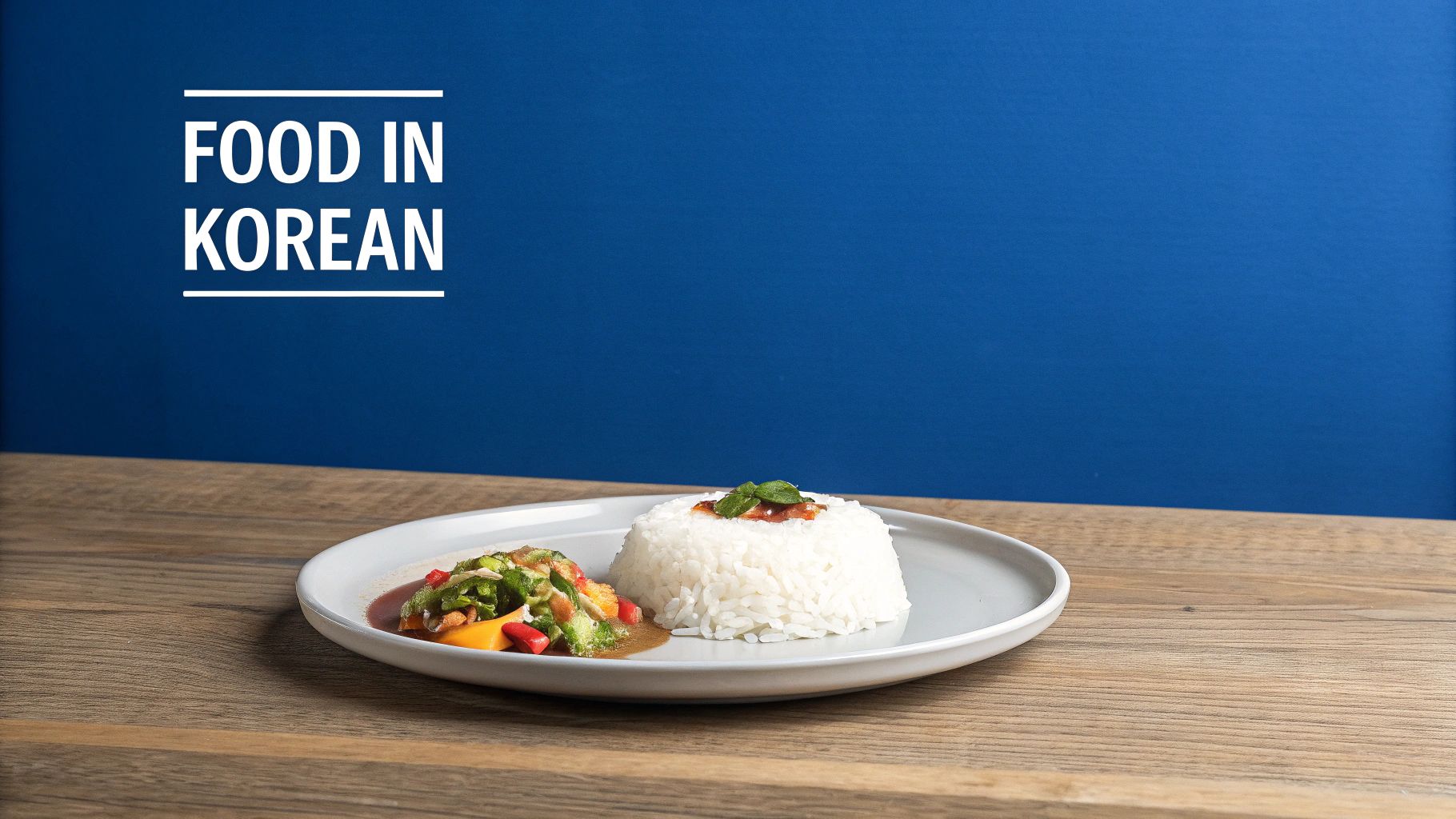
From ordering in a bustling Seoul market to discussing your favorite meal, these words are your gateway to countless culinary conversations. Mastering them will immediately improve your ability to navigate social and dining situations.
Practical Tips for 물 (Mul) and 음식 (Eumsik)
- When to Use: Use them when ordering at a restaurant, expressing a need, or discussing your preferences.
- Example Sentences:
- 물 한 잔 주세요 (Mul han jjan juseyo) - "One glass of water, please."
- 이 식당은 음식이 맛있어요 (I sikdang-eun eumsig-i masisseoyo) - "This restaurant's food is delicious."
- Pro Tip: Expand your vocabulary by combining 음식 (Eumsik) with country names. For example, 이탈리아 음식 (Itallia eumsik) is "Italian food."
5. 사람 (Saram) / 집 (Jip) - Person / Home
To build meaningful sentences, you need core nouns like 사람 (Saram), meaning "person," and 집 (Jip), meaning "home." These words are essential for describing individuals, talking about groups, giving directions, or planning to visit a friend. They are foundational blocks for conversations about daily life.
Whether you’re pointing someone out or describing where you live, these words will be at the heart of the conversation. They are incredibly versatile and serve as anchors for countless personal sentences.
Practical Tips for 사람 (Saram) and 집 (Jip)
- When to Use: Use them to describe people, talk about locations, or make social plans.
- Example Sentences:
- 저 사람은 좋은 사람이에요 (Jeo saram-eun jo-eun saram-i-eyo) - "That person is a good person."
- 지금 집에 있어요 (Jigeum jibe isseoyo) - "I am at home now."
- Pro Tip: The plural of 사람 (Saram) is 사람들 (saramdeul), which means "people." It's a useful distinction when talking about a group.
6. 시간 (Sigan) / 좋다 (Johta) - Time / Good
Understanding how to talk about time and express opinions is fundamental. 시간 (Sigan) means "time" or "hour," and it's essential for scheduling meetings or asking for the current time. 좋다 (Johta) is a powerhouse word meaning "good" or "to be good," perfect for sharing your preferences.
Mastering 시간 (Sigan) helps you organize your day, while 좋다 (Johta) allows you to express positive feelings about everything from food to films. Both are crucial for practical, everyday conversations.
Practical Tips for 시간 (Sigan) and 좋다 (Johta)
- When to Use: Use them for telling time, scheduling plans, describing quality, and giving positive feedback.
- Example Sentences:
- 3시에 만나요 (Se si-e mannayo) - "Let's meet at 3 o'clock."
- 이 책은 좋아요 (I chaeg-eun joayo) - "This book is good."
- Pro Tip: Be careful with grammar! To say you like something, use the verb 좋아하다 (joahada). For example: 한국 음식을 좋아해요 (Han-guk eumsig-eul joahaeyo) - "I like Korean food."
Conclusion: Your Korean Journey Starts Now!
Congratulations! You’ve just equipped yourself with a toolkit of the most essential basic words Korean speakers use every day. Think of each word you've learned as a key, ready to unlock a new interaction, a new friendship, or a new cultural understanding. The next step is to put this knowledge into practice. Don't worry if you make mistakes—what matters most is progress.
Every word you learn brings you one step closer to confidence. Start by listening for these words in K-dramas, labeling items around your home, and trying to form simple sentences. You're not just learning vocabulary; you're building a bridge to a new culture. Keep going—your Korean journey starts now!
🌟 Ready to start your Korean journey? Join K-talk Live — where global learners connect, speak, and grow together
Ready to stop reading and start speaking?
Practice what you just learned with a native Korean teacher — free for 100 minutes. No card, no commitment.