
Want to practice this with a native Korean teacher?
100-min free trial — no card required.
Ever found yourself watching a K-drama, completely hooked, and wishing you could ditch the subtitles? You're not alone. That initial spark of curiosity is often the first step towards a fun and rewarding journey, and the good news is, learning the basic Korean language is far more straightforward than you might think.
Diving into basic Korean isn't just about memorizing random words. It's about building a solid foundation—starting with the surprisingly logical alphabet, Hangul, and moving on to essential phrases that open up real conversations. With the right approach, this seemingly challenging adventure becomes a blast! This guide is here to walk you through those first steps, making your path to understanding Korean clear and encouraging.
Your Korean Learning Adventure Starts Here
That pull you feel towards Korean culture—whether it’s the catchy lyrics in a K-pop song or the witty dialogue in a film—is the best motivation you can have. You're already connected to the language in a meaningful way, and this guide is all about turning that interest into real-world skills and confidence.
We'll walk you through the core components that make up the basic Korean language, showing you just how logical and enjoyable the learning process can be.
Here’s a glimpse of what we'll cover together:
- Mastering Hangul: The genius behind the Korean alphabet and why it’s so easy to learn.
- Essential Phrases: Practical, everyday sentences you can actually use.
- Core Grammar: The simple rules that govern how Korean sentences are built.
- A Simple Study Plan: A clear roadmap for your first month of learning.
This is all about making steady, enjoyable progress. With a clear path forward and the right support, like the live small-group classes at K-talk Live, you'll be surprised at how quickly you can start understanding and speaking Korean.
Mastering Hangul: The Genius Korean Alphabet
If you think learning a new alphabet sounds intimidating, you're in for a very pleasant surprise. The Korean alphabet, known as Hangul (한글), is famous for being one of the most logical and straightforward writing systems ever created. Forget the years of study needed for other scripts; you can genuinely learn to read Hangul in just a couple of hours.
The best way to think of Hangul is not as a list of random symbols to memorize, but as a clever set of building blocks. It was designed to be scientific and intuitive. In fact, many characters are drawn to look like the shape your mouth makes when you say the sound. This direct link between form and function makes it incredibly accessible, especially for absolute beginners.
The Science Behind the Simplicity
The real genius of Hangul is in its structure. Unlike English, where letters can have all sorts of unpredictable sounds (think 'ough' in 'through', 'though', and 'tough'), each Hangul character consistently represents a single sound.
The vowels are built from just three simple strokes: a horizontal line representing the flat earth, a vertical line for a standing human, and a short mark representing the sun. The consonants are even cooler—they often mimic the position of your tongue, lips, or throat.
For example, the consonant ㄱ (g/k) looks a bit like the shape your tongue makes at the back of your mouth. The character ㄴ (n) looks like the tip of your tongue touching just behind your teeth. This clever design takes a lot of the usual guesswork out of learning a new script.
Hangul was created back in 1443 by King Sejong the Great. His goal was simple but profound: to make reading and writing accessible to everyone, not just the wealthy elite. This commitment to simplicity is a huge reason why South Korea boasts an incredible 98.8% literacy rate today. You can read more about South Korea's linguistic landscape at imminent.translated.com.
This map illustrates how the core components of basic Korean fit together.
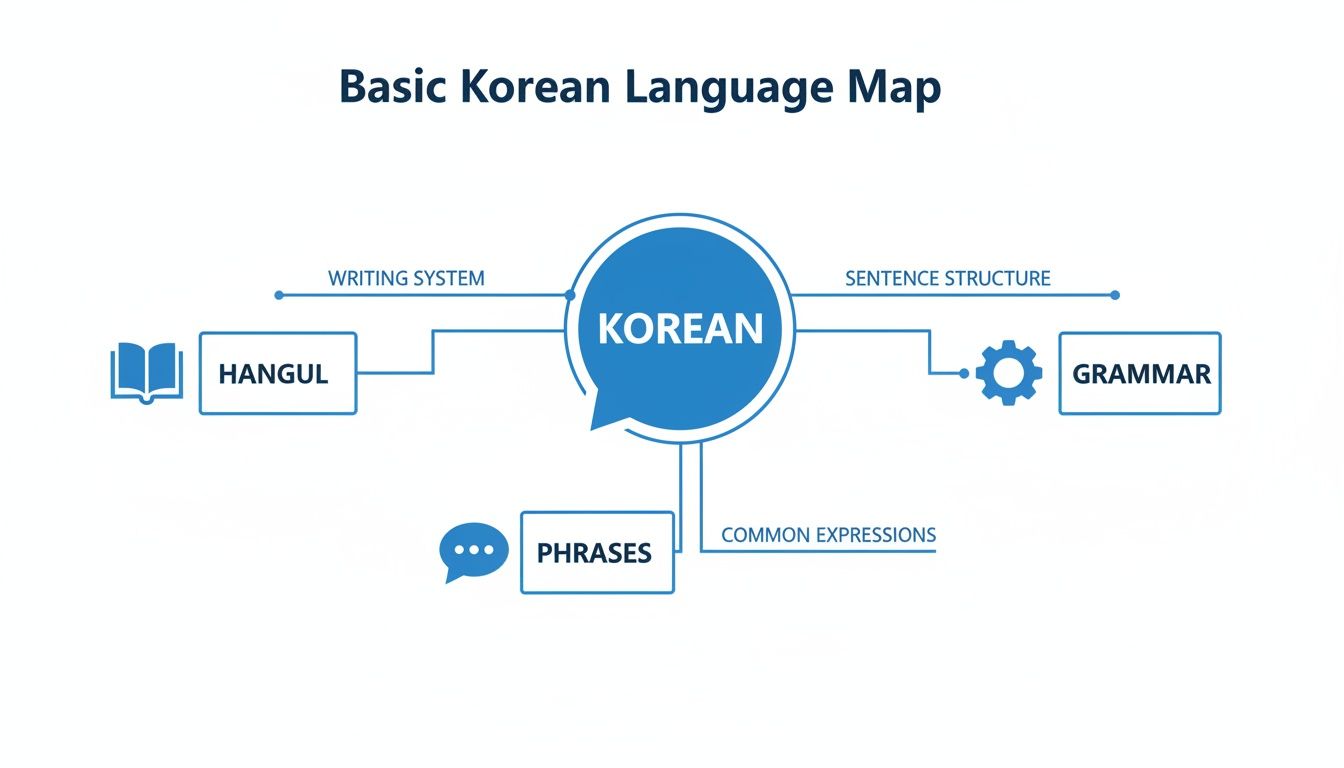
As you can see, getting comfortable with Hangul is the foundation. From there, you can start building with phrases and understanding how grammar works.
Your First Steps with Hangul
To get started, you just need to get familiar with the basic vowels and consonants. These characters are then grouped into syllable blocks to make words. Every block will always have at least one consonant and one vowel.
Here’s a small set of the fundamental characters to show you how it works.
Essential Hangul Vowels and Consonants
This table breaks down some of the first Hangul characters you'll encounter. Think of these as your starter kit for reading and writing Korean.
| Hangul Character | Romanization | Pronunciation Guide |
|---|---|---|
| ㅏ | a | Like the 'a' in "father" |
| ㅓ | eo | Like the 'o' in "song" |
| ㅣ | i | Like the 'ee' in "see" |
| ㅜ | u | Like the 'oo' in "moon" |
| ㄱ | g/k | A soft 'g' sound, as in "go" |
| ㄴ | n | An 'n' sound, as in "nose" |
| ㅁ | m | An 'm' sound, as in "mom" |
| ㅅ | s | An 's' sound, as in "sit" |
Once you know these few characters, you can already start combining them to form simple syllables and words.
It's a beautifully systematic process. For example, let's take the word 나무 (namu), which means "tree." You just combine ㄴ (n) + ㅏ (a) to create 나 (na), and then ㅁ (m) + ㅜ (u) to create 무 (mu). Put them together, and you have 나무 (namu). It’s that logical! Mastering these first few characters is your first major win on the path to learning the basic Korean language.
Using Essential Korean Survival Phrases
Alright, you've got the building blocks of Hangul sorted. Now for the fun part: actually using them! This is where learning the basic Korean language starts to feel real—moving from letters and sounds to actual conversations. Think of this as your practical toolkit, the "survival" phrases you can pull out and use from day one.
These are your keys to unlocking everyday situations in Korea. We’re talking about the essentials for greeting someone, ordering a fantastic meal, or finding your way around. I’ll break each one down for you with the Hangul, a simple Romanized version, and a pronunciation guide to help you say it with confidence.

Everyday Greetings and Introductions
First impressions matter, and that's just as true in Seoul as it is anywhere else. Getting the greeting right sets a friendly, respectful tone for any chat you're about to have.
Your absolute must-know phrase is 안녕하세요 (Annyeonghaseyo). This is the standard, polite way to say "hello," and it's a true all-rounder. You can use it morning, noon, or night with pretty much anyone you meet.
Cultural Tip: Politeness is baked right into the Korean language. While 안녕하세요 (Annyeonghaseyo) is your safe, formal bet, you'll hear friends use a much more casual 안녕 (Annyeong). Think of it as the difference between "Hello" and "Hey!"
Here are a few more phrases that will get you through almost any basic interaction:
- 감사합니다 (Gamsahamnida) - Thank you (Formal)
- Pronunciation: Gam-sa-ham-ni-da
- 죄송합니다 (Joesonghamnida) - I'm sorry (Formal)
- Pronunciation: Jwe-song-ham-ni-da
- 네 (Ne) - Yes
- Pronunciation: Ne
- 아니요 (Aniyo) - No
- Pronunciation: A-ni-yo
Honestly, just getting these five phrases down will carry you a surprisingly long way.
Phrases for a Restaurant or Cafe
Let’s be real, one of the best parts of exploring Korean culture is the food. But ordering can feel a bit intimidating when you’re just starting out. Armed with a couple of key phrases, you can navigate any menu and dive into all the deliciousness Korea has to offer.
When you're ready to order, you can point to what you want on the menu and say:
- 이거 주세요 (Igeo juseyo) - Please give me this.
- Pronunciation: Ee-guh joo-se-yo
This phrase is a game-changer. "Igeo" means "this," and "juseyo" is a polite way of saying "please give me." It works for everything, from your morning coffee to a sizzling plate of bibimbap.
Here are a couple more handy phrases for your culinary adventures:
- 메뉴 주세요 (Menyu juseyo) - Please give me the menu.
- 물 주세요 (Mul juseyo) - Please give me water.
- 얼마예요? (Eolmayeyo?) - How much is it?
Starting with these simple, practical sentences turns the language from an abstract concept into a genuinely useful tool. You build confidence right away and see firsthand how the basic Korean language can open up a whole new world of experiences.
Getting to Grips with Core Korean Grammar
Let's be honest, the word "grammar" can make even the most enthusiastic language learner a little nervous. But here’s the good news: the foundation of Korean grammar is surprisingly logical. Once you wrap your head around a couple of key differences from English, you'll start to see just how elegantly the pieces fit together.
The single biggest mental shift is the sentence structure. English runs on a Subject-Verb-Object (SVO) track, like in "I (S) eat (V) kimchi (O)." Korean flips this around, using a Subject-Object-Verb (SOV) structure.
What does that mean in practice? The verb always, always comes at the very end. That same sentence in Korean is "I (S) kimchi (O) eat (V)."
- English (SVO): I study Korean.
- Korean (SOV): 저는 한국어를 공부해요 (Jeo-neun hangugeo-reul gongbuhaeyo).
- Literally: I (S) Korean (O) study (V).
It feels a bit backwards at first, I know. But because it’s such a consistent rule, you’ll find it actually makes sentences easier to build once you get the hang of it.
The Magic of Particles
You might be wondering, "If the word order is different, how do I know what's the subject and what's the object?" Great question. This is where Korean’s secret weapon comes in: particles.
Think of particles as the "grammar glue" of the language. They're tiny markers that stick to the end of nouns, telling you exactly what role that word plays in the sentence. They are, without a doubt, one of the most important concepts you'll learn.
Let's look at the two most essential types you'll meet right away:
- Topic Particles (-은/는, -eun/neun): These attach to the main topic of the sentence—what you're actually talking about. It’s a bit like saying "As for me..." or "Speaking of the weather..." in English.
- Subject Particles (-이/가, -i/ga): These pinpoint the specific subject of the verb—the doer of the action.
For instance, in 저는 학생이에요 (Jeo-neun haksaeng-ieyo), which means "I am a student," the particle -는 (neun) clearly marks "I" as the topic of our conversation. It's a simple little attachment that adds a ton of clarity.
Figuring out which particle to use and when is a huge step toward making your sentences sound natural.
A Simple Approach to Verbs
Of course, you can't have a sentence without a verb. In Korean, verbs conjugate (or change their endings) depending on things like politeness and tense. As a beginner, your go-to form will be the present tense polite form, which ends in -아요/어요 (-ayo/eoyo).
This one ending is incredibly versatile and will get you through most everyday situations. The basic idea is you take a verb's dictionary form, remove its final syllable, and attach the correct polite ending. There are a few rules for choosing which one, but it becomes second nature with a little practice.
It's no secret that interest in Korean is booming. The Korean language learning market in South Korea alone is on track to surpass USD 2.6 billion by 2034, fuelled by a wave of international students and professionals. This explosion in demand shows just how valuable guided learning is, and it's why structured programs, like those offered at K-talk Live, are the perfect way to master these fundamentals. You can read more about this growing market at gminsights.com.
Nail these three things—the SOV structure, a few key particles, and the basic polite verb ending—and you’ll have built the solid foundation you need for speaking Korean.
Your First Four Weeks: A Simple Study Plan
Okay, so where do you even begin? That's usually the biggest question, and it can feel a little overwhelming. Let's break it down into a straightforward, week-by-week plan that gives you a clear path for your first month.
The secret ingredient here is consistency. Seriously, even just 20-30 minutes a day adds up incredibly fast. Think of it less like a sprint and more like building a foundation, one brick at a time. Each week, we’ll layer a new skill on top of the last one.

Week 1: Master the Alphabet
Your first mission, should you choose to accept it, is to conquer Hangul. Forget about grammar and vocabulary for now. Just put all your energy into learning the shapes and sounds of the 14 basic consonants and 10 basic vowels.
By the end of this week, you should feel comfortable reading and writing simple syllable blocks. This one skill is the master key that unlocks every other door on your Korean learning journey.
- Suggested Activities: Grab a flashcard app and drill those characters. Find videos of native speakers saying each sound so you can really nail the pronunciation. A fun little challenge? Try writing your own name in Hangul.
Week 2: Build Your Survival Vocabulary
Now that you can actually read the words, it’s time to learn some! For Week 2, your goal is to memorize about 20-30 essential "survival" words. We’re talking about the greetings and restaurant phrases we looked at earlier, plus a few other useful ones.
Stick to words you’re likely to see and use. It’s far better to have a small, rock-solid vocabulary you can use confidently than a huge list of words you can't quite remember.
A quick tip for making words stick: use active recall. Don't just read a list over and over. Cover up the Korean side and try to remember it from the English. It feels like a mini-test, but this simple trick works wonders for your memory.
Week 3: Understand Core Grammar
You've got the alphabet and some words. Week 3 is when we start putting them together. Your focus here is to get your head around the Subject-Object-Verb (SOV) sentence structure. We'll also introduce the basic topic (-은/는) and subject (-이/가) particles.
This is often the week where things start to click, and you get that "aha!" moment. You'll also learn the standard polite present tense verb ending (-아요/어요), which lets you start forming real sentences.
Week 4: Combine and Create
It's the final week of your first month, and it's time to bring everything together. The goal now is to mix your Hangul skills, vocabulary, and grammar to create your own simple sentences. You can start by introducing yourself, saying what you like, or talking about what you’re doing.
For instance, you'll be able to put together a sentence like 저는 커피를 마셔요 (Jeoneun keopireul masyeoyo), which means "I drink coffee." And that's a massive milestone!
This step-by-step approach is exactly how our courses at K-talk Live are structured. We focus on building your skills and confidence progressively, week by week, so you can start speaking from day one.
To make it even clearer, here’s a quick summary of the plan.
4-Week Beginner Korean Study Plan
| Week | Main Goal | Suggested Activities |
|---|---|---|
| Week 1 | Learn the Hangul alphabet | Use flashcards, watch pronunciation videos, write your name in Hangul. |
| Week 2 | Memorise 20-30 survival words | Learn greetings, numbers, and basic nouns. Practise with active recall. |
| Week 3 | Grasp basic sentence structure | Study SOV order, topic/subject particles, and polite verb endings. |
| Week 4 | Form your own simple sentences | Introduce yourself, describe your likes, and state simple actions. |
Following this simple roadmap will give you a fantastic start and a real sense of accomplishment in just one month.
Practical Tips to Bring Your Korean Skills to Life
A study plan is a great roadmap, but turning those plans into real, everyday habits is where the magic happens. This is all about weaving basic Korean language practice into your daily routine so it stops feeling like a chore and starts feeling like a natural part of your life. Consistency, more than anything, is what will carry you forward.
The secret is to take things you already love doing and sprinkle some Korean into them. When you surround yourself with the language in small, enjoyable ways, you’ll find your listening, speaking, and vocabulary improving without you even noticing. It’s how you build that gut feeling for the language that textbooks just can't teach.
Dive into Korean Culture
Good news: you don't need a plane ticket to Seoul to immerse yourself in Korean. Thanks to the global explosion of Korean culture, you have a massive library of fun, engaging learning materials just a click away.
- Listen to K-Pop: Don't just hum along; really listen to the lyrics. Look up words that pop up frequently and try to sing along. It's a fantastic way to learn new vocabulary and get a natural feel for the rhythm and flow of spoken Korean.
- Watch K-Dramas: Kick things off with English subtitles, but challenge yourself to switch to Korean subtitles as you get more comfortable. This is a game-changer for connecting the sounds you hear with the Hangul you've learned. Try "shadowing" by pausing and repeating short lines from the actors to work on your pronunciation.
- Find a Language Partner: Jump on a language exchange app and find a native Korean speaker who wants to learn English. It's a win-win: you both get to practise in a relaxed, low-pressure way, help each other out, and maybe even make a new friend.
Don't Be Afraid to Speak Up
Listening and reading are essential, but you can't become a speaker without, well, speaking. I know this can be the scariest part for many learners, but it’s easily the most rewarding. Don't let the fear of making mistakes hold you back—every single error is just a signpost on your path to getting better.
The most important thing is to just try. Even if your sentence comes out a bit wonky, making the effort to speak shows respect and turbocharges your learning. Confidence isn’t something you wait for; it's something you build by doing.
This is precisely why a structured, supportive environment can be so helpful. Joining a small-group class, like the ones we run at K-talk Live, gives you a safe space to find your voice. You get plenty of time to actually speak and get instant, helpful feedback from an experienced tutor who knows exactly how to guide you past those common hurdles.
And you’re in good company! Interest in the Korean language is booming globally. As of September 2025, a record-breaking 550,000 people sat for the official TOPIK exam, largely fuelled by the Korean wave. The number of test-takers abroad has shot up fourfold since 2020, which just goes to show how many others are on this exact same journey. You can read more about this incredible surge in Korean language learners at koreatimes.co.kr.
Your Korean Journey Starts Now
Learning the basic Korean language is an exciting adventure, and you've already taken the most important step by starting. Remember, every word you learn brings you closer to understanding a vibrant culture and connecting with millions of new people. The path from beginner to conversational is built one small, consistent step at a time. Don’t worry if you make mistakes—what matters most is progress!
So, embrace the journey, celebrate your small wins, and keep that initial spark of curiosity alive. Every word you learn brings you one step closer to confidence. Keep going—your Korean journey starts now!
🌟 Ready to start your Korean journey? Join K-talk Live — where global learners connect, speak, and grow together! You can book your free trial class here.
Ready to stop reading and start speaking?
Practice what you just learned with a native Korean teacher — free for 100 minutes. No card, no commitment.