
Want to practice this with a native Korean teacher?
100-min free trial — no card required.
Ever tried to say "I studied late so that I could pass the exam," or "I laughed to the point that my stomach hurt" in Korean? Learning a new language can feel challenging, but understanding key grammar points like 도록 ngữ pháp makes the journey exciting and rewarding. This small but mighty connector bridges the gap between an action and its purpose, helping you express yourself more naturally.
This guide will break down the versatile -도록 grammar pattern. We'll go beyond simple definitions to explore how native speakers use it in real life. Mastering this will take your Korean from just "correct" to truly fluent. With global interest in Korean learning booming, getting these nuances right is a huge step toward confidence. By the end, you'll be able to use -도록 ngữ pháp to clearly express your intentions and the results of your actions.
1. Expressing Your Goal with "So That"

One of the most common ways to use 도록 is to talk about your purpose or goal. Think of it as the Korean version of "so that" or "in order to." It's perfect for connecting an action with the result you hope to achieve.
Essentially, you build a sentence where the first part (ending in 도록) sets up the desired outcome. The second part describes what you're doing to make that happen.
The best part? It's super easy to use. Just attach 도록 to the verb stem (the part before -다). No need to worry about vowels or consonants—it works the same for both!
How to Build Sentences with a Goal in Mind
Let's look at a few examples. Notice how the first half of the sentence clearly states the goal.
Example 1:
- 한국말을 잘 하도록 매일 공부해요.
- (Hangukmareul jal hadorok maeil gongbuhaeyo.)
- I study every day so that I can speak Korean well.
Example 2:
- 늦지 않도록 일찍 출발했어요.
- (Neutji antorok iljjik chulbalhaesseoyo.)
- I left early so that I wouldn't be late.
The second example shows how to frame a negative goal—what you want to avoid. Just make the verb negative with -지 않다, drop the final 다, and then add 도록. This creates the meaning "so that... not..."
Don’t worry if this feels tricky at first! The structure is always: [Your Goal] + 도록 + [The Action You Take]. This flow feels very natural and is a fantastic way to explain your motivations clearly.
How to Use 도록 for Purpose (So That)
This table shows how to attach '도록' to different verb stems.
| Verb Stem | Attach 도록 | Example Sentence | English Meaning |
|---|---|---|---|
| 보다 (bo-da) - to see | 보도록 | 잘 보도록 앞으로 갔어요. | I went to the front so that I could see well. |
| 듣다 (deut-da) - to hear | 듣도록 | 모두가 듣도록 크게 말했어요. | I spoke loudly so that everyone could hear. |
| 잊다 (it-da) - to forget | 잊지 않도록 | 잊지 않도록 메모했어요. | I made a note so that I wouldn't forget. |
| 성공하다 (seong-gong-ha-da) - to succeed | 성공하도록 | 성공하도록 최선을 다할 거예요. | I will do my best in order to succeed. |
This pattern is a fundamental tool for building more complex, meaningful sentences. Once you start practicing, you'll find yourself using it all the time.
2. Describing the Extent with 'To The Point That'
While 도록 is great for expressing purpose, it also has a more expressive side. This second meaning helps you describe the extent or degree of an action. Think of it as saying "to the point that," "until," or "so much that..."
It’s a fantastic way to add color to your sentences. Instead of just saying "I studied hard," you can now explain the consequence of studying so hard.
This usage turns a simple statement into a little story, letting you share experiences with more feeling.
Painting a Picture with Your Words
When you use 도록 to talk about extent, you connect an action to its result. The first part describes the resulting state, and the second part explains what led to it.
Let's break it down with some examples:
- Example 1:
- 목이 아프도록 노래를 불렀어요.
- (Mogi apeu*dorok noraereul bulleosseoyo.)*
- I sang to the point that my throat hurt.
See how that works? "My throat hurt" (목이 아프다) shows the degree to which you sang. It has much more impact than just saying, "I sang a lot."
- Example 2:
- 밤이 새도록 친구와 이야기했어요.
- (Bami sae*dorok chinguwa iyagihaesseoyo.)*
- I talked with my friend until the sun came up.
This example highlights duration. The conversation went on for so long that it reached the start of a new day. This is the kind of natural expression that makes your Korean sound more fluent.
Key Difference: When 도록 means "so that," it's about a future goal. When it means "to the point that," it's describing the result of a past action.
Feeling the Difference Between Purpose and Extent
So, how do you tell the two meanings apart? Context is everything, but the verb tense in the second clause is your biggest clue.
Purpose (Future/Present Tense):
- 들을 수 있도록 크게 말해 주세요.
- (Deureul su it*dorok keuge malhae juseyo.)*
- Please speak loudly so that I can hear. (This is about a goal.)
Extent (Past Tense):
- 배가 아프도록 웃었어요.
- (Baega apeu*dorok useosseoyo.)*
- I laughed to the point that my stomach hurt. (This is about a result.)
Once you get comfortable with this descriptive side of the 하도록 ngữ pháp, your storytelling will become so much richer.
3. Using the Common Phrase: -도록 하다
Once you understand 도록’s main uses, you'll start noticing it in common phrases. The most useful one by far is -도록 하다 (dorok hada).
This is your go-to pattern for giving polite instructions, making a strong suggestion, or declaring your own intention. Think of it as "make sure to..." or "I'll see to it that..."
Making Suggestions and Giving Instructions
When you use -도록 하다 with someone else, it becomes a polite but firm instruction. It’s softer than a direct command like -(으)세요 but stronger than a simple suggestion.
For example, a doctor might say:
- 약을 제때에 먹도록 하세요.
- (Yageul jettae-e meok*dorok haseyo.)*
- Please make sure to take your medicine on time.
The polite -세요 ending makes the instruction respectful while still emphasizing its importance.
Expressing Your Own Intentions
The nuance shifts when you talk about your own plans. In this context, -도록 하다 sounds like "I will try to..." or "I will make an effort to..."
Imagine you've decided to start a new habit. You might say:
- 이제부터 매일 운동하도록 할게요.
- (Ijebuteo maeil undongha*dorok halgeyo.)*
- From now on, I'm going to make sure I exercise every day.
This isn't just a casual plan; it’s a resolution. You're showing your commitment to making it happen.
The Negative Pattern: 못하도록
Another practical variation is 못하도록 (motadorok), which means "so that (one) cannot..." or "to prevent..." Use this to explain an action taken to stop something else from happening.
- 아이가 만지지 못하도록 약을 높은 곳에 두었어요.
- (Aiga manjiji motadorok yageul nopeun gose dueosseoyo.)
- I put the medicine in a high place so that the child couldn't touch it.
Mastering these common patterns will add a new layer of precision to your Korean, helping you sound more like a native speaker.
4. Comparing 도록 with Similar Grammar
Korean has a few ways to talk about purpose. Understanding the subtle differences between 도록, -(으)려고, and -기 위해서 is a game-changer for sounding natural.
Think of them as different tools for the same job. This section will help you pick the right one for the right situation.
First, let's look at 도록 하다. The decision tree below helps you figure out if you're making a suggestion or stating your own intention.
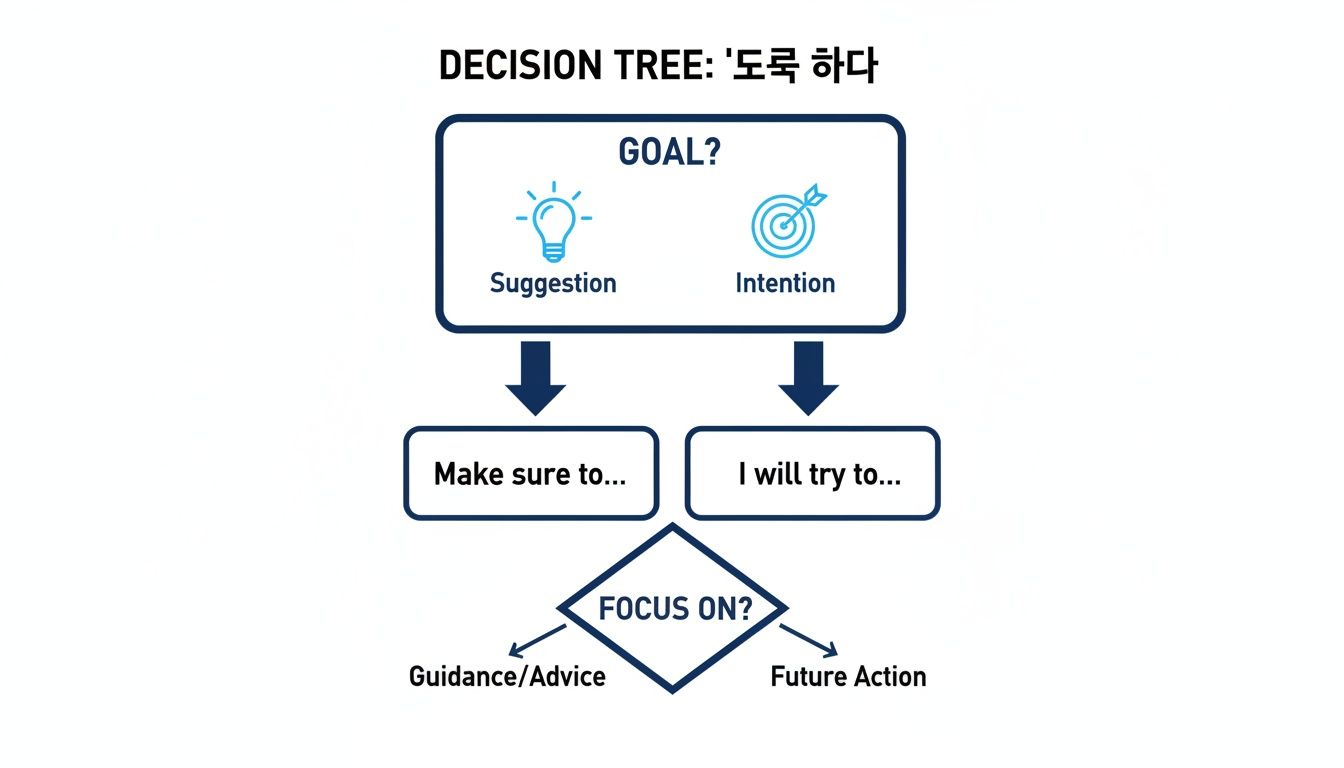
As you can see, your goal—politely suggesting an action or stating your own plan—guides your choice.
Distinguishing Between Key Grammar Points
Now, let's break these three down. The real difference is in the nuance and grammatical rules.
-(으)려고 (euryeogo): The Immediate Intention
This one is all about a direct, immediate plan. The catch? You can't use it in commands or suggestions.- Example: 친구를 만나려고 카페에 가요. (I'm going to the cafe to meet a friend.)
-기 위해서 (gi wihaeseo): The Formal Goal
This is the more formal way to state a purpose, often for a larger goal that requires effort over time.- Example: 시험에 합격하기 위해서 열심히 공부해요. (I study hard in order to pass the exam.)
-도록 (dorok): The Desired State or Result
도록 is more about achieving a certain state or result. It's more flexible than -(으)려고 because it works in commands and suggestions.- Example: 아이가 잘 수 있도록 조용히 해 주세요. (Please be quiet so that the baby can sleep.)
Key Takeaway: Choose -(으)려고 for immediate intentions, -기 위해서 for big goals, and 도록 for desired results, especially in commands. Nailing this will make your Korean sound much more precise.
Quick Comparison: 도록 vs -(으)려고 vs -기 위해서
This table helps highlight where each one shines.
| Grammar Point | Primary Nuance | Usage Constraint | Example |
|---|---|---|---|
| -도록 | Focuses on achieving a desired state or result. Versatile. | None; works well in commands and suggestions. | 늦지 않도록 서두르세요. (Hurry up so that you won't be late.) |
| -(으)려고 | Expresses a direct and often immediate intention or plan. | Cannot be used in imperative or propositive sentences. | 점심을 먹으려고 식당에 갔어요. (I went to the restaurant to eat lunch.) |
| -기 위해서 | States a more formal, significant, or long-term purpose. | None; very flexible but can sound too formal in casual chat. | 한국어를 배우기 위해서 한국에 왔어요. (I came to Korea in order to learn Korean.) |
Choosing the right one is a classic sign of a more advanced speaker.
5. Common Mistakes to Avoid with 도록
Every grammar point has its own traps. Getting a handle on these common slip-ups will help you use 도록 like you’ve known it for years.
Let's break down the most frequent mistakes. Once you know what to look for, you'll be able to dodge them.
Sticking 도록 on Nouns
This is the number one mistake for newcomers. Remember, 도록 needs a verb or an adjective to work.
Incorrect: 학생도록 열심히 공부해요. (x)
- This is like saying, "I study hard so that student." It's missing a verb.
Correct: 좋은 학생이 되도록 열심히 공부해요.
- (Joeun haksaengi doedorok yeolsimhi gongbuhaeyo.)
- Translation: I study hard so that I can become a good student.
Mixing Up the Subjects
When using 도록 for purpose, be careful about who is doing what. Typically, the subject doing the action is the same one who benefits.
Incorrect: 제가 합격하도록 선생님이 가르쳤어요. (x)
- This feels awkward because "I" (제가) and "the teacher" (선생님이) are fighting for the main role.
Correct: 선생님은 제가 합격하도록 가르치셨어요.
- (Seonsaengnimeun jega hapgyeokhadorok gareuchisyeosseoyo.)
- Translation: The teacher taught so that I would pass.
A Quick Tip: Before you finalize a 도록 sentence, ask yourself: "Who is doing the action? Who is the goal for?" If it's two different people, try to rephrase it. This small check makes a big difference.
Conclusion
We've really dug deep into the world of 도록! From setting goals to describing results, you've seen just how flexible this little piece of grammar can be. We’ve broken down its main uses, compared it to similar patterns, and pointed out common mistakes. Now it’s your turn to start using it.
Every word you learn brings you one step closer to confidence. Don't worry about getting it perfect right away—what matters most is progress. Mastering a connector like 도록 helps you express more complex ideas, just like you do in your native language. Keep going—your Korean journey starts now!
🌟 Ready to start your Korean journey? Join Ktalk.live — where global learners connect, speak, and grow together
Ready to stop reading and start speaking?
Practice what you just learned with a native Korean teacher — free for 100 minutes. No card, no commitment.