
Want to practice this with a native Korean teacher?
100-min free trial — no card required.
Have you ever made a big decision, like starting a new hobby or setting a goal for yourself? Learning to express those choices is a huge step in your Korean journey. If you've been wondering how to say "I decided to..." or "We agreed to...", you're in the right place. The 기로 하다 grammar is the key, and it’s easier to master than you think!
Learning Korean is a rewarding adventure, and grammar points like 기로 하다 are the tools that help you share your thoughts, plans, and promises. It moves you beyond simple statements and allows you to express your intentions clearly. Don't worry if it seems tricky at first—we'll break it down step-by-step. By the end of this guide, you’ll be making plans in Korean with total confidence.
What is 기로 하다 Grammar?
Think about your New Year's resolutions or a promise you made to a friend. The 기로 하다 grammar is what you use to talk about these commitments. It attaches to a verb to show that a decision, agreement, or promise has been made.
It’s an essential pattern because it allows you to:
- Share Personal Plans: Talk about goals like deciding to quit smoking or learn a new skill.
- Make Agreements: Arrange plans with friends, like agreeing to meet at a certain time.
- Sound More Natural: This is a go-to phrase for native Korean speakers when discussing their choices.
Mastering 기로 하다 is a game-changer. You’re no longer just describing what’s happening; you’re explaining what you have decided will happen. It’s a huge step toward expressing more complex thoughts and intentions, making your conversations much richer.
How to Form Sentences with 기로 하다

Ready to build some sentences? The best part about the 기로 하다 grammar is its simplicity. You don't have to worry about complex conjugation rules or irregular verbs—it works the same way for every action verb.
The formula is straightforward: Verb Stem + 기로 하다.
The Basic Formation Rule
First, find the verb stem by dropping the -다 (da) from the end of the dictionary form of the verb.
- 가다 (gada - to go) → Stem: 가 (ga)
- 먹다 (meokda - to eat) → Stem: 먹 (meok)
Once you have the stem, just add -기로 하다. It’s that easy! For a deeper dive into verb stems and other essential patterns, you can explore more Korean grammar points on hanabira.org).
Let's see it in action:
- 가다 (to go) + 기로 하다 → 가기로 하다 (gagiro hada)
- "to decide to go"
- 먹다 (to eat) + 기로 하다 → 먹기로 하다 (meokgiro hada)
- "to decide to eat"
Adding Tense with 하다
The final step is to conjugate the 하다 (hada) part to show when the decision was made. Most of the time, you'll be talking about a decision you've already made, so you'll use the past tense: -기로 했어요 (haesseoyo).
Here are the most common conjugations:
- Past (Most Common): -기로 했어요 (haesseoyo) - I decided to...
- Present: -기로 해요 (haeyo) - Let's decide to... / I decide to...
- Future: -기로 할 거예요 (hal geoyeyo) - I will decide to...
Combine the verb stem with the conjugated ending, and you have a complete, natural-sounding phrase. For example, "I decided to study" becomes 공부하기로 했어요 (gongbuhagiro haesseoyo).
Decision vs. Promise: The Two Faces of 기로 하다

Now that you have the structure down, let's explore the two powerful ways to use the 기로 하다 grammar. It’s not just about "deciding"—it can also mean making a promise or an agreement with others. The meaning all depends on the context of the conversation.
This flexibility is what makes 기로 하다 a cornerstone of everyday Korean.
Meaning 1: Expressing a Personal Decision
The most common use is to state a personal decision or a plan you've made for yourself. Think of it as making a firm commitment. This is perfect for talking about new habits or personal goals.
The subject is usually "I" (저는/나는) or "we" (우리는) if it’s a group decision.
- 저는 매일 운동하기로 했어요. (Jeoneun maeil undonghagiro haesseoyo.)
- I decided to exercise every day.
- 올해는 담배를 끊기로 했어요. (Olhaeneun dambaereul kkeunkireo haesseoyo.)
- I decided to quit smoking this year.
- 한국 드라마를 자막 없이 보기로 했어요. (Hanguk deuramareul jamak eopsi bogiro haesseoyo.)
- I decided to watch K-dramas without subtitles.
Each sentence shows a clear, internal choice. You’ve made up your mind!
Meaning 2: Making a Promise or Agreement
The second meaning appears when you make a plan with someone else. Here, -기로 하다 shifts from a solo "I decided" to a collaborative "we promised" or "we agreed."
You'll use this when arranging to meet friends, setting deadlines, or confirming any mutual plan. The decision is a shared one.
- 우리는 내일 영화를 보기로 했어요. (Urineun naeil yeonghwareul bogiro haesseoyo.)
- We promised/agreed to see a movie tomorrow.
- 친구와 7시에 만나기로 했어요. (Chinguwa ilgopsie mannagiro haesseoyo.)
- I promised/agreed to meet my friend at 7 o'clock.
- 다시는 싸우지 않기로 했어요. (Dasineun ssauji ankiro haesseoyo.)
- We promised not to fight again.
Understanding both meanings will help you navigate conversations with much more confidence.
Using Different Tenses with 기로 하다
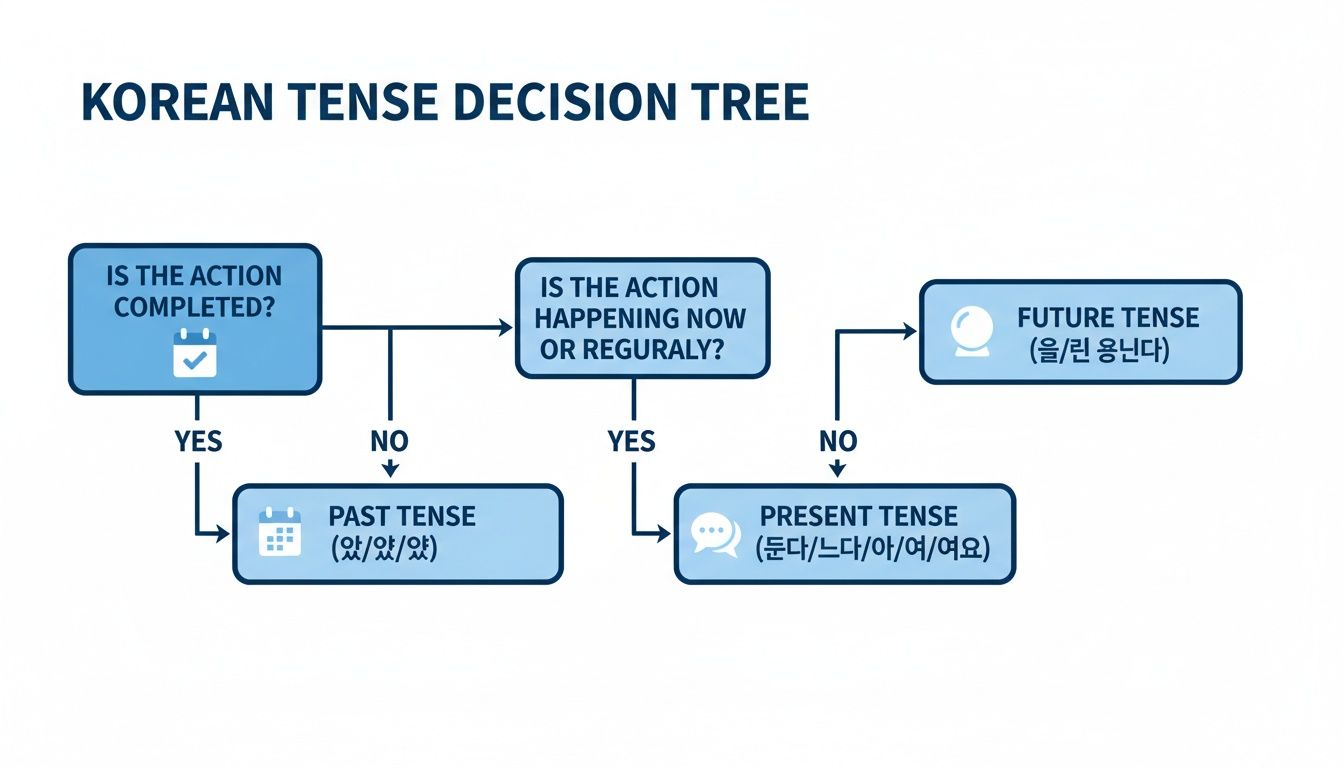
When you make a decision is just as important as the decision itself. While you'll almost always use the past tense, understanding all three tenses will add precision to your Korean.
Past Tense: -기로 했어요 (The Default)
You'll use -기로 했어요 (giro haesseoyo) about 99% of the time. It’s for reporting a decision that is already made and locked in. The choice is final, and you are sharing the result.
- 어제부터 다이어트를 하기로 했어요. (Eojebuteo daieoteureul hagiro haesseoyo.)
- I decided to start a diet yesterday.
- 우리는 주말에 부산에 가기로 했어요. (Urineun jumare busane gagiro haesseoyo.)
- We decided to go to Busan on the weekend.
Present Tense: -기로 해요 (On-the-Spot Decisions)
Use the present tense, -기로 해요 (giro haeyo), when you're making a decision right now, often with others. It has a collaborative feel, like saying, "Okay, let's agree to this!"
- 좋아요, 그럼 이걸로 하기로 해요. (Joayo, geureom igeollo hagiro haeyo.)
- Okay, then let's decide on this one.
- 지금부터 서로 돕기로 해요. (Jigeumbuteo seoro dopgiro haeyo.)
- Let's promise to help each other from now on.
Future Tense: -기로 할 거예요 (Looking Ahead)
Though less common, you can use -기로 할 거예요 (giro hal geoyeyo) to talk about a decision that will be made later. You're communicating an intention to make a choice, but it hasn't happened yet.
- 회의가 끝난 후에 결정하기로 할 거예요. (Hoeuiga kkeutnan hue gyeoljeonghagiro hal geoyeyo.)
- I will decide after the meeting ends.
Common Mistakes to Avoid
Making mistakes is a natural part of learning! Don’t worry if you get things wrong sometimes—even native speakers do. By knowing the common pitfalls with the 기로 하다 grammar, you can avoid them and speak more accurately.
Confusing -기로 하다 with -려고 하다
A frequent mix-up is between -기로 하다 (to decide) and -려고 하다 (to intend/plan to). They seem similar, but carry a different weight of commitment.
- -기로 하다: A firm, settled decision. The plan is solid.
- -려고 하다: A softer intention. The plan isn't set in stone and could change.
Compare these two:
- Correct: 내일 운동하기로 했어요. (Naeil undonghagiro haesseoyo.)
- I made a definite plan to exercise tomorrow.
- Sounds Weak: 내일 운동하려고 했어요. (Naeil undongharyeogo haesseoyo.)
- This implies you only intended to, but might not.
Getting the Negative Form Wrong
When you decide not to do something, a common mistake is to make the 하다 part negative. Instead, you should attach -지 않다 to the first verb.
The correct formula is: Verb Stem + -지 않기로 하다.
- Incorrect: 오늘 외식하기로 안 했어요. (Oneul oesikhagiro an haesseoyo.)
- Correct: 오늘 외식하지 않기로 했어요. (Oneul oesikhaji ankiro haesseoyo.)
- I decided not to eat out today.
This correctly places the "not" on the action itself ("not to eat out").
Conclusion: Start Making Your Plans in Korean!
You've just unlocked a powerful piece of Korean grammar! We've covered how to form 기로 하다, its dual meanings of decision and promise, and how to use it in different tenses. Now you have the perfect tool to talk about your goals and agreements. Every grammar point you learn brings you one step closer to fluency.
The next step is simple: practice! Think of a decision you made today. Did you decide to study Korean (한국어를 공부하기로 했어요)? Try saying it out loud. By actively using it, you'll make this grammar your own. Keep going—your Korean journey starts now!
🌟 Ready to start your Korean journey? Join Ktalk.live — where global learners connect, speak, and grow together! You can learn more at https://ktalk.live.
Ready to stop reading and start speaking?
Practice what you just learned with a native Korean teacher — free for 100 minutes. No card, no commitment.