Want to practice this with a native Korean teacher?
100-min free trial — no card required.
Ever looked at Korean writing and felt a mix of curiosity and confusion? It's a common feeling, but here's a little secret: you can actually start reading it in just a few hours. That's the magic of the Korean alphabet, Hangul, and this guide is your first friendly step into understanding this brilliant writing system. Learning the Korean Hangul characters is the smartest and easiest way to begin your language journey. Forget complex symbols; Hangul is a logical, phonetic alphabet designed to be learned quickly. So, are you ready to unlock the Korean language? Let's dive in!

Why Hangul is the Key to Learning Korean
Think of Hangul as the ultimate key to unlocking the entire Korean language. Instead of trying to memorise thousands of complex characters like in some other Asian languages, you only need to get familiar with 24 basic letters. These letters then snap together like LEGO bricks to form every sound and word you'll ever need.
It's this simple, modular system that allows most people to get the hang of it in just one sitting. By starting with the Korean Hangul characters, you’re not just memorizing; you're building a foundation that makes learning vocabulary, grammar, and pronunciation so much easier down the road. It’s your first big win on the path to fluency!
The Genius Story Behind Hangul's Creation
Picture this: it’s 15th-century Korea, and the ability to read and write belongs almost exclusively to the elite. For the average person, literacy wasn't even a distant dream. The official writing system was Hanja (Chinese characters), a notoriously complex script that demanded years of rigorous study. This effectively locked most of the population out of education and government.
King Sejong the Great, Korea’s fourth ruler, saw this as a massive barrier holding his people back. He was a compassionate leader who believed literacy should be a right for everyone, not a privilege. He imagined a completely new writing system, one so logical and straightforward that anyone could learn it in a matter of days.
A New Alphabet For The People
With this powerful vision, King Sejong gathered his top scholars and got to work. What they developed was a phonetic system far ahead of its time, officially presented to the public in 1446 in a document called Hunminjeongeum, or "The Proper Sounds for the Instruction of the People." The new alphabet had just 28 characters (which later simplified to 24), each designed with brilliant, intuitive logic. You can explore the history of this groundbreaking document at the Korean Cultural Centre.
"Because the speech of this country is different from that of China, it does not match the letters. Therefore, even if the ignorant want to communicate, many of them in the end cannot state their concerns. Saddened by this, I have had 28 letters newly made." - King Sejong the Great
This wasn't just about creating new symbols. It was a bold move towards cultural independence and a tool to empower an entire nation. The design was genius; the shapes of the consonants actually mimic the position of your mouth, tongue, and throat when you make their sounds. Take ‘ㄱ’ (g/k), for instance—its shape represents the back of the tongue pressing against the throat.
A Legacy of Logic and Simplicity
The vowels were just as thoughtfully designed, based on a philosophical trio: a dot for Heaven (•), a horizontal line for the flat Earth (ㅡ), and a vertical line for Humanity (ㅣ). By combining these fundamental shapes, Hangul could accurately capture every sound in the Korean language.
The creation of the Korean Hangul characters was an act of incredible foresight. It completely changed the course of Korean society, swinging the doors of education and opportunity wide open for all. As you start your own journey learning these letters, remember they were designed with you in mind—a system built for simplicity and speed.
Meet The Jamo: The Building Blocks Of Hangul
Alright, you've seen the genius behind Hangul's creation. Now, let's get hands-on and meet the actual characters. These individual letters are called jamo (자모), and they're the wonderfully simple pieces you’ll use to build every single Korean word.
Think of them just like the ABCs, only with different shapes and sounds.
Believe it or not, there are only 24 basic jamo in modern Korean: 14 consonants and 10 vowels. That’s it! Instead of memorising thousands of complex symbols, you just need to get comfortable with these two dozen shapes to unlock the ability to read.
When King Sejong first introduced Hangul back in 1446, there were actually 28 characters. But language is a living thing, and over the centuries, four of them simply fell out of use. This natural slimming-down process is what gives us the incredibly efficient system used today. For a deeper dive into how the alphabet has changed, you can explore more about Hangul's development on Wikipedia.
Let's break them down, starting with the vowels.
The Basic Vowels
The vowels are the soul of the Korean syllable, and their design is pure poetry. They were inspired by three philosophical elements: a vertical line (ㅣ) representing a person standing tall, a horizontal line (ㅡ) for the flat earth, and a dot (now a short stroke) for the heavens above. Every single vowel is just a combination of these simple lines.
Here are the 10 basic vowels you need to know:
- ㅏ (a): Sounds like the 'a' in "father."
- ㅓ (eo): A sound that’s a bit like the 'o' in "song" or 'u' in "sun."
- ㅗ (o): Sounds like the 'o' in "go."
- ㅜ (u): Sounds like the 'oo' in "moon."
- ㅡ (eu): This one is tricky. Try saying "oo," but without rounding your lips—almost like a soft grunt.
- ㅣ (i): Sounds like the 'ee' in "see."
The other four are "y" sounds, made by adding a second short stroke to the first four vowels:
- ㅑ (ya): The 'ya' sound in "yacht."
- ㅕ (yeo): The 'yo' sound in "yonder."
- ㅛ (yo): The 'yo' sound in "yoyo."
- ㅠ (yu): The 'yu' sound in "you."
The Basic Consonants
Now for the 14 basic consonants. Here’s another touch of genius: many of their shapes are designed to look like the position of your mouth or tongue when you make the sound. This makes them surprisingly intuitive to memorise.
A great memory trick is to associate the character's shape with a familiar object. For instance, the character ㄱ (g/k) looks a bit like a gun, which can help lock in its sound.
Let’s look at a few of the most common ones:
- ㄱ (g/k): Shaped like a gun.
- ㄴ (n): Looks like the shape of your tongue touching the roof of your mouth for the 'n' sound, or you can think of your nose.
- ㅁ (m): It's a square, like a closed mouth.
- ㅅ (s): This one looks like a person standing or a mountain peak (san).
- ㅇ (ng/silent): This is a special one. At the beginning of a syllable, it's a silent placeholder. At the end, it makes the 'ng' sound you hear in "sing."
To make it even easier, here’s a quick reference chart with the basic jamo all in one place.
Basic Hangul Vowels and Consonants (Jamo)
| Hangul Character (Jamo) | Romanisation | Sounds Like (English Example) |
|---|---|---|
| Vowels | ||
| ㅏ | a | father |
| ㅑ | ya | yacht |
| ㅓ | eo | song |
| ㅕ | yeo | yonder |
| ㅗ | o | go |
| ㅛ | yo | yo-yo |
| ㅜ | u | moon |
| ㅠ | yu | you |
| ㅡ | eu | (Like "oo" without rounded lips) |
| ㅣ | i | see |
| Consonants | ||
| ㄱ | g/k | go / sky |
| ㄴ | n | nose |
| ㄷ | d/t | door / stop |
| ㄹ | r/l | rice / lamp |
| ㅁ | m | mouth |
| ㅂ | b/p | bed / stop |
| ㅅ | s | sea |
| ㅇ | ng/silent | sing / (placeholder) |
| ㅈ | j | jam |
| ㅊ | ch | church |
| ㅋ | k | key |
| ㅌ | t | top |
| ㅍ | p | pie |
| ㅎ | h | hat |
Don't worry about memorising this table perfectly right now. Just use it as a guide as we move on. In the next section, we’ll show you how to start snapping these jamo together into syllable blocks. It’s where the magic really starts to happen!
How to Build Syllable Blocks Like LEGOs
You’ve met the individual jamo—the basic Korean Hangul characters. Now for the fun part: snapping them together to build words. The best way to think about this is like building with LEGO bricks. Every Korean syllable is packed neatly into a single square block, which gives the written language an incredibly organised look.
Each syllable block is formed by combining an initial consonant, a vowel, and sometimes a final consonant. These pieces always lock together in a predictable order, and how they assemble depends on the shape of the vowel you're using.
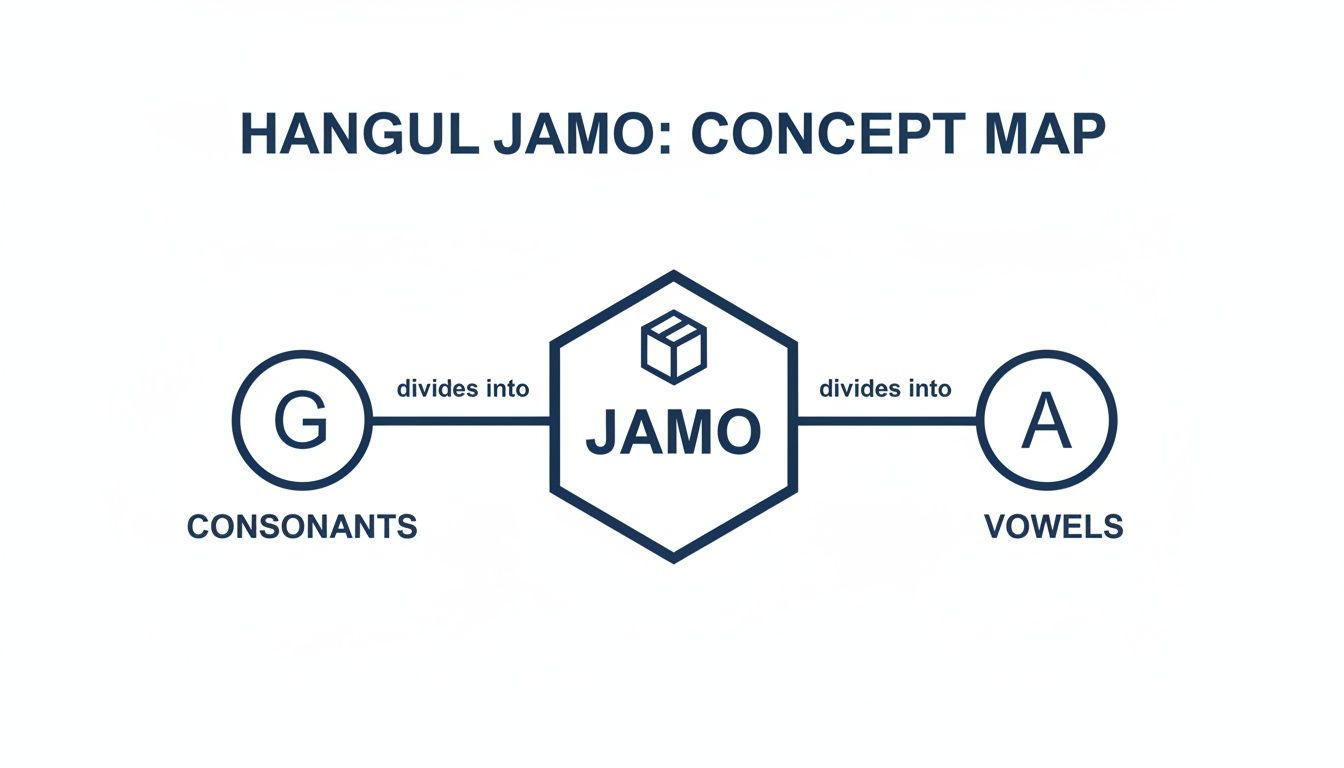
As you can see, every single syllable block begins with these two core components. This structure is what makes Korean words so easy to deconstruct once you know the rules.
The Two Main Block Structures
There are two main ways these blocks are built, and it all depends on whether the vowel is "standing up" (vertical) or "lying down" (horizontal).
Vertical Vowels: For tall vowels like ㅏ (a), ㅣ (i), or ㅑ (ya), the characters are arranged from left to right. The initial consonant takes the left side, and the vowel slots in next to it.
- Example: To build the syllable ‘가’ (ga), you place the consonant ㄱ (g) on the left and the vowel ㅏ (a) on the right.
Horizontal Vowels: For wide vowels like ㅗ (o), ㅜ (u), or ㅡ (eu), the characters are stacked. The initial consonant sits on top, with the vowel positioned directly underneath.
- Example: To make the syllable ‘고’ (go), you would place the consonant ㄱ (g) directly on top of the vowel ㅗ (o).
Adding a Final Consonant
But what happens when a syllable ends with a consonant sound? This final consonant, known in Korean as a batchim (받침), is always placed at the very bottom of the block, tucking in neatly underneath the other letters.
The Golden Rule: Initial Consonant + Vowel + (Optional) Final Consonant. The batchim is always the last piece to complete the square.
Let's break down a real word to see this in action. The word for ‘Korea’ is 한국 (Hanguk).
First Block (한 - Han):
- Initial Consonant: ㅎ (h)
- Vowel: ㅏ (a) - A vertical vowel, so it goes to the right of ㅎ.
- Final Consonant: ㄴ (n) - This batchim goes at the bottom.
- Result: 한
Second Block (국 - Guk):
- Initial Consonant: ㄱ (g)
- Vowel: ㅜ (u) - A horizontal vowel, so it goes underneath ㄱ.
- Final Consonant: ㄱ (k) - This batchim goes at the very bottom.
- Result: 국
Once you master these simple rules, you can deconstruct and build any Korean word. This is the moment when reading clicks, turning from a puzzle into a practical skill.

Practical Tips to Master Hangul Fast
You’ve grasped the basics of the Korean Hangul characters. That’s a huge first step, so give yourself a pat on the back! You've just unlocked one of the most logical writing systems ever created.
It’s this brilliant design that helped Korea achieve an incredible 98.8% literacy rate. You can learn more about Hangul's impact on Korean literacy on koreaetour.com. The same efficiency that transformed a nation is now your biggest advantage as a learner. But where do you go from here?
Here are some practical tips you can apply immediately to go from knowing the letters to using them confidently:
- Drill with Flashcards: Use an app like Anki or Quizlet to burn the jamo into your long-term memory. Spend 10-15 minutes a day, and you'll be amazed at your progress.
- Start Writing by Hand: Grab a notebook and practise writing your name, your favorite K-pop group, or simple words like "annyeong" (안녕). This builds muscle memory and reinforces the syllable block rules.
- Sound It Out Loud: Find Korean text online—song lyrics, webtoons, simple news headlines—and try to read it aloud. Don't worry about understanding every word; just focus on connecting the characters to their sounds.
The goal is to shift from passively seeing the letters to actively using them. Every little bit of practice turns those abstract symbols into the foundation for real communication.
Your Hangul Journey Starts Now
Learning the Korean Hangul characters is your first and most rewarding step into a beautiful language and culture. You’ve seen how this brilliant alphabet was created for everyone, and now you have the tools to learn it yourself—quickly and easily. Remember, this isn’t about perfection; it’s about progress. Every character you recognize and every word you sound out is a victory. Keep going, and you'll be reading Korean before you know it. Your Korean journey starts now!
🌟 Ready to start your Korean journey? Join Ktalk.live — where global learners connect, speak, and grow together
Ready to stop reading and start speaking?
Practice what you just learned with a native Korean teacher — free for 100 minutes. No card, no commitment.